

A good brief to a videographer is one page that says why the film exists, who it is for, what they should do after watching, and the practical limits: date, place, people, deliverables, budget and who signs it off. You do not need a script, a shot list or technical vocabulary. You need decisions. At LemonLens every booking starts by clarifying the purpose of the imagery, and the same habit is the best thing you can bring to a videography enquiry, whether it is for a wedding, a brand film, an event or a music project.
TL;DR
- Write the goal and the key message as one sentence each. If you cannot, the film is not ready to brief.
- Give the videographer substance (goal, audience, message, practical details) and leave concept and treatment to them.
- Show the look with three or four reference films or stills, each with a note on what you like about it.
- Agree budget range, deadline, who approves, how many revision rounds are included and where the film will be used before the shoot.
- Settle usage and copyright in writing, because the person who films a video is usually its first owner by default.
Table of Contents
- Why the brief matters more than the camera
- Step 1: Say what the film is for
- Step 2: Describe the look with references, not adjectives
- Step 3: Pin down the practical details
- Step 4: Agree approvals, revisions and feedback
- Step 5: Settle usage, rights and releases
- Adapting the brief to your kind of project
- A brief you can copy
- What a good videographer asks back
- Where we come in
- FAQ
- Sources
Why the brief matters more than the camera
Most disappointing videos fail before anyone presses record. The footage is fine, but the film was never asked to do one specific thing. A vague brief leads to a vague quote, a generic concept and a long edit with opinions arriving from five directions.
A clear brief does the opposite. The videographer can price the job accurately, because they know the days, crew and deliverables. They can pitch an idea that fits, because they know the audience. And you get fewer changes at the edit, because the decisions were made when changing them was free.
Length is not the point. One page, or a ten-minute call that you then summarise in writing, is enough. What matters is that every line is something the videographer can act on.
Step 1: Say what the film is for
Start with the purpose, in a single sentence about what the viewer should do or feel. Compare:
- Weak: “We want a nice video of our company.”
- Useful: “We want prospective clients to book a discovery call after watching a 90-second film on our website.”
Then add the audience. Not “everyone”, but a person: who they are, what they already know, where they will watch. A film for procurement managers viewing on a laptop at work is shot and paced differently from one for wedding guests watching on a phone.
Next, the key message. A simple test: if a viewer remembers one thing, what is it? Write that down, then add three or four supporting points, such as what makes you different, proof (a result or a client story), how your process works and what you want viewers to do next.
If you are not sure of the answers, that is useful to know before you spend money. Work them out first, with the videographer if they run a briefing call. When we shoot brand story films, settling the purpose up front is what keeps reshoots off the table.
Step 2: Describe the look with references, not adjectives
“Modern, clean, authentic” means something different to everyone. Pictures do not. Collect three or four references and put them in one shared folder or document:
- A film or still whose pace or camera movement you like.
- One whose colour and light you like.
- One whose tone is close to what you want, whether warm, serious, playful or cinematic.
- Optionally, one you do not want, which is often the most useful of the four.
Under each, write one line: what you are borrowing and what you are not. “Inspired by” is not a direction, but “the slow handheld movement, not the dark grade” is. Add three adjectives for tone and the videographer has a working picture.
This is the same logic as a mood board in stills. If you are also commissioning photographs, our guide to photoshoot mood boards shows how to build one that people sign off quickly, and the method carries straight over to film.
Step 3: Pin down the practical details
This is the section that turns a brief into an accurate quote. Cover each of these:
| Detail | What to write |
|---|---|
| Date and deadline | Shoot date or window, and the date you need the finished film |
| Locations | Addresses, indoor or outdoor, access times, permissions needed |
| People on camera | How many, who they are, whether they are comfortable speaking to camera |
| Length and number of films | One master film, or a main film plus short cutdowns |
| Formats | Where it will be shown: website, social, screens at an event |
| Audio | Interviews, speeches, music, voiceover |
| Approvals | Who reviews the cuts and who has the final say |
| Budget | A realistic range, not a hidden number |
Formats are worth a line of their own. A film made only for a widescreen website looks awkward on a phone. If you will post on social platforms, say so, and read how to get vertical and horizontal video from one shoot before you commit to a shot plan.
Budget is the item people avoid and the one that helps most. Giving a range lets the videographer propose the right scale of crew, kit and edit rather than guessing high or low. It also saves both sides a round of quotes that never fit.
Step 4: Agree approvals, revisions and feedback
Unplanned revision rounds are one of the commonest reasons video budgets overrun. Put three things in the brief:
- One person who collects feedback and gives it as a single list.
- The final decision-maker, named, so the cut is not reopened after sign-off.
- The number of revision rounds the price includes, and what a further round would involve.
If a committee will watch the film, ask for feedback to be consolidated before it reaches the videographer. Contradictory notes from several people cost more time than any single change.
Step 5: Settle usage, rights and releases
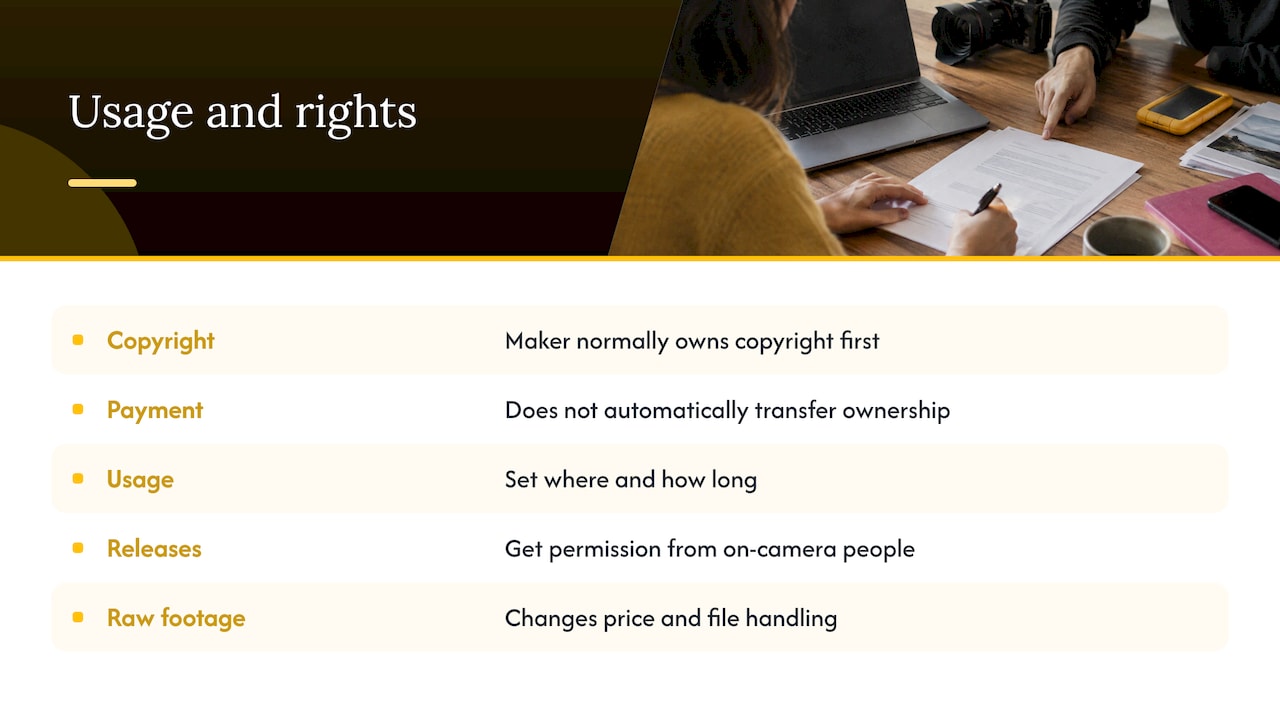
This is where UK clients get caught. Under the UK Copyright Service’s fact sheet on video, the first owner of copyright is normally the person who made the recording, unless an employment relationship or a written agreement says otherwise. So “we paid for it” does not automatically mean “we own it”.
In the brief, say where and for how long you will use the film: your website, paid social, events, broadcast, internal training. Ask for the usage terms to be written into the quote or contract. If people appear on camera, check you can get their permission to be filmed and for the footage to be used in the way you intend, and tell the videographer early who needs to sign.
If you want raw footage as well as the edit, say so now. It changes the price and the file handling.
Adapting the brief to your kind of project
The five steps above work for any film. Each type then adds its own questions.
Business and brand films
Add your competitors’ tone (what you want to sit apart from), the proof points you can show (clients, results, process) and the one action viewers should take. If the film features interviews with staff or customers, the interview video setup guide explains what a clean sound and lighting arrangement involves, so you can brief the location properly. For a larger corporate project, our notes on choosing a corporate videographer in London cover what to ask at the pitch stage.
Weddings
Couples rarely need a technical brief. Give the videographer your running order, venue, and the moments that matter most: the vows, a speech, a first dance, a grandparent. Say whether you want a short highlight film, a longer documentary edit or both. Audio is the thing most often under-planned, particularly vows in echoing venues, so read our wedding video audio steps before the day and mention your ceremony setup in the brief.
Events
Organisers should give the event name and description, date, venue, expected attendance, coverage hours, must-capture moments, whether full sessions need recording, any interviews, the intended audience and where the content will run. The more specific you are about what must be captured, the less is left to chance on a day you cannot repeat. If the main output is a promotional edit, see how to ship event highlight videos faster and what belongs in an event sizzle reel. Our event videography page sets out what we cover.
Music projects
For a music video the brief is closer to a treatment. Start with the song: its emotional core, its hook, the main image you want people to remember. Then add a one-line logline, a few reference frames with notes, the number of locations you can afford and your budget range. A treatment can run to a few pages, but images carry it better than paragraphs. Our music video visualiser work and creative visualiser film show how a concept can be built around a track.
A brief you can copy
Paste this into an email, fill each line, and you have briefed a videographer properly:
- Goal: one sentence on what the viewer should do or feel.
- Audience: who they are and where they will watch.
- Key message: the one thing to remember, plus three or four supporting points.
- Tone: three adjectives.
- References: three or four links or stills, each with a line of explanation.
- Must-have shots and moments, and anything to avoid.
- People and locations: names, addresses, access and permissions.
- Deliverables: main film, cutdowns, formats, captions, raw footage yes or no.
- Music and audio: licensed track, interviews, voiceover.
- Schedule: shoot date and delivery deadline.
- Budget range.
- Approvals: the feedback owner, the final decision-maker and the number of revision rounds.
- Usage: where, how long, and who owns what.
What a good videographer asks back
Expect questions. A videographer who asks “what should people do after watching?” or “who will see this first?” is protecting your budget, not delaying you. Typical questions cover who the audience is, how the film will be distributed, whether there is a deadline tied to a launch or event, who signs off, and what happened with any previous video you were unhappy with. Answer them in writing and add them to the brief, so the answers survive the project.
Where we come in
We shoot photography and videography across London for weddings, events, brands, businesses and musicians, in the studio and on location. Our process runs from enquiry to delivery, and every booking begins by working out what the imagery is for. Prices for photography and event work are published: for example, London event photography is 400-900 GBP, and our corporate events are priced from £350 for a half-day, from £650 for a day and from £1,100 for a two-day conference, on the corporate events page. Videography is quoted individually, so send your brief to us through the videography page and we will respond to what you have written.
Our view
We have found that the most useful thing a client can bring to a shoot is not a mood board or a budget, it is a clear answer to “what is this for?” Every booking with us starts there, because imagery that has a purpose is easier to direct, easier to approve and far more likely to do its job once it is published.
That is why we would rather read a half-page brief with a sharp goal than a ten-page document with none. Tell us who must be persuaded, moved or informed, and we will build the day around them: relaxed direction so people on camera are comfortable, and a clear plan for what is delivered and when.
Bring us the one-sentence goal, the references and the practical limits, and the rest is our job.
Emmet
FAQ
How long should a videography brief be?
One page is usually enough, and a short call followed by a written summary works just as well. Clarity matters more than length. Cover the goal, audience, message, practical details and approvals, and stop there.
Do I need a script or shot list before I brief a videographer?
No. Your job is to supply the goal, audience, message and practical details. Concept, structure and shot planning are the videographer’s work. If you have must-have moments, such as a speech or a product close-up, list them as simple bullet points.
Should I tell a videographer my budget?
Yes, as a range. It lets them propose the right crew, kit and edit for what you can spend, and it avoids quotes that miss the mark. A range also makes it easier to compare what is included in each proposal.
Who owns the video once it is made?
By default in the UK, the person who made the recording is the first owner of copyright unless a contract or employment relationship says otherwise, according to the UK Copyright Service. Agree usage in writing before the shoot, including where the film can appear and for how long.
What if I am not sure what I want yet?
Then start with the goal and the audience, and bring any reference films you like. A briefing conversation can turn those into a clear direction. If you cannot yet write the goal and the key message in one sentence each, settle that first.