
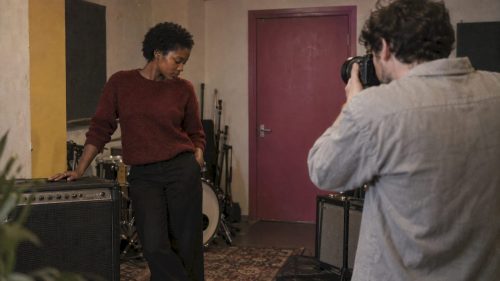
The best album cover photoshoot ideas start with the music, not the camera. Pick one clear feeling from the record, choose one subject or setting that carries it, and shoot it in a square frame with room for the title. We direct musician shoots in London, and every booking starts by working out what the image is for, so the cover ends up doing a job rather than just looking good. Below are concepts by genre, locations, poses, a planning routine and the file sizes to check before you upload.
TL;DR
- Describe the record in three words, then choose one image that says them. If the cover cannot say it at thumbnail size, simplify it.
- Match one visual system to your genre: documentary for gritty scenes, minimal objects for electronic, bold portrait crops for pop and rap.
- Shoot square (1:1) from the start and leave clean space for the title.
- Plan with a mood board and shot list so the day is spent on frames you will actually use.
- Check the upload specification before the shoot: most distributors want a square JPEG of at least 3000 x 3000 pixels.
Table of Contents
- Start with the music, not the location
- Album cover photo ideas by genre
- Ten concepts you can shoot in a day
- Locations, lighting and poses that carry a cover
- What to plan before the shoot
- File sizes to check before you upload
- Our view: one purpose per image
- Book a London shoot for your cover
- FAQ
- Sources
Start with the music, not the location
Most weak covers begin with a place (“let’s use the warehouse”) instead of a feeling. A simple method from CoverArtPlace’s 2026 guide is to describe the song in three words, such as restless, intimate or nocturnal. Then choose one subject that communicates them. Next decide whether this release needs to introduce your face or build a fictional visual world. Sketch three variations and compare them at thumbnail size before you develop the clearest one.
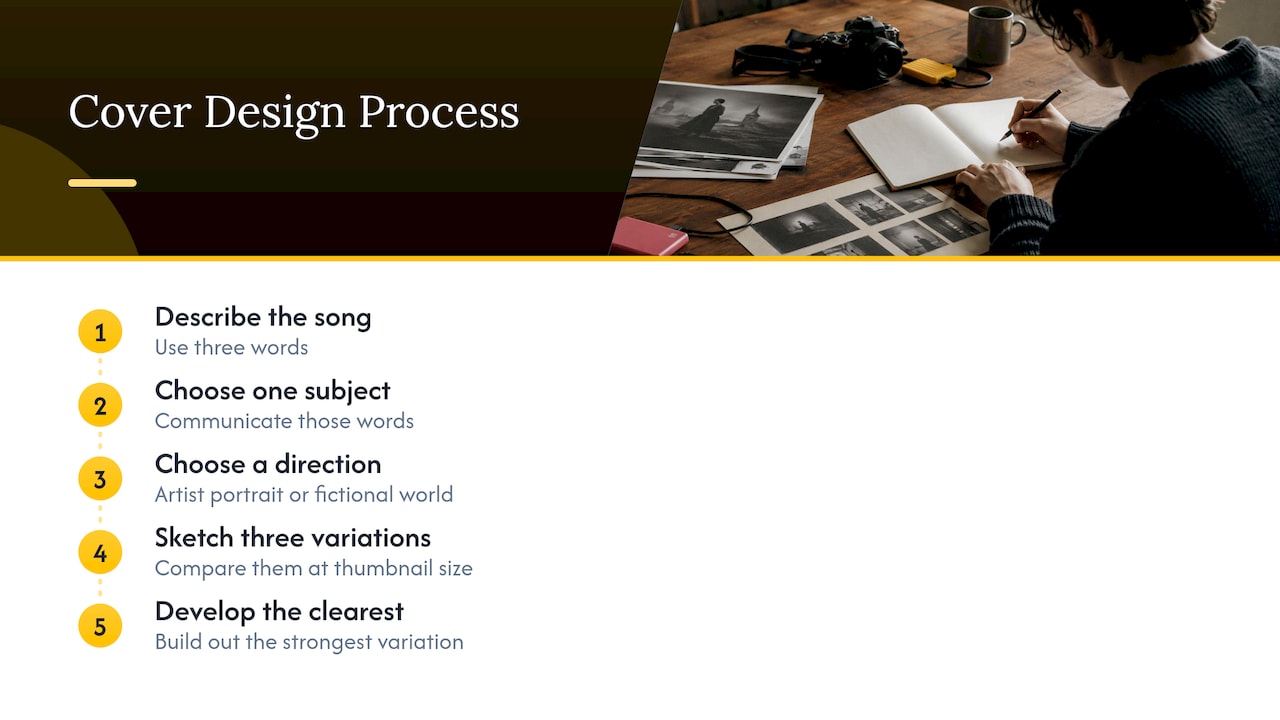
The thumbnail test matters because most listeners meet your cover as a tiny square in a streaming app. Detail that looks wonderful on a 12-inch sleeve disappears there. A face, a strong shape or a single object survives.
The question to answer is the one the Arctic Monkeys’ designer faced. In Creative Review’s 2026 oral history of the band’s debut cover, Scott Jones answered “What does this music look like?” with a day-in-the-life story shot in local pubs, friends’ flats and after-parties, using non-actors. The cover centred on a raw, unstyled portrait of a friend in a Liverpool bar. It worked because it looked like the songs sounded.
Album cover photo ideas by genre
Genre sets expectations, and the strongest covers pick one visual system and stick to it. The Ghost Production’s 2026 guide suggests this split:
| Music | Visual system that tends to suit it |
|---|---|
| Melodic house, techno, indie electronic | Minimal objects |
| Rap, pop, singer-producer releases | High-contrast portrait crops |
| Ambient, garage, left-field club music, instrumentals | Abstract textures |
| DJ edits, local-scene records, gritty EPs | Documentary photographs |
Treat these as starting points. The point is not to mix all four on one cover.
Rock, indie and punk
Documentary honesty beats polish. A rehearsal-room shoot, an empty grassroots venue before doors, or a wet London street after dark all give you atmosphere without a big budget. Flash-lit backstage portraits bring punk energy, and long-exposure movement suits a more experimental record. These come from Sanguine Band’s 2026 UK ranking of band photoshoot ideas, which also argues that a staged scene needs only one readable action. Fog, candles, televisions, masks and a stuffed fox in the same frame is too many ideas.
Pop, R&B and rap
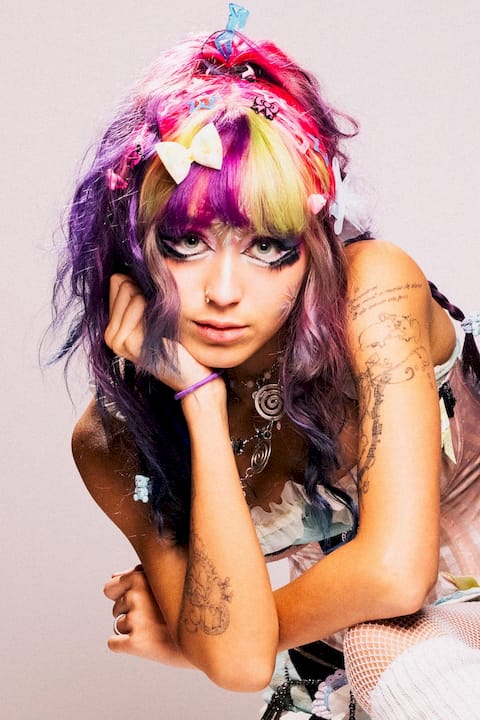
These genres usually lead with a face. A tight, high-contrast portrait with a strong colour choice and one styling statement reads instantly at small size. Decide the colour temperature deliberately: AlbumArtCreator’s 2026 genre guide says warm, saturated colour tends to read as energy and joy, while cold, desaturated colour reads as distance.
Electronic, DJ and producer releases
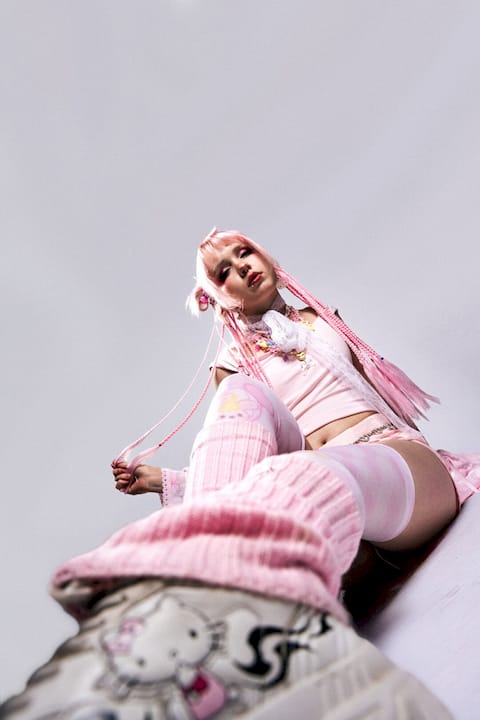
You may not want to be on the cover at all. Objects, textures, light trails or a single located detail can carry the release. If you are a DJ, your press images and cover art can share one look so the whole campaign feels coherent. For a debut, though, Landr’s album cover guide recommends a creative picture of you, so listeners know who is behind the music.
Folk, jazz and singer-songwriter
Quiet records suit quiet images: natural window light, a single instrument, a black-and-white portrait with generous empty space. Restraint is the concept.
Ten concepts you can shoot in a day
These ideas work with a small crew and London locations. Pick one, not several.
- The empty venue. Shoot the room you play in with nobody in it, or with you alone on the stage. It suits live-sounding, guitar-led records.
- The rehearsal-room documentary. Cables, amps, tea mugs, a tired face. Cheap, honest and distinctive when the frame is composed with care.
- The wet street at night. British weather becomes an asset: reflections, streetlight colour, a lone figure. Good for moody indie, grime and electronic.
- The single-colour studio. One coloured backdrop and one lighting set-up, repeated across singles so a campaign looks designed.
- Motion blur. Slow the shutter and let movement smear the frame. Good for records about loss, speed or chaos.
- The found-image collage. Layer vintage magazine pages or public-domain photography, as Landr suggests, then add a portrait element.
- The object portrait. One loaded object (a cracked mirror, a single trainer, a plant) photographed like a person.
- The staged scene with one action. Someone mid-fall, mid-turn or mid-laugh. One readable action, with the rest of the frame uncluttered.
- The environmental portrait. You in a place that explains you: your estate, your workplace, your studio. Our environmental portrait service is built for this kind of on-location image.
- The fictional world. A set of characters or a story told across the single, EP and album, as the Arctic Monkeys cover did with its night-out narrative.
Locations, lighting and poses that carry a cover
Use real examples as a guide to how much planning a famous frame takes.
Locations. Photographer Jack Alexander scouted a multi-storey London warehouse for an industrial edge before photographing Liam Gallagher, pulled reference images and finished eight looks in about an hour and a half, according to Format’s 2017 feature. Scouting beforehand is what makes a fast shoot possible. Disc Makers suggests choosing a location that complements your message: urban settings, natural landscapes, abandoned buildings or rehearsal spaces. Abandoned and public locations in London can need permission, so check access before you commit. Our band photoshoot poses guide includes a UK permit checklist.
Lighting. One light source done well beats five done badly. Single-colour gels give a studio concept consistency. Stage lighting and smoke bring on-stage energy to an in-venue shoot. Window light suits intimate records.
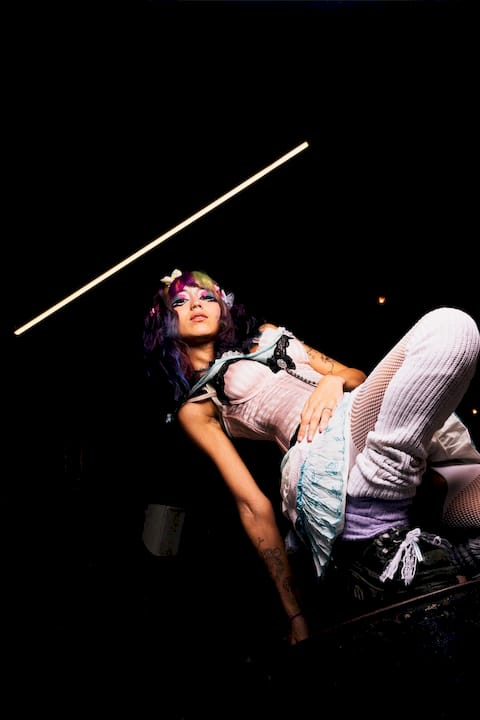
Poses. Movement and unease often read better than a smile. For an artist’s cover in a UK studio, PRISMA Photography Magazine describes poses such as falling off a stool and lying on the floor, shot with in-camera motion blur at around 1/5s, ISO 200 and f/2.8. The team chose a black-and-white edit because it conveyed the song’s sense of loss. Our 12 band photoshoot poses give direction for groups.
Props. Choose props that mean something. For Oasis’s Definitely Maybe, photographer Michael Spencer Jones had the singer lie on the floor in a tiny lounge, shot with a wide-angle lens, and filled the room with personal items such as a pink flamingo and a photo in the fireplace. He also used diluted Ribena instead of wine, because wine photographs black. This is all in The Guardian’s 2019 feature. Props work when they tell a story about the people in the frame. For more on turning everyday objects and photographs into narrative, see this piece on turning ordinary photos into emotional stories.
Composition. Album art is square, so compose for 1:1 from the first frame and leave space for text or a logo. Louder’s 2020 guide to shooting album sleeves says portrait and landscape framing is generally not applicable, and recommends shooting classic portraits at a minimum of 12in x 12in at 300dpi. Not every cover needs the band: Louder also notes that many classics use abstract or illustrative imagery instead.
What to plan before the shoot
A good cover day is mostly decided before anyone presses the shutter.
- Build a mood board. CD Baby’s 2021 planning guide recommends collecting album covers, portraits and magazine images, then being specific about what you like in each: the lighting, colour palette, location and positioning. We offer a mood board approach for first photoshoots that makes sign-off easier.
- Write a shot list. Cover close-ups and full-lengths, horizontal and vertical, individual and group, and keep compositions flexible enough to crop and add text. Even if the cover is square, you will want other formats for press and social.
- Settle styling early. Coordinate clothing so the look is cohesive and fits your genre, and bring the pieces that mean something to you.
- Agree the one idea. Louder advises arriving with pre-established ideas about lighting, props and mood, then covering everything from wide shots to close-ups. Do both: commit to a lead concept, then shoot safe alternatives.
- Talk about the music. A single lyric or anecdote from the recording process can spark a whole concept, as design studio Untz Creative argues in its 2023 journal piece on album cover design. Tell your photographer those stories.
Keep the text and the rules in mind
A cover that works needs room for the artist name and title, and no more. AlbumArtCreator warns against neon gradients with glowing text, three fonts and polaroid borders. Distributors also often reject covers containing website URLs, contact details or pricing, so leave those off the artwork.
File sizes to check before you upload
Check your distributor’s specification before the shoot, then export to it.
- Shape: square, 1:1.
- Size: RouteNote’s upload guide asks for exactly 3000 x 3000 pixels in JPG, under 25MB, in RGB rather than CMYK. It rejects blurry or pixelated images and copyrighted material.
- Apple Music and iTunes: Striped Circle’s 2026 guide to Apple’s UK packaging guidance says 3000 x 3000 pixels or larger is recommended, with 1400 x 1400 as a minimum. It suggests building artwork at 4000 x 4000 in RGB to avoid automatic adjustment or rejection.
Specifications change, so confirm the current figures on your distributor’s own page. Our musician press photos page covers square art and press files for the same reason: the picture needs to survive being cropped, shrunk and reused.
Our view: one purpose per image
We think an album cover is a piece of marketing before it is a piece of art, and it needs a job: to stop a thumb scrolling, to say who you are, to make the first listen feel like the continuation of an image.
That is why every booking with us starts by clarifying the purpose of the photos. For a musician, the answer might be “introduce my face”, “set the mood of a record” or “give the label a cover and a press set that feel like one campaign”. Once that is clear, the concept, location and styling follow, and the shoot is fully directed so you are comfortable in front of the camera rather than guessing.
Our advice is to resist stacking ideas. Choose one subject, one setting, one light. Then shoot the alternatives you will need for the press kit, the single artwork and social, so the cover is not the only frame you leave with. If you are in London and want direction, our musician work, from press shots to cover art, is where we would start.
Emmet
Book a London shoot for your cover
If you want a photographer to direct the session, see our musician photographer page for press shots and cover art. Portraits start at £200 (The Solo), and the details are on our portraits page. If you want to see our style first, browse the photography galleries. Tell us what the record sounds like, and we will start from there.
FAQ
What are the simplest album covers to shoot?
A single portrait against a plain background, one object on a coloured backdrop, or an empty room. Simple covers survive thumbnail size and are the easiest to match to a distributor’s spec. They still need a clear idea, light and careful framing to look deliberate.
Do I have to be on my album cover?
No. Many classic covers use abstract or illustrative imagery instead of the band. A debut often benefits from your face so listeners know who made the music, while later releases can lean on objects, places or textures.
Is 2000 x 2000 pixels good enough for an album cover?
It is risky. RouteNote’s upload guide asks for exactly 3000 x 3000 pixels, and Apple’s guidance as summarised by Striped Circle recommends 3000 x 3000 or larger with a 1400 x 1400 minimum. Shoot at high resolution and export to the largest size your distributor accepts.
How do I turn a photo into an album cover?
Crop to a square, leave space for the artist name and title, and check it at thumbnail size. Export as an RGB JPEG at the size your distributor asks for, with no URLs or contact details on the artwork. It helps to plan this at the shoot so you compose in 1:1 from the start.
How long should an album cover shoot take?
A focused concept can be shot quickly if the planning is done. Jack Alexander’s London shoot with Liam Gallagher covered eight looks in about an hour and a half after scouting the location. Allow more time for staged scenes, styling changes and motion experiments.
Sources
- An oral history of Arctic Monkeys’ first album cover, Creative Review
- 10 tips for shooting an album sleeve, Louder
- Album Cover Ideas: 10 Inspiring Styles, Landr
- Album Cover Ideas: 12 Styles for Singles, EPs & Albums, CoverArtPlace
- The Best Rock and Metal Band Photoshoot Ideas, Sanguine Band
- Album cover ideas: Release Art, The Ghost Production
- Album Cover Ideas for Every Genre, AlbumArtCreator
- Album cover design, Untz Creative
- In the Music Studio, PRISMA Photography Magazine
- Michael Spencer Jones’s best photo, The Guardian
- How to Photograph Liam Gallagher, Format
- 14 Band Photoshoot Ideas, Disc Makers
- How to plan a photo shoot for musicians, CD Baby
- Upload Guide, RouteNote
- Album Artwork for iTunes, Striped Circle