
The best corporate videographer in London is the one who starts with what the video has to do, then films, edits and delivers it while it is still useful. That is how we work at LemonLens: every booking begins by clarifying the purpose of the footage, the shoot is fully directed so people on camera are comfortable, and delivery is fast. Below you will find the main kinds of provider compared, what to put in a brief, what to agree on rights and revisions, and how to book.
TL;DR
- Choose on purpose first: an investor update, a recruitment film and a conference recap need different crews, lengths and edits.
- LemonLens is a London photography and videography studio that works purpose-first, with transparent pricing and a directed process. Corporate event coverage starts from £350 for a half-day and from £650 for a full day.
- Your three real options are a solo videographer, a larger production company, or a studio that covers photo and film together. The right one depends on how many days, locations and deliverables you need.
- Settle usage rights, music licences, formats and revision rounds in writing before the shoot, not after the edit.
- A good brief is one page: objective, audience, where it will be watched, must-haves, deadline and who signs off.
Table of Contents
- What a corporate videographer actually does
- Your options compared
- How much a corporate video costs in London
- How to write a brief that gets a useful quote
- The process from enquiry to delivery
- Rights, music and revisions: what to agree before you sign
- Filming people at work: a few practical points
- Booking LemonLens for a corporate video
- Our view
- FAQ
- Sources
What a corporate videographer actually does
“Corporate video” covers a wide range of work, and the label matters because the crew, kit and edit time differ for each type. The common London briefs are:
- Executive and team interviews. A talking-head film for a website, a results announcement or an investor update. It needs good light, clean sound and someone who can put a nervous director at ease.
- Company and culture films. Footage of the office, the people and the work, used for recruitment and the About page.
- Testimonial and case-study videos. A client tells their story in their own words. We have an example of this style, a testimonial video for a restaurant POS client.
- Event coverage. Conferences, launches, awards and away days, filmed live and cut into highlights, speaker clips and social snippets. Our event highlight video guide covers how to turn this around quickly.
- Brand and social video. Short films built for LinkedIn, Instagram or paid campaigns. See our guide to brand story videos and the production checklist that avoids reshoots.
- Training and internal communications. Process films, onboarding and leadership messages.
A videographer is usually one person or a small crew who shoots, and often edits, the finished piece. A production company adds producers, directors, scriptwriters and sometimes animators. Neither is better in the abstract. The question is which fits your project.
Your options compared
Most London businesses end up choosing between three types of provider. The table sets them against the criteria that decide most projects.
| Criteria | LemonLens (studio covering photo and video) | Solo freelance videographer | Larger production company |
|---|---|---|---|
| Best for | Interviews, events, brand films, and shoots where you also want stills | A single, simple shoot | Scripted, multi-day, multi-location productions |
| Starting point | Purpose of the footage agreed before booking | The brief you provide | Brief, treatment and script |
| Photo and video from one booking | Yes | Varies by person | Often separate |
| Published pricing | Event coverage from £350 (half-day) and from £650 (day); video quoted per project | Varies by person | Usually quote-only |
| Event turnaround | 48 hours for events | Varies by person | Varies by project |
| Directing people on camera | Fully directed process | Varies by person | Dedicated director on larger crews |
We are the pick for most corporate briefs because the work we do covers them: interviews, events, brand content and the stills that go with them, delivered quickly. Where a project needs a scripted, multi-day production with a large crew, a production company is built for that, and you should expect a longer timeline and a quote per project.
Why a studio that does both photo and video helps
A corporate shoot rarely needs only moving image. The same day usually produces a need for headshots for the website, event photographs for the press release and clips for social. One booking, one brief and one delivery date is simpler than coordinating two suppliers. Our videography service sits alongside business photography and corporate photography, so the visual identity stays consistent across both.
How much a corporate video costs in London
Video prices in London vary because you are paying for crew time, kit, editing and the rights you receive. Three things move a quote more than any others: the number of shoot days, the amount of editing, and the number of final versions (a main film, a 30-second cutdown, vertical clips for social).
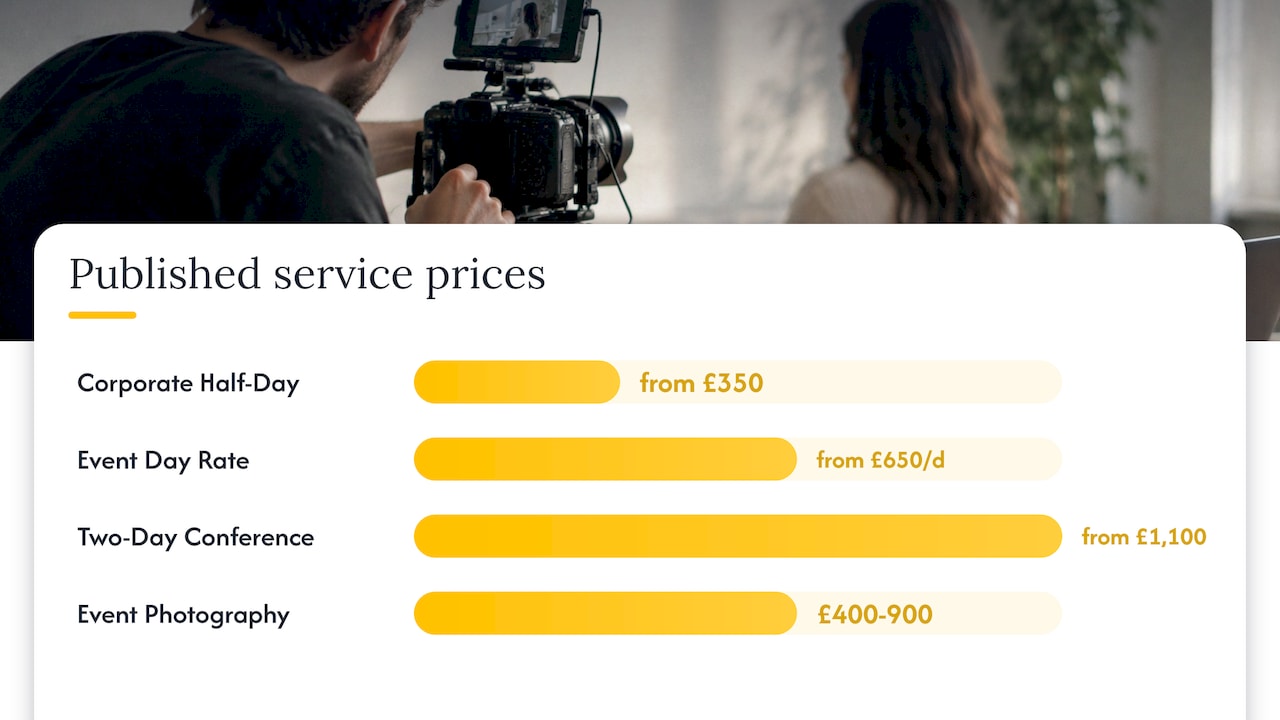
Our published prices cover event and corporate coverage:
| Service | Price |
|---|---|
| Corporate Half-Day | from £350 |
| Corporate Event Day Rate | from £650 per day |
| Two-Day Conference | from £1,100 |
| London event photography | £400 to £900 |
These are on our corporate events page. Videography itself has no published price because the cost depends on what the film has to achieve, so we quote it per project once we know the purpose, length and versions you need. Our event videography page is the place to start for live coverage.
When you compare quotes from any provider, line them up on the same basis:
- Number of filming days and crew size.
- Editing time and the number of revision rounds included.
- Final deliverables: lengths, aspect ratios, subtitles, cutdowns.
- Music and stock footage licences.
- Usage rights and who owns the raw footage.
- Travel, equipment hire and VAT.
Two quotes with the same headline figure can contain very different things. A low number that excludes captions, social versions and a second round of changes often ends up the more expensive option.
How to write a brief that gets a useful quote
The better the brief, the more accurate the quote and the fewer surprises in the edit. One page is enough. Include:
- The objective. One sentence on what the video must achieve: win a tender, support recruitment, explain a product, recap an event.
- The audience. Who will watch, where (website, LinkedIn, a conference screen, an internal portal) and what they already know.
- Must-haves. Brand guidelines, who has to appear on camera and when they are free, legal or compliance lines, locations, accessibility requirements.
- Deliverables. Length, formats, aspect ratios, subtitles and any shorter social versions.
- Deadline and sign-off. The date it must be live and who gives final approval. Having several reviewers without a named decision-maker is the usual cause of late edits.
This follows the structure that production teams commonly recommend in a corporate video brief template. With us, the brief is where the work begins: every booking starts by clarifying what the images or footage are for, so what you send us is refined into a shoot plan before anyone picks up a camera.
The process from enquiry to delivery
A corporate shoot follows the same arc whoever you hire. What differs is how much of it is handled for you.
- Enquiry and purpose. You describe the project. We ask what the video is for and who it is for, because that decides length, tone and style.
- Quote. You receive a clear quote based on the days, versions and rights involved.
- Planning. Locations, running order, who appears and when. For interviews, decide the questions and send them to speakers in advance so they arrive prepared.
- Filming. The shoot is directed so that people on camera feel comfortable. This matters more than most clients expect: a relaxed speaker gives you usable lines in fewer takes.
- Edit and review. A first cut, consolidated feedback from one person, and a final version.
- Delivery. Files in the formats you asked for. For events we deliver in 48 hours, because highlights are worth most while the event is still a live topic.
Our approach to interview setups is covered in our interview video setup guide, which shows how a clean, usable recording is captured.
Where projects go wrong
Most delays come from the same few places: late changes to the brief, feedback from five people instead of one, a speaker unavailable on the day, and music or footage that was never licensed for the use you planned. A purpose agreed at the start prevents most of these, because every decision can be tested against it.
Rights, music and revisions: what to agree before you sign
This is the part businesses skip and later regret. Put these points in writing before the shoot.
Usage rights. Copyright in a film is automatic; copyright protects films and video as soon as they are created, so unless the contract says otherwise, you should not assume that paying for a shoot transfers every right. Agree where you can use the film (website, social, paid advertising, events), for how long, and in which territories. If you plan to run the film as a paid ad, say so up front. Our event highlight guide goes into UK rights for event videos.
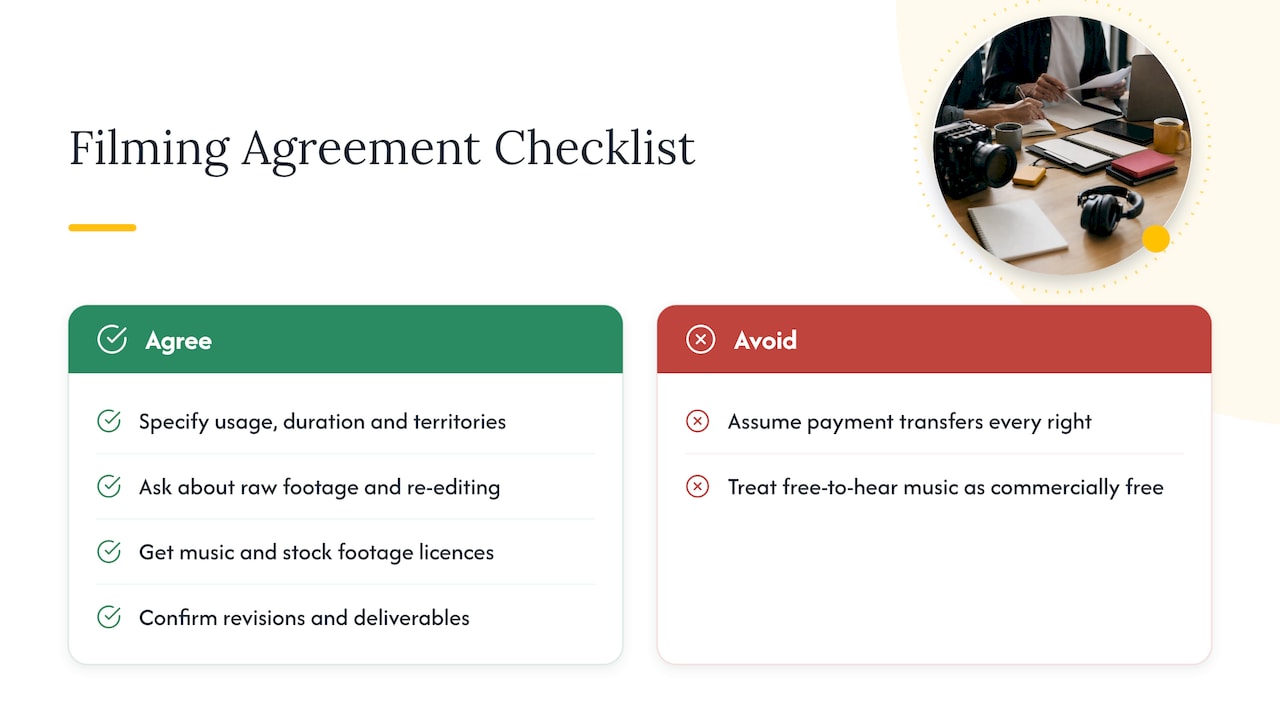
Ownership of the footage. Ask whether you receive the final edit only or also the raw footage, and whether you may re-edit the film later for new campaigns.
Music. Music is the most common rights trap. A track that is free to hear is not necessarily free to use commercially, and the two terms are often confused: this explainer on royalty free versus copyright free music sets out the difference. Ask for the licence details of every track and any stock footage in the final film.
Contract protections. Written terms on ownership and usage should be as specific as you would expect for any commercial supply. Buyers in other sectors face the same issue, as shown in contract protections buyers should write in when they commission media that will be used across several channels.
Revisions. Agree how many rounds of changes are included and what counts as a round. A common structure is one consolidated round of feedback after the first cut and a final check. Changes to the script or interview content after filming are a different matter from corrections to the edit.
Deliverables. Confirm the file formats and the aspect ratios (16:9 for websites and presentations, 9:16 and 1:1 for social), subtitles, and any shorter cutdowns.
Filming people at work: a few practical points
Before filming in an office, tell colleagues the date and the areas that will be on camera, and give anyone who would rather not appear a chance to step out of shot. For interviews, agree the speaker’s consent for how the footage will be used. If the film will show clients, visitors or the public, ask the videographer how consent and signage will be handled. Where the film includes personal data, your own data protection lead is the right person to confirm the arrangements.
Booking LemonLens for a corporate video
If you are filming executives, a conference, a launch or a brand story in London, we cover the whole job: planning, directing, filming and fast delivery. Event coverage starts from £350 for a half-day and from £650 for a full day, and a two-day conference starts from £1,100. Videography is quoted per project. Start with the videography page, or see the corporate event rates if the brief is an event. We work across London, from the City to the boroughs of Camden, Hackney, Ealing, Lambeth and beyond.
Our view
Most corporate videos disappoint for one reason: nobody agreed what they were for. The kit, the crew and the grade are secondary. A film that is beautiful but has no job to do ends up on a shelf.
That is why every LemonLens booking starts with purpose. We ask who the film is meant to move and what you want them to do afterwards, then plan the shoot backwards from that. The result is footage that is intentional rather than merely attractive.
The second thing we care about is speed. Footage from an event is worth most while people are still talking about it, which is why we deliver event work in 48 hours. The third is plain pricing, because no one should have to decode a quote.
Finally, directing. Most people are not used to being filmed, and a calm, directed shoot gets you the honest, confident version of your team. That is what we aim to give every client.
Emmet
FAQ
How much does a corporate videographer cost in London?
It depends on days, crew, editing and rights. Our corporate event coverage starts from £350 for a half-day and from £650 for a full day, and a two-day conference starts from £1,100. Videography is quoted per project once we know the purpose, length and versions you need.
How long does it take to receive the finished video?
For events we deliver in 48 hours. For planned corporate films, timing depends on the length of the edit and how quickly feedback comes back, so agree the delivery date in the quote.
Should I hire a freelancer or a production company?
Choose by scope. For interviews, events and brand films that need directing, filming and quick delivery, a studio such as ours covers the job from one booking. For a scripted, multi-day production with a large crew, a production company is set up for that scale.
Can the same team shoot photos and video?
Yes. We cover portraits, business photography, events and videography, so one brief can produce the film, the headshots and the event stills together. That keeps the look consistent and saves you coordinating two suppliers.
What should I send before asking for a quote?
Send the objective, audience, where the video will be shown, deliverables, deadline and the name of the person who signs it off. A one-page brief is enough for an accurate quote.
Sources
- Corporate Video Brief Template: What to Send
- Copyright: UK government guidance
- Contract protections for media buyers