
Build a prioritised shot list of roughly 40 to 60 grouped essentials, then hand your photographer a one-page, day-of summary rather than the full document. Highlight your top 10 non-negotiables, send the complete checklist two to four weeks before the wedding, and confirm coverage times and image licence in your contract before signing anything.
TL;DR:
- Sending a detailed shot list two to four weeks prior allows the photographer to address timing and venue restrictions effectively.
- Prioritize a maximum of 60 grouped shots across all stages to maintain natural photography and prevent rushed, staged images.
- Family portraits should be limited to six to eight groups, taking about 3 to 5 minutes each to avoid delays during the reception.
- Clearly communicate your top 10 must-have shots and assign a family liaison to gather guests efficiently on the day.
- Confirm contract specifics, including coverage times, image rights, and deliverables, before signing to prevent misunderstandings.
Table of Contents
- What should go on your wedding photography shot list?
- Getting-ready and detail shots: what to plan for
- Ceremony shot list: the moments you can’t reshoot
- How long do family and couple portraits actually take?
- Reception and evening shots worth prioritising
- Sample wedding day timeline and how to build in buffers
- Contracts and copyright basics you must confirm before booking
- Sharing your shot list with your photographer
- Photographer’s note: lists protect moments, they shouldn’t script them
- Book a photographer who plans the day with you
- Where to check the details
- Sources
- FAQ
What should go on your wedding photography shot list?
A working list has six stages: details, getting ready, ceremony, family portraits, couple portraits, and reception through to evening. Group everything by stage rather than by importance. It mirrors how the day actually unfolds, which makes the list far easier for your photographer to scan between moments.
Mark each item as must-have, nice-to-have, or optional. Must-haves are the shots you’d genuinely regret missing: the first kiss, the rings exchange, both sets of parents together. Nice-to-haves add polish but survive being dropped if the timeline slips. Optional shots are creative extras, think pets, drone aerials, or a prop-heavy flat-lay, worth flagging but never worth stressing over.
A stage-ordered starting point:
- Detail flat-lays: rings, invitations, shoes, perfume, vows
- Getting ready: hair, makeup, dressing, candid reactions
- Ceremony: processional, vows, ring exchange, first kiss, recessional
- Family portraits: capped at 6 to 8 combinations
- Couple portraits: a short session plus golden hour
- Reception and evening: speeches, first dance, dancefloor energy
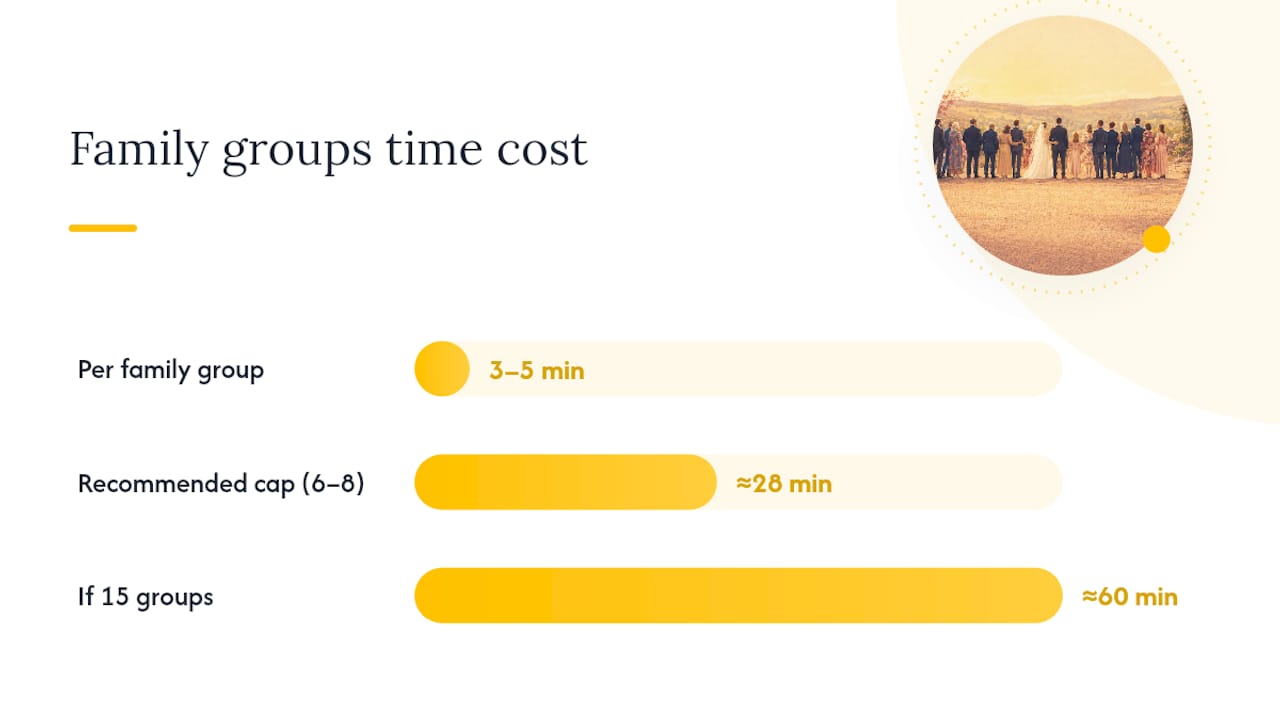
Capping family combinations at 6 to 8 groups matters more than it sounds. Each combination realistically takes 3 to 5 minutes to arrange and shoot, so a list of 15 “essential” groupings can quietly eat an hour of your reception. A stage-grouped checklist with clear prioritisation is what turns a wish list into something usable on the day.
Leave a line at the bottom of your printed copy for venue-specific notes: no flash in the ceremony room, no confetti near the flowerbeds, a balcony that’s out of bounds after dark. Annotate these once and your photographer never has to guess.
Getting-ready and detail shots: what to plan for
The morning sets the tone for every photo that follows, so it’s worth planning properly rather than leaving it to chance.
Detail flat-lays worth listing:
- Rings, on their box or a textured surface
- Invitation suite and stationery
- Shoes, paired or styled together
- Handwritten vows
- Perfume or cologne bottle
- Jewellery, cufflinks, or other accessories
Getting-ready moments to capture:
- Hair and makeup application, mid-process rather than posed
- Getting into the dress or suit
- A parent’s reaction on seeing you ready
- Candid conversation or nerves in the room
If you and your partner are preparing at separate locations, a second shooter isn’t a luxury, it’s the only way both storylines get told. One photographer physically cannot be in two houses at once, and asking a partner’s morning to wait until the other’s is finished usually means it gets rushed or skipped entirely.
Allow 30 to 45 minutes for detail shots and candid prep combined; longer if hair and makeup overruns, which it usually does.
Pro Tip: Set out your flat-lay items the night before in a small box, rings included. Photographers lose real time hunting for a shoe under a hotel bed at 9am.
Ceremony shot list: the moments you can’t reshoot
Everything before guests arrive should be captured empty. Venue shots, the altar or arch, seating details, and any signage need photographing before the room fills, since you only get one chance at a clean, guest-free frame.
Ceremony essentials:
- Processional and the walk down the aisle
- The couple’s first look at each other
- Vows and ring exchange
- The first kiss
- Signing the register or legal documents
- Recessional
- Guest reactions: laughter, tears, applause
Check venue restrictions well before the day, not on it. Many churches and register offices ban flash photography during vows, restrict confetti to outdoor areas only, or require separate permission for drone shots. Working within these restrictions is routine for an experienced wedding photographer, but only if they know about them in advance.
Coordinate with your officiant or ushers on anything time-sensitive, a surprise musical entrance, a reading from a specific family member, a release of doves. A quiet heads-up beforehand means your photographer is already in position rather than reacting a beat too late.
How long do family and couple portraits actually take?
Group photos are the part of the day most likely to run over, and almost always because the guest list for photos was never agreed in advance.
- Immediate family together — both sets of parents, siblings, the couple
- Couple with each set of parents separately
- Couple with grandparents
- Extended family groupings — aunts, uncles, cousins
- Wedding party — bridesmaids, groomsmen, full bridal party
- Couple with close friends
Budget 3 to 5 minutes per combination. For 6 to 8 groups, that’s 20 to 35 minutes total, plus a few minutes of buffer for people wandering off between shots (someone always does).
Appoint a family liaison, an usher, sibling, or parent who knows everyone by face, to physically round people up. Hand them the pre-assembled grouping list rather than relying on a photographer who’s meeting your extended family for the first time.
For the two of you, plan two shorter sessions instead of one long one: a 15 to 30 minute portrait window during drinks, and a 20 to 30 minute golden hour session later.
Pro Tip: Tell grandparents and older relatives exactly when their group shot happens, ideally in writing on the day-of sheet. They tend to wander toward seats otherwise, and chasing them costs everyone time.
Reception and evening shots worth prioritising
The reception is where posed shots give way to documentary coverage, and it’s worth briefing your photographer on which moments matter most if time gets tight.
Reception essentials:
- The room and table settings before guests sit down
- Food and any styled details (cake, favours, place cards)
- Guest book or well-wishes station
- Speeches and toasts
- Cake cutting
- First dance
Evening and party prompts:
- Sparkler exit or send-off, if planned
- Bouquet or garter toss
- Dancefloor energy once things loosen up
Low light changes what’s achievable, so it’s worth your photographer knowing the venue lighting in advance. Fast prime lenses, off-camera flash, and higher ISO settings all help freeze motion on a dark dancefloor without flattening the mood. A checklist covering after-party details is a useful reference if you want extra creative ideas beyond the core list.
If coverage time is tight, keep speeches, first dance, and cake cutting non-negotiable. Everything else on the party list is a bonus if the clock allows it.
Sample wedding day timeline and how to build in buffers
A 1pm ceremony gives you a workable frame to schedule everything else around.
- 9:00 to 11:00am — getting ready and detail shots
- 12:00pm — travel to ceremony venue
- 1:00pm — ceremony (allow 30 to 45 minutes)
- 1:45 to 2:20pm — family portraits (3 to 5 minutes per group)
- 2:20 to 2:50pm — couple portraits during drinks reception
- 3:00pm — wedding breakfast and speeches
- 6:30 to 7:00pm — golden hour couple portraits (check sunset time locally)
- Evening — first dance, party, evening shots
Build a 15 to 30 minute buffer between each block. Ceremonies overrun, speeches go long, someone always needs five more minutes for hair touch-ups. Without slack built in, a 20-minute delay at 2pm cascades through the rest of the day.
Full-day coverage typically runs 8 to 10 hours, which is usually enough to cover getting ready through to the first dance without rushing. Share the finished timeline with your venue, caterer, and band or DJ at least two weeks ahead, so everyone is working from the same schedule.
Contracts and copyright basics you must confirm before booking
Read the contract properly before you sign, not the day before the wedding. Vague phrasing like “full day coverage” leaves too much open to interpretation.
Confirm these before booking:
- Exact start and end times, stated as clock times, not “all day”
- Number of photographers attending (and whether a second shooter is included)
- Number and format of final images, and the editing style
- Delivery timeline for the finished gallery
- Deposit amount and cancellation or postponement terms
- Contingency plan if your photographer falls ill (a named substitute, for instance)
A quick copyright fact: under UK law, the photographer usually retains copyright over wedding images. Couples should get written permission before publishing photos online, and it’s worth agreeing a personal-use licence for printing and social sharing at the same time.
Contracts should specify exact deliverables and timelines rather than leaving them loose, and it’s standard for RAW files not to be included by default, so ask directly if you want them.
Sharing your shot list with your photographer
Send the full checklist two to four weeks before the wedding, giving your photographer time to ask questions and flag anything unrealistic. Mark your top 10 must-haves clearly, then condense everything into a single one-page summary for the day itself, nobody wants to read a six-page document between the ceremony and the first dance.
Your day-of summary should include:
- Exact locations for each portrait session
- Timings for each block
- Your family liaison’s name and phone number
- Any sensitive or off-limits shots (an estranged relative, a no-photos request)
Book a 20 to 30 minute planning call a few weeks out to walk through timing and venue restrictions together.
Pro Tip: Resist the urge to script every candid moment. A shot list works best when it protects your must-haves and leaves room for your photographer to catch what actually happens.
Photographer’s note: lists protect moments, they shouldn’t script them
A list works when it protects the handful of shots you’d never forgive yourself for missing, and gets out of the way for everything else. Micromanaging every minute tends to produce stiffer photos, not better ones. A short planning call solves most of this before it becomes a problem on the day.
Purpose-led imagery and rapid delivery often come from knowing what actually matters to a couple before the shutter clicks. Pick your top 10, annotate them clearly, then trust the rest to the day itself.
— Emmet
Book a photographer who plans the day with you
A photographer who works from your annotated shot list rather than a generic template, with a planning call built into every booking to confirm timings, venue restrictions, and your non-negotiable top 10 before the day arrives, offers a more personalised experience. Unlike some photographers who hand you a standard package and then disappear until the wedding, a more engaged photographer keeps the collaboration going and aims to turn images around quickly, so they’re still relevant when you want to share them.
Wedding coverage starts from £1,850, with an optional second shooter available for couples getting ready at separate locations. If you’re weighing up a registry ceremony, a Morden registry office booking shows how a compact shot list works for a smaller-scale day, and a full-day hotel wedding in Twickenham shows the same planning approach scaled up.
Get in touch to check your date and start building your shot list together.
Where to check the details
For copyright and permissions, GOV.UK’s guidance on digital images covers who owns what. For contract wording, the Institute of Photographers’ contract guide and Forms-legal’s photography contract template both set out standard clauses. For extra shot ideas beyond the essentials, Brides’ full checklist is a solid reference, and photographers marketing their own portfolios can find useful context in SEO guidance for photographers.
Sources
- Gov
- Wedding photography contract essentials UK: A professional guide for 2026
- Photography contract UK | Forms-legal
- A complete wedding photography shot list – Brides
FAQ
How many photos should be on a wedding shot list?
Aim for 40 to 60 grouped items across all stages of the day. Fewer than 30 risks missing key moments, while more than 80 tends to push photographers toward staged, rushed shots rather than natural ones.
When should I send my shot list to my photographer?
Send the full list two to four weeks before the wedding, then follow up with a condensed one-page summary for the day itself. This gives your photographer time to flag timing issues and confirm any venue restrictions in advance.
How long do family photos take on a wedding day?
Budget 3 to 5 minutes per group combination, which means 20 to 35 minutes total for 6 to 8 groups. Appointing a family liaison to round people up speeds this up considerably.
Who owns the copyright to my wedding photos?
Under UK law, the photographer usually owns copyright by default, even though you commissioned the images. You should agree a personal-use licence in writing before printing or posting photos online.
How much does wedding photography cost with Lemonlens?
Lemonlens wedding coverage starts from £1,850, with full pricing and package details available on the main booking page. The exact price depends on hours of coverage and whether a second shooter is added.