
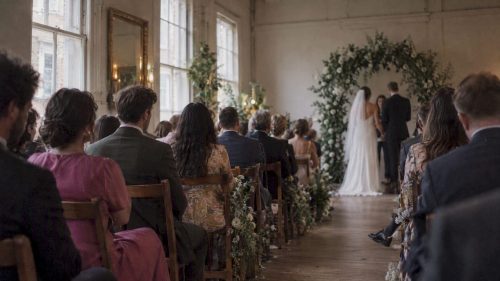
An unplugged ceremony is a wedding ceremony where the couple asks guests to put away their phones, tablets and cameras, so everyone is watching the moment rather than filming it. The professional photographer and videographer (if you have them) are the only people recording. Most couples keep the request to the ceremony itself, a thirty-minute stretch or so, and let guests pick their phones up again afterwards for the confetti, the group photos and the party.
That is the short answer. The rest of this guide covers the details couples actually get stuck on: how strict to be, what to put on the sign, what to say on the day, how it affects your photos and the audio of your vows, and what to do if some of your guests will struggle with it.
TL;DR
- “Unplugged” means no guest phones, tablets or cameras during the ceremony. Your hired photographer and videographer still work as normal.
- Couples choose it for presence, cleaner photos (no raised arms in the aisle) and quieter video audio.
- Say it three ways: on the invitation or wedding website, on a sign at the entrance, and spoken by your celebrant or registrar before you begin.
- If you are unsure, a short “tech window” lets guests take one photo as you arrive, then devices go away.
- Unplugged usually covers the ceremony only. Say clearly when phones are welcome again.
Table of Contents
- What an unplugged ceremony actually means
- Why couples choose it
- Unplugged versus partly unplugged
- How to tell your guests
- What if someone breaks the rule?
- Why it matters for the photographer and videographer
- Our perspective
- Questions to settle before you decide
- A note on the aisle itself
- Booking us for your wedding
- FAQ
- Sources
What an unplugged ceremony actually means
The word comes from the idea of unplugging from technology. In wedding terms it is a request, not a rule of law: you are asking your guests, politely, to be present. Wedding publication The Knot describes it as asking guests to put down the technology and enjoy the event without documenting it on their devices.
Three things are worth being clear about:
- It is a request from you, not a venue rule. Some venues and registrars have their own photography policies, so check with yours. In England and Wales a civil ceremony is conducted by a registrar, and many couples ask the registrar in advance what is and is not allowed.
- It normally covers the ceremony, not the whole day. Some couples extend it to the drinks reception or the speeches, but the classic version is ceremony only.
- Your professionals are exempt. The point is to give one trained person (or two) the job of recording the day, so everyone else can simply watch.
The idea has been around long enough to be mainstream. When the Daily Mail-era complaints from photographers were gathered in an i news report on photographers urging couples to ban mobile phones, couples were already embracing the unplugged wedding, and professional bodies including the British Institute of Professional Photography backed the idea.
Why couples choose it
You see faces, not screens
Walk down an aisle where every guest holds a phone up and you get a wall of glass instead of expressions. An unplugged ceremony means your first look at your guests, and theirs at you, is direct. This is the reason most couples give, and it is a good one.
Your photographs are cleaner
A wedding cannot be re-shot. If a guest steps into the aisle at the moment you walk in, or leans out as you exchange rings, the photographer cannot ask everyone to do it again. One celebrant writing about the practice notes that the real frustration is a lack of tech etiquette: guests blocking the aisle or the photographer’s sightline at the entrance, the rings and the first kiss. The aim, as she puts it, is not to police guests but to protect the intimacy of the moment.
That matches what we see on the day. The most common problem is not malice. It is an enthusiastic aunt in the front row who wants the same angle as the photographer.
Your video audio is quieter
If you have a videographer, there is a second reason. Microphones that record vows well are very sensitive, and they pick up persistent noise too. The Society of Wedding and Portrait Photographers makes the point that shutter noise during quiet moments is something a non-photographer may not notice but a microphone will. Phone beeps, camera sounds and whispered “can you see?” add to that. If you care about how your vows sound years from now, see our practical guide to avoiding muffled vows in UK wedding video.
Your guests relax
There is a quieter benefit: guests stop trying to get the shot. Nobody has to worry whether the phone is charged, whether they are in the way, or whether they will miss the moment while fiddling with a screen.
Unplugged versus partly unplugged
Not every couple wants a total ban, and not every guest list suits one. Here are the realistic options.
| Approach | What you ask | Best for | Watch out for |
|---|---|---|---|
| Fully unplugged ceremony | No devices from the processional to the recessional | Couples who want full presence and clean photos and video | Guests who forget; an older relative who wants one picture |
| Tech window | One quick photo as the couple arrives at the front, then devices away | Couples who are on the fence | The window needs a clear announcement or it drifts |
| Unplugged ceremony and speeches | Devices away until the reception starts | Couples who want speeches heard properly | Longer stretch for guests to stay off phones |
| Fully unplugged day | No guest photography at all, with the photographer sharing images quickly | Private weddings, or couples with privacy concerns | Hard to enforce; guests may feel left out |
| Photo-friendly | No request | Relaxed, informal weddings | Photographers and videographers work around guests |
The tech-window compromise is widely suggested by professionals: the officiant says guests may take one quick photo immediately after the couple reaches the front, then asks for devices to be put away for the vows. It gives people their snap and gives you the rest of the ceremony back.
How to tell your guests
A request that appears only once is easy to miss. The couples who get the result they want tell guests at three points.
1. Before the day
Put a line on your wedding website or invitation suite. Something like: “We are having an unplugged ceremony. Our photographer will share images with everyone afterwards.” The last sentence matters. It answers the question guests are really asking, which is how they will get pictures of the day.
2. At the entrance: the sign
A sign on an easel at the ceremony door is the single most effective tool, because guests read it as they arrive with their phones already in their hands. Keep it short, warm and clear. A few wordings you can adapt:
- “Welcome to our unplugged ceremony. Please switch off your phones and cameras and be here with us. Our photographer will share the pictures.”
- “We have hired a professional to capture how today looks. Please help us capture how it feels, with your full attention.”
- “Phones away for the ceremony, please. We promise photos and fun afterwards.”
- For a tech window: “Feel free to take one photo as we arrive. After that, please put your devices away and enjoy the ceremony.”
A collection of announcement wordings at The Wedding Playbook runs from sentimental to funny if you want more ideas. Choose the tone that sounds like you. Gentle humour tends to work better than a stern “NO PHONES” notice, which can feel like a telling-off at a celebration.
3. Out loud, before you begin
Signs get ignored. Your celebrant, registrar or officiant should make a brief announcement as guests settle, thirty seconds at most: please put away your phones, the photographer has it covered, you will have images afterwards. Guests take instruction from the person at the front far more readily than from a sign. Canon’s guidance on guest etiquette also reports a humanist celebrant in England saying that at most ceremonies he conducts it is made clear at the start that photos are not to be taken during the ceremony, so many guests will already expect it.
Ask the person leading the ceremony in advance whether they are happy to say it. Most are.
What if someone breaks the rule?
Someone will probably check a phone. Plan for it without drama:
- Appoint a gentle enforcer. An usher or a bridesmaid can quietly remind a guest. You should not be the one doing it.
- Brief the family. Your parents and grandparents are the likeliest to want a photo. A short word beforehand, with a promise they will have the professional pictures within days, solves most of it.
- Let it go. One phone at the back does not ruin a photograph. A forest of phones at the front does.
- Think about accessibility. Some guests use a phone for medical alerts, hearing support or as a communication aid. “Put away” is not the same as “switch off” for everyone, and a quiet word to an individual is kinder than a blanket rule applied rigidly.
Why it matters for the photographer and videographer
From the professional side, an unplugged ceremony does a few concrete things.
Clear sightlines. The aisle, the moment you reach the front, the ring exchange and the kiss are the images you will not get twice. Keeping the aisle free of arms and elbows is half the job.
Natural expressions. Guests who are watching the ceremony react to it. Their laughing and crying in the background is what makes the pictures tell the story. Guests looking down at a screen do not.
A quieter recording. Fewer clicks, pings and shuffles means cleaner vows audio. If your ceremony is in a quiet room, a registry office or a church, this matters more.
Better planning. Give your photographer and videographer the order of events in advance so they can position themselves once and not move during the ceremony, which also reduces noise. For a walkthrough of what to cover, our wedding photography timeline and wedding photography shot list are written for UK couples. If you are exploring how a candid photographer thinks about protecting the live moment, one wedding photographer’s guide to planning an unplugged ceremony is another useful perspective.
Our perspective
We photograph and film weddings across London, and the thing we say to every couple who asks about unplugged ceremonies is the same: decide what the ceremony is for. If it is for being fully there with the people you love, ask them to put their phones away and mean it. If it is a lively, informal celebration where guests joining in is part of the fun, a tech window or no rule at all may suit you better.
Our approach to every shoot starts by clarifying the purpose of the images, and the same logic applies here. An unplugged ceremony works best when it is a choice with a reason behind it, not a trend. When the reason is clear, guests tend to follow it happily, because it is explained kindly and comes with a promise that they will see the pictures.
That promise is the part we can help with. We know guests are most tempted to take their own photos when they fear they will never see the professional ones. Fast, reliable delivery removes that fear, and that is a big part of why we care about turnaround. Tell your guests when the gallery will arrive, and the request feels less like a restriction and more like a trade.
A practical point from our side of the lens: the brief you give us matters as much as the sign at the door. Tell us your ceremony plan, whether you are going fully unplugged or using a tech window, and who might struggle with the rule. We will work out where to stand and how to cover the room without getting in the way.
— Emmet
Questions to settle before you decide
Use these to make the call with your partner:
- What do you most want from the ceremony? Presence, or participation?
- Who is on the guest list? A room of close family is different from a room of two hundred.
- Do you have a videographer? If so, audio quality is a strong argument for unplugged.
- How will guests receive the photos? Name a date and, ideally, a shared gallery.
- What does your venue or registrar allow? Confirm before you print the sign.
- Will you extend the request to the reception? If not, say clearly when phones are welcome again.
If you have a photographer and videographer lined up, ask how they handle guest phones on the day. Our list of ten questions to ask a wedding videographer includes the audio and positioning questions that matter here, and our guide to wedding photography styles helps you work out what you want from the images in the first place.
A note on the aisle itself
One thing couples sometimes combine with the unplugged conversation is who walks them in. In the UK there is no official rule about it, especially in civil or humanist ceremonies, and it is increasingly common for mothers, both parents, step-parents or close friends to take that role. It is worth deciding early, because the entrance is the moment your photographer most wants a clear aisle, and it is the moment guests are most tempted to raise their phones.
Booking us for your wedding
If you are planning a London wedding and want a photographer and videographer who will work calmly around your ceremony plan, whether it is unplugged or not, see our wedding photography in London. Our weddings start from £1,850, and you can read more on our main site. We direct the day so you are comfortable, and we deliver quickly so your guests are not left wondering where the pictures are. If your ceremony is in a registry office, our work at a Morden registry office wedding shows how we cover shorter, quieter ceremonies. For the audio side, ask about our videography.
FAQ
What does it mean when a wedding is unplugged?
It means the couple has asked guests to keep phones, tablets and cameras away during the ceremony, and sometimes the reception. The professional photographer and videographer still record the day. Guests are then usually sent the images afterwards.
What should an unplugged ceremony sign say?
Keep it to two or three short sentences: that the ceremony is unplugged, a polite request to put devices away, and a reassurance that the photographer will share pictures. A warm tone works better than a stern one. If you are allowing a quick photo as you arrive, say so on the sign.
Will an unplugged ceremony improve my vows audio?
It can. Video microphones are sensitive and can pick up persistent shutter clicks, notifications and movement in the room. Fewer devices means fewer of those sounds under your vows, though a good microphone placement matters just as much.
Is it rude to ask guests to put their phones away?
Not when you ask kindly and explain why. Most guests are happy to follow the request when it is clear and short, and when they know they will receive professional photographs. If you are worried, a tech window is a gentle compromise.
Does unplugged mean no photographer too?
No. Unplugged applies to your guests. Your hired photographer and videographer are there precisely so that nobody else has to record the ceremony.
Sources
- All About Hosting an Unplugged Wedding Ceremony or Reception, The Knot
- Not Sure if You Want an Unplugged Ceremony? Here’s a Good Compromise, The Knot
- Frustrated photographers urge couples to ‘ban mobile phones’ at their weddings, i news
- Why I love ‘Unplugged’ Ceremonies, Knight Ceremonies
- Let’s Learn to Work Together, SWPP
- Wedding guest photography etiquette, Canon UK
- 14 Ways to Announce an Unplugged Wedding, The Wedding Playbook
- How to include your family and friends in your wedding ceremony, Alex Hilder