
Book around eight hours of coverage and pick the sample timeline below that matches your ceremony start time, then share it with your photographer. That single block of coverage, the industry standard for a full wedding day, typically stretches from morning preparation to the first dance. Three template families, morning, midday and late afternoon, cover most ceremony patterns. Agree arrival and finish times with your photographer early, and appoint one person to act as timeline marshal on the day.
TL;DR:
- Eight hours of wedding photography coverage is the industry standard, accommodating all main segments from preparation to the first dance.
- Adjustments to the timeline should factor in travel, large guest lists, multiple portrait locations, and the potential need for a second photographer.
- Effective planning involves appointing a timeline marshal, sharing prioritized shot lists early, and confirming venue or registrar restrictions beforehand.
- The three main templates for ceremony times—morning, midday, or late afternoon—offer flexibility but each has optimal portrait and reception trade-offs.
- Building in slack and focusing on key shots rather than minute-perfect scheduling minimizes stress if the day runs over.
Table of Contents
- Three sample timelines you can copy and adapt
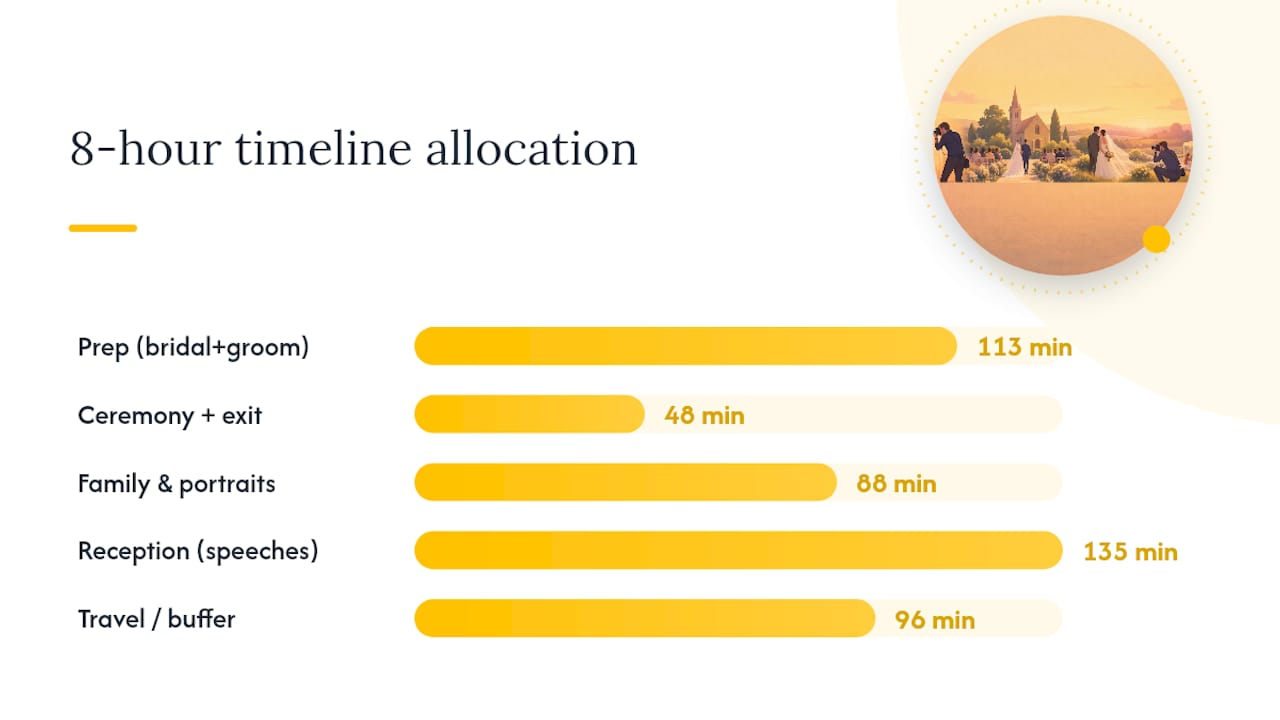
- How much time to allocate for each photography segment
- Practical tips to keep your photography timeline on schedule
- What to tell your photographer before the day
- Registrar and venue rules that shape ceremony photography
- Adapting your template to your actual ceremony time
- Why the “perfect” timeline matters less than the flexible one
- How LemonLens builds your timeline with you
- Sources
- FAQ
Three sample timelines you can copy and adapt
Each template assumes coverage long enough to span a typical ceremony time such as 2pm, 1pm or 4pm. Adjust the clock times but keep the gaps between phases, since they reflect how long each part of the day genuinely takes.
- Morning ceremony (11am start): photographer arrives 8:30am, bridal prep 8:30 to 10:15am, travel and arrivals 10:15 to 11am, ceremony 11 to 11:40am, confetti and mingling 11:40am to 12:15pm, family photos 12:15 to 1pm, couple portraits 1 to 1:45pm, wedding breakfast 1:45 to 3:15pm, speeches 3:15 to 3:45pm, evening reception and first dance from 6pm.
- Midday ceremony (1pm start): photographer arrives 10:30am, bridal prep 10:30am to 12:30pm, ceremony 1 to 1:40pm, family photos 1:40 to 2:20pm, couple portraits 2:20 to 3:10pm, wedding breakfast 3:30 to 5pm, speeches 5 to 5:30pm, golden hour portraits 6:30 to 7pm, first dance 8:30pm.
- Late afternoon ceremony (4pm start): photographer arrives 1pm, prep coverage 1 to 3:15pm, ceremony 4 to 4:40pm, family photos 4:40 to 5:15pm, couple portraits with early golden hour 5:15 to 6pm, wedding breakfast 6:30 to 8pm, speeches during or after the meal, first dance 9pm.
The morning template gives the most flexibility for a relaxed afternoon and evening. The midday version balances portrait time against a full reception, and the late afternoon slot suits couples who want golden hour portraits without a late first dance. In summer, golden hour portraits sit best after the wedding breakfast and speeches, so they don’t collide with the meal.
How much time to allocate for each photography segment
Every wedding day breaks into the same rough phases, though the exact minutes shift depending on your ceremony time, venue distances and family size.
- Bridal prep: 60 to 90 minutes of coverage, more if hair and make-up run in sequence rather than parallel.
- Groom prep: 30 to 45 minutes, often shorter since there’s usually less to document.
- Ceremony: 20 to 40 minutes depending on the format, civil or religious.
- Confetti and exit: 15 to 20 minutes, including guest mingling.
- Family and group photos: 30 to 45 minutes is the standard allowance.
- Couple portraits: 40 to 60 minutes, split between a main session and a shorter golden hour top-up if light allows.
- Speeches and the meal: roughly 90 minutes combined, though this varies with courses and speaker count.
- First dance and evening candids: photographers usually capture the first dance and 30 to 60 minutes of the evening before stepping back.
8 hours of coverage is the industry standard for a full wedding day, and it’s built around those minute ranges rather than an arbitrary round number.
Add extra time when travel separates venues, when the guest list runs large, when you’re doing a first look before the ceremony, or when you want portraits at more than one location; consider how Photography SEO services can help photographers be discovered and booked for shoots like yours. A second photographer becomes worth budgeting for if you want simultaneous coverage of bridal and groom preparation in different places, since one shooter can’t cover both without missing arrival moments.
Practical tips to keep your photography timeline on schedule
Timelines slip for predictable reasons: family members wandering off, suppliers running late, or a couple that didn’t warn their photographer about a change. A few habits prevent most of that.
- Appoint a gatherer: a friend or relative who knows everyone by sight and can round up group photos fast.
- Share a shot list in advance: a prioritised list of must-have shots and a simple group order stops guesswork on the day.
- Feed your photographer: scheduling a break and a meal keeps energy and attention consistent through a long shift.
- Flag delays immediately: logistics, not the photographer, are usually what cuts into portrait time, so tell them as soon as something runs over.
- Move golden hour earlier in winter: sunset before 4pm means portraits need to happen straight after the ceremony rather than after speeches.
- Layer group formations: photograph the biggest group first, then release people in smaller layers rather than reassembling from scratch each time.
Pro Tip: Print two copies of your shot list, one for your gatherer and one for your photographer, so nobody’s relying on memory during the busiest hour of the day.
What to tell your photographer before the day
A workable timeline depends on both sides having the same information well before the wedding.
- Confirm arrival time, number of photographers, expected finish time and any travel buffers between venues.
- Share your must-have shot list and a group names and order list, ideally a month before the wedding.
- Ask about contingency plans for equipment failure, backup shooter arrangements, meal breaks and preview delivery timing.
- Get ceremony behaviour and any registrar or venue restrictions confirmed in writing so nobody’s caught out.
Photographers commonly ask for the finished timeline about a month out and will often schedule a call to check the finer details before the day.
Registrar and venue rules that shape ceremony photography
Civil ceremonies in particular come with restrictions that catch couples out if nobody checks in advance.
- Registrars commonly limit photographer movement and flash use during vows and the signing of the register.
- Some venues require the photographer to stay in one fixed spot for parts of the ceremony rather than moving around freely.
- Confetti and outdoor photo rules vary by venue, so confirm whether photos are permitted immediately outside after the ceremony.
Registrars will sometimes ask photographers to remain seated or in a fixed position during the ceremony, and any close signing shot is often best handled as a mock signing afterwards to avoid disrupting the legal paperwork.
Your photographer must follow whatever direction the registrar or venue gives on the day, so raising these questions beforehand saves an awkward moment mid-ceremony. Couples marrying in a register office setting can find more detail on what to expect in a registry office wedding photographer guide, while a Chelsea Town Hall case study shows how one civil ceremony handled its own timing constraints.
Adapting your template to your actual ceremony time
The three templates above cover most ceremony times, but small tweaks matter once travel, weather or venue quirks enter the picture.
- Morning ceremonies give you the widest margin, so if travel between venues runs long, borrow minutes from the afternoon gap rather than the portrait session.
- Midday ceremonies work best when you want a genuine split between portrait time and reception time, since neither has to be rushed to fit the other.
- Late afternoon ceremonies suit couples who want golden hour built into the main portrait session, but leave less room if the meal or speeches overrun.
Couples wanting longer, unhurried portraits should lean towards a morning ceremony. Those who’d rather maximise reception hours with family and friends tend to do better with a midday start. A decorated hotel wedding in Twickenham shows how a midday timeline played out across multiple spaces on one site.
Why the “perfect” timeline matters less than the flexible one
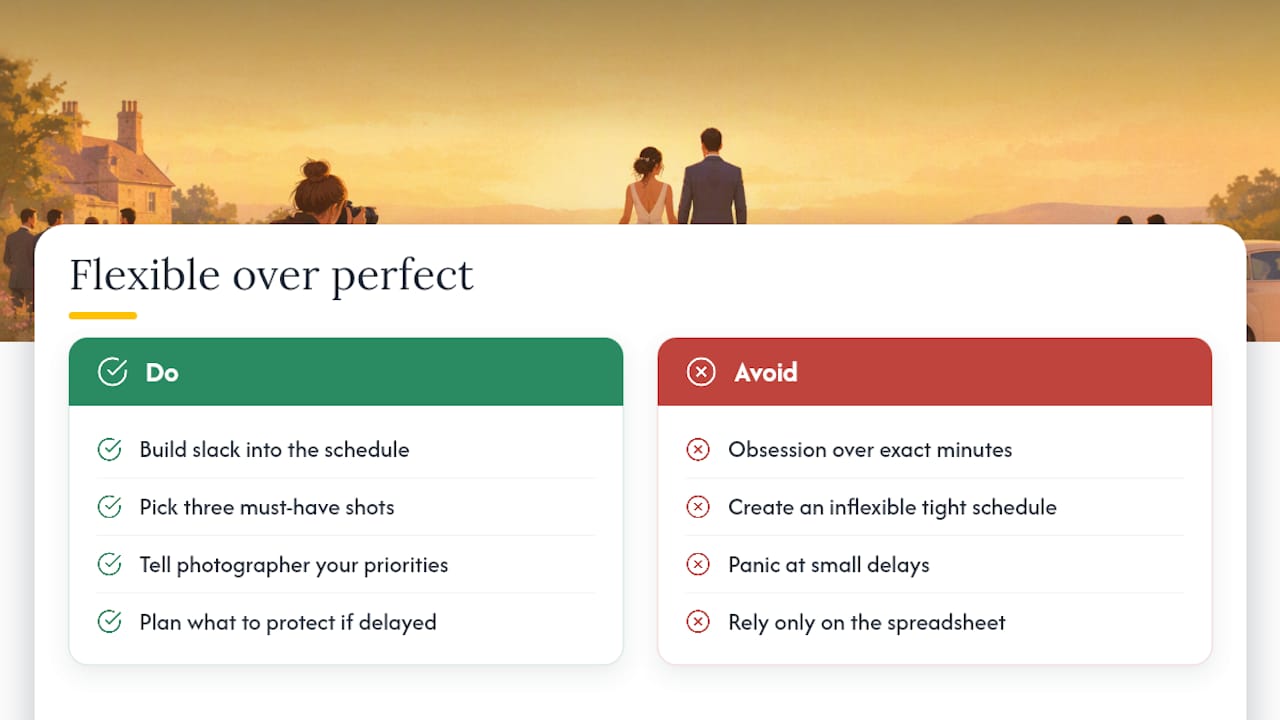
Couples spend hours perfecting a minute-by-minute schedule, then panic the moment it slips by twenty minutes. A timeline’s real value isn’t precision, it’s giving everyone, family, suppliers, the registrar, a shared sense of what happens next. The couples who stay calmest on the day aren’t the ones with the tightest schedule. They’re the ones who built in slack and told their photographer which three shots actually matter if time runs short.
When I review a timeline with a couple, I’m less interested in exact minutes and more interested in priorities: what happens if the ceremony starts fifteen minutes late, and what gets protected regardless. That conversation, not the spreadsheet, is what keeps a wedding day photography plan from falling apart.
— Emmet
How LemonLens builds your timeline with you
LemonLens approaches every wedding the same way: a timeline review call to confirm arrival time, must-have shots and how the day fits together, followed by purpose-led coverage rather than a generic shot list. Packages start at £1,850 with transparent pricing throughout, and previews land with you within 48 hours so the images are still fresh when you want to share them.
- Send your date and a rough timeline draft to start the conversation.
- We’ll schedule a short call to confirm must-have shots and coordinate with your venue or registrar where needed.
- You’ll get your photographer’s contact details shared with your timeline marshal ahead of the day.
If you’re planning a registry office ceremony or a Town Hall wedding, the registry office and Chelsea Town Hall pages show how those timings work in practice. Ready to talk through your date? Get in touch through the weddings page to start your timeline review.
Sources
- The 12 things your wedding photographer wants you to know – Hitched
- Wedding day timeline — Bridebook
- Photographer/Videographer guidance note — Worcestershire County Council
FAQ
What is the 20-60-20 rule in photography?
The 20-60-20 rule isn’t a standard wedding photography timing convention, and definitions of it vary widely online. It’s better to plan around the tested minute ranges in this guide, such as 30 to 45 minutes for group photos, than to rely on an unverified rule.
In what order should wedding photos be taken?
Most wedding days follow the same order: preparation, ceremony, confetti and mingling, family and group photos, couple portraits, then the wedding breakfast and speeches. This sequence lets photographers capture natural moments before the more posed sessions.
Is 2 hours enough time for wedding photos?
Two hours is tight but workable if it covers only the ceremony, family photos and a short couple portrait session, without preparation or evening coverage. For a full day including getting ready and the first dance, eight hours is the industry standard.
What is a typical 8-hour wedding photography timeline?
An eight-hour timeline typically runs from bridal preparation through the ceremony, family and couple portraits, the wedding breakfast and speeches, and into the early evening reception. It’s built around allowances like 30 to 45 minutes for group photos and 40 to 60 minutes for couple portraits, with the exact clock times shifted to match your ceremony start.