
The right queer performance photographer in London depends on what the pictures are for. An artist-led portrait project, a regular cabaret night that needs a house photographer, and a one-off show that needs gallery-ready images by the next morning are three different jobs. Each is best served by a different kind of photographer. Below we compare the main types of option, say what to check with each, and explain where we fit. We are LemonLens, a London photography and videography studio, so we are on the side of the second and third jobs, and we say so plainly.
TL;DR
- London has three broad kinds of queer performance photographer: artists who treat performance as a long-term subject, specialists who cover the scene night after night, and event studios that add speed and a set process.
- Choose by purpose: art and editorial, ongoing documentation, or promotion and press. Then check consent, lighting experience and delivery time.
- For events, we deliver within 48 hours, and our London event photography is priced from £400 to £900 depending on the job.
- Ask every photographer how images of performers are shared, credited and retouched before you book.
- Send a clear brief: running order, venue, the five shots you cannot miss and who approves the final selection.
Table of Contents
- What “queer performance photography” covers
- The three kinds of option in London
- How to compare them: six criteria that matter
- Where LemonLens fits
- A worked example: choosing for three real briefs
- How to brief any photographer
- Questions to ask before you book
- Our perspective
- Book a London queer night or performer shoot with us
- FAQ
- Sources
What “queer performance photography” covers
The phrase sounds like one genre. In practice it covers drag shows, cabaret, club nights, live music, wrestling cabaret, fashion-led raves, book launches with readings, and staged portrait sessions with performers. The light is difficult, the movement is fast, and the subject is often someone whose stage persona and private identity are both part of the story.
That last point separates this work from general event photography. A good photographer here understands that a performer may be out in one setting and not in another. They also know that a name tag, a tagged post or a published face can carry real consequences. The skills are technical (low light, mixed stage colour, shooting through haze), but the judgement is social.
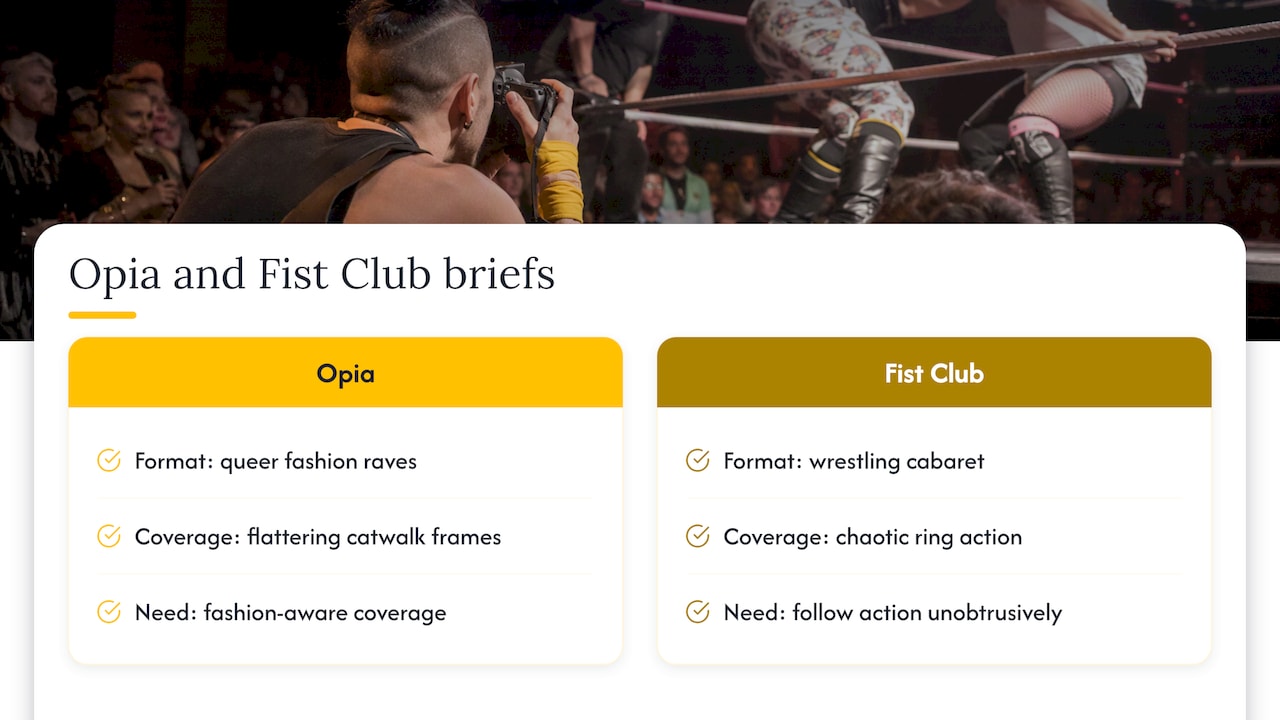
London’s scene is varied enough that the format matters. British Vogue reported in 2024 on Opia’s queer fashion raves, which combine themed nightlife, editorial styling, live catwalks and performance pieces, with the organisers extending the nights into shoots and social content. That is a very different brief from Fist Club, which produces queer women- and trans*-led wrestling cabaret and presents wrestling as drag for everyone. One needs fashion-aware coverage with flattering catwalk frames. The other needs someone who can follow chaotic physical action in a ring without getting in the way.
The three kinds of option in London
| Type | Best for | Typical strengths | What to confirm |
|---|---|---|---|
| Artist-photographers | Editorial projects, books, exhibitions, collaborative portraits | A distinctive, authored visual language | Availability, whether they take commissions, usage rights |
| Scene specialists | Regular club nights, drag collectives, ongoing documentation | Familiarity with performers and venues | Turnaround, how images are credited, retainer terms |
| Event and brand studios | Launches, promotional nights, festivals, sponsored events | Fast delivery, clear quotes, a repeatable process | Experience with your type of night, consent approach |
Artist-photographers
Several London photographers treat queer identity and performance as the centre of their practice rather than as a service line. Holly Revell describes making collaborative portraits with fellow queer people exploring transforming identities. Felix Pilgrim describes his work as exploring portraiture, performance and the queer experience, and his CV states that it is influenced by his background in theatre-making. Vic Lentaigne works as a photographer and film director and was profiled by Vogue among queer photographers to follow.
If you want a body of work that feels like art, a photographer in this group is often the right call. The trade-off is fit: their diaries, commissioning habits and styles are their own, so approach them with a project in mind and a flexible timeline rather than a tight promotional deadline. We would not pretend that a structured event studio produces the same kind of authored work, and we do not try to.
Scene specialists
Some photographers have built their reputation by being in the room, week after week. AbsolutQueer describes itself as photographing the queer performance scene in London and internationally. QueerGarden’s photography page describes work around London parties and drag. Harry Richards Photography describes itself as an award-winning LGBTQ and gay wedding photographer in London with more than 20 years of experience, which shows how long-standing specialists exist across the wider queer photography market, not only on stage.
The advantage of a specialist is trust. Performers recognise them and relax. If you run a recurring night and want the same eyes on it each month, this route makes sense. Check how booking works, because popular photographers may take work by email only or have limited dates.
Event and brand studios
This is where we sit. A studio brings a fixed process: a conversation about purpose, a shoot plan, a named delivery time and a quote you can read before you commit. It suits organisers who need pictures to promote the next date, satisfy a sponsor, fill a press pack or post while the night is still being talked about.
How to compare them: six criteria that matter
1. Purpose fit
Write down one sentence: “These photos are for ___.” A press kit needs clean, well-lit portraits of each act. A social campaign needs energy and crowd shots. A book needs consistent style across hundreds of frames. Photographers excel at different ones, and the sentence tells you who to shortlist.
2. Consent and representation
This is the criterion that separates queer performance work from generic event coverage. Ask:
- Will performers be asked before images are published, and can they opt out of specific frames?
- Are names, pronouns and stage names used as the performer wants?
- Is there a policy for shots taken in changing areas or backstage? (A sound answer is that there are none without explicit agreement.)
- Who can request removal after publication, and how fast does it happen?
Community voices make the same point. Gay Star News reported that the creators of Sublime Society, a queer erotic performance art night, stress moving beyond the male gaze in cabaret and favour intimate, artistic, femme-focused experiences. If your night has a stated ethos like that, your photographer needs to work inside it, which means a briefing conversation before the doors open.
3. Low-light and stage craft
Ask to see full, unedited sequences from a show in a dark room, not only a highlight reel. You are looking for sharp faces under coloured light, usable frames in haze, and the ability to catch peak moments such as a reveal, a lip-sync drop or a catwalk turn.
4. Delivery time
Performance content loses value quickly. A set of images two weeks later rarely helps promote a night that has already happened. We deliver event photographs within 48 hours. Whoever you choose, get the number of days in writing and ask whether a small “first selects” batch comes sooner.
5. Price clarity
Get a quote that states hours of coverage, number of edited images and usage rights. Be wary of any quote that cannot say what is included. Our published pricing for London event photography runs from £400 to £900 depending on the scope of the event.
6. Where they will work
London venues vary from a railway-arch club to a theatre bar to a gallery. Ask whether the photographer has shot in rooms like yours, and whether they travel across boroughs. We cover Greater London, including Hackney, Lambeth, Camden, Islington, Lewisham and further out.
Where LemonLens fits
We are not an artist-photographer, and we are not a one-person scene diarist. We are a London studio that treats every booking as a brief with a purpose. Before a shoot, we ask what the images need to achieve: sell tickets, thank sponsors, document a premiere or make a performer feel seen. Then we plan the coverage around that answer.
For queer nights specifically, we have written about how we approach them on our LGBTQ event photographer page. If you want to see how it plays out, our case pages cover a community night in Peckham, a themed night in Vauxhall and a night at The Distillery in East London.
What you get
- A short conversation about purpose and the shots you cannot miss
- Directed, comfortable sessions for portraits of performers, in a studio or on location
- Event photographs delivered within 48 hours
- A transparent quote before you confirm
What it costs
Our London event photography is priced from £400 to £900. For larger or multi-act productions run as corporate or sponsored events, the corporate events page lists a half-day from £350, a day rate from £650 and a two-day conference from £1100. If you want to pair stills with moving image, we also offer event videography; there is no published price for it, so ask us for a quote.
For performers who want their own portraits, such as a press shot or a promo set, we offer portrait sessions: The Solo is £200, The Brand is £500, and The Team starts from £795. Prices on our site were read on 22 September 2026, so confirm the current figures when you enquire.
A worked example: choosing for three real briefs
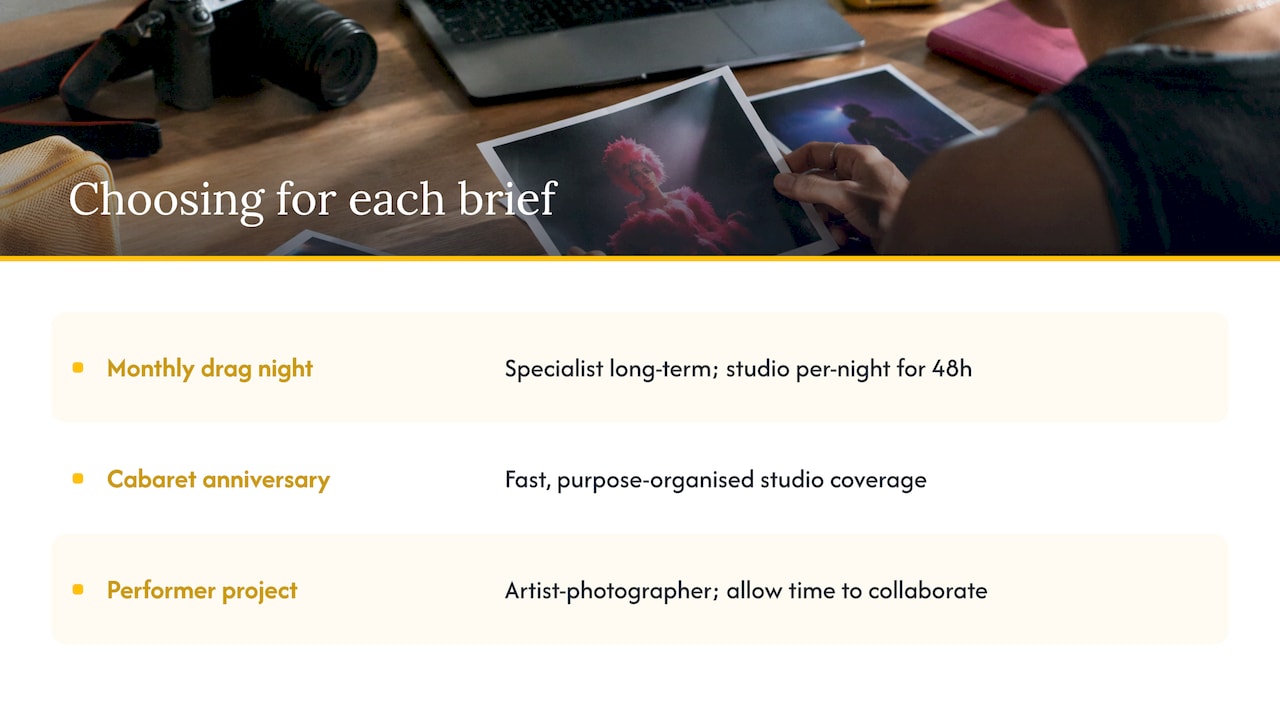
A monthly drag night in a pub function room. You need a consistent face for the night, quick social posts and a few strong images for a poster. A scene specialist is a natural fit for the long haul. If you only need a handful of dates, or want images ready within 48 hours of each one, an event studio on a per-night basis is simpler to budget.
A one-off cabaret anniversary with sponsors. The sponsors want proof of the night, and the performers want flattering stills. This is a promotional job with several audiences, so a studio that delivers fast and organises coverage by purpose works well. Agree who approves the final selection before the event.
A performer’s own project, such as a zine or exhibition. Begin with the artist-photographers, whose authored style is the point. Be prepared to wait, and to collaborate on concept.
How to brief any photographer
A good brief saves hours on the night and money afterwards.
- State the purpose in one sentence and say who will see the images.
- Share the running order with set times, so the photographer is at the stage for the moments that matter.
- List the must-have shots: headliner, group photo, sponsor banner, a particular costume reveal.
- Flag sensitivities: performers who do not want to be photographed, who use stage names only, or who have a no-faces policy for certain content.
- Describe the room: stage height, light colours, whether flash is acceptable to the performers and audience.
- Agree the delivery date, format and credit line in writing, and decide who gets to approve the final selection.
Studio-style community initiatives also stress consent and respect for personal space as the basis of fair creative exchange, as Studio101’s Camera Club listing in London shows. Treat the same principles as your baseline for any shoot, however informal.
Questions to ask before you book
- Have you photographed this kind of night, and can I see a full sequence?
- How do you handle consent for performers and audience members?
- When will I have the images, and in what form?
- What does the price include in hours, edited images and usage?
- How are performers credited, and how can they ask for a picture to be removed?
- Do you work with our venue’s lighting or bring your own?
The answers tell you more than any portfolio. A photographer who answers quickly and specifically will usually be calm and prepared in the room as well.
Our perspective
We believe a performance photograph should do a job. Sometimes that job is to sell the next ticket, sometimes to give a performer a portrait they are proud to use for years, and sometimes simply to record a night that will not happen twice. Pretty is not enough if the picture does not serve the person in it.
That is why every booking with us starts with purpose, and why we direct sessions so people feel comfortable in front of the camera. With performers, comfort is not a nicety. It is what lets someone drop their guard on a stage, in a dressing room doorway or against a studio backdrop, and it shows in the frame.
We also think speed is part of respect. A night’s energy lasts a few days online. Delivering event images within 48 hours means the images arrive while people are still talking about the night, and while the performers are still proud of it.
And we think you should know the price before you commit. Clear quotes and package pricing remove the awkward part of hiring, so you can focus on the night itself.
Emmet
Book a London queer night or performer shoot with us
If your brief is an event, a performer portrait set or a promotional night, start with our London event photography page for scope and prices, or read how we work on our guide to hiring a queer photographer in London. Send us the date, venue and purpose, and we will come back with a clear quote. You can also browse our galleries first.
FAQ
How much does a queer performance photographer cost in London?
Rates vary with the photographer, the hours and the usage you need, so ask each for a written quote. Our London event photography is priced from £400 to £900, and a corporate half-day starts from £350. Our site prices were read on 22 September 2026, so confirm current figures when you enquire.
How fast should I expect the photos?
For promotional use, aim for a few days at most. We deliver event photographs within 48 hours. With any photographer, agree the delivery date in writing and ask whether a small first batch can come sooner.
Should I pick a specialist or an event studio?
Choose by purpose. A specialist suits long-running documentation and authored, artistic work. An event studio suits promotional nights, sponsors and tight deadlines, where a fixed process and a clear quote help. Many organisers use both for different projects.
How do I protect performers’ privacy and consent?
Tell the photographer in advance who must not be photographed and who uses stage names only. Agree how images are credited and how a performer can ask for removal. Confirm that no backstage or changing-area pictures are taken without explicit agreement.
Can you cover video as well as photos?
Yes. We offer videography and event videography alongside photography. There is no published price for either, so send us your brief and we will quote for it.
Sources
- British Vogue: I Went To London’s Only Queer Fashion Rave
- Fist Club: The Big One, about
- Gay Star News: Sublime Society, Queer Erotic Performance Art In London
- Studio101 Camera Club listing