The best LGBTQ+ brand photographer in London is the one whose work fits your brief, whose way of directing people makes your subjects comfortable, and whose terms are clear before you pay a deposit. Lived experience of the community matters. It does not replace a portfolio of real commercial work and a clean process. Below, we compare the main routes open to you, including ours, and give you the questions that separate a good fit from a risky one.
TL;DR
- You have four realistic routes: a queer photographer directory, an independent queer photographer, a general commercial studio with queer-event experience, and an agency-style team. Each suits a different brief.
- Write the purpose of the shoot before you look at portfolios. It makes every comparison easier.
- Ask about consent, image usage, access needs and delivery time up front, in writing.
- LemonLens publishes its prices: brand portraits from £200 to from £795, events £400 to £900, and 48-hour delivery for events.
- Shortlist two or three photographers and ask each for a short call before deciding.
Table of Contents
- What a brand shoot for an LGBTQ+ audience needs
- Define the brief before you compare photographers
- Your options in London, compared
- How to judge whether a photographer is inclusive in practice
- What brand photography costs in London
- How booking, planning and delivery usually work
- How LemonLens approaches LGBTQ+ brand work
- Perspective: purpose first, then the picture
- Ready to brief a shoot
- A simple way to decide
- FAQ
- Sources
What a brand shoot for an LGBTQ+ audience needs
A brand shoot is not a portrait session with a logo behind it. It is a set of images that must do a job: sell a product, introduce a founder, fill a campaign, or show a community event honestly enough that the people in it recognise themselves.
For LGBTQ+ audiences that last point carries weight. Readers spot tokenism quickly. Stock-style images of smiling groups with a rainbow flag in shot can read as a Pride-month afterthought. The stronger work shows specific people, in specific places, doing real things, and treats them as the subject rather than as a symbol.
That shapes what you should look for:
- Direction without stiffness. Many people in a brand shoot are not models. Some have had bad experiences in front of a camera, especially around being misgendered or posed in ways that feel wrong. A photographer who directs gently and asks how people want to be shown gets better frames.
- Commercial discipline. Shot lists, usage rights, deadlines, retouching limits and file formats all matter. A beautiful portfolio does not guarantee that the work arrives on time.
- Context knowledge. Knowing the difference between photographing a Pride march, a club night, a founder headshot and a product campaign is part of the craft.
Define the brief before you compare photographers
The most useful step costs nothing. Creative Review’s guidance on commissioning photography advises pinning down the idea and what the images need to communicate before looking at portfolios, then thinking about boundaries, possible aesthetics and a solid mood board. IBM’s Emily Keegin makes the same argument there: clarity about the message comes first, the photographer second.
In practice, write down five things:
- The job of the images. Website hero, social content, a press kit, a recruitment campaign, event recap.
- Who appears in them. Founders, staff, customers, performers, models, and whether they are comfortable being identifiable.
- Where they will be used and for how long. Organic social only, paid ads, print, out-of-home.
- The look. Documentary and candid, polished studio, editorial, nightlife.
- The deadline and the budget range.
If your campaign message is still fuzzy, it helps to settle it first. This piece on event branding guidelines and the checks organisers can tie to ROI is a practical way to define what your visuals must communicate, and what a photographer’s portfolio should demonstrate, before you brief anyone.
Your options in London, compared
London has a deep pool of photographers who work with queer clients. They sit in a few distinct groups, and the right one depends on the kind of project. We have named examples where they help you search. We have not linked to any of them, and the descriptions are general: check each photographer’s own site for current work and terms.
| Route | Best for | Strengths | Watch for |
|---|---|---|---|
| Queer photographer directory (for example queer.photo) | Smaller briefs where you want matched options quickly | Lists LGBTQ+ photographers working in London, with portfolios and rates shown; says it matches within 24 hours | You are choosing from profiles, so brief and contract detail still rests with you and the individual |
| Independent queer photographer (for example Bex Wade, Kai Fiáin) | Editorial, documentary or art-led work with a strong personal voice | Distinct visual style and deep community roots; Bex Wade, for instance, is a London-based trans non-binary photographer whose work documents queer life, Pride and protest | Availability can be tight, and some practices lean towards film, exhibition or art rather than turnkey commercial packages; rates are often by enquiry |
| Wedding and portrait specialists who serve LGBTQ+ clients (for example Barbara K Photography, FilmFolk) | Same-sex weddings and couple portraits | Clear packages and experience of LGBTQ+ weddings | Not designed for brand campaigns or multi-person corporate shoots |
| Commercial studio with queer-event and brand experience (LemonLens) | Brand portraits, team shoots, community events, event videography | Published prices, a purpose-first process and fast delivery | Not a fine-art or exhibition practice; best when you have a commercial goal |
Two things stand out from comparing these. First, price transparency is uneven. Many independent practices state rates only on request, so an apples-to-apples comparison means asking each one for the same quote based on the same written brief. Second, “LGBTQ+ photographer” can describe the photographer, the clientele or the subject matter. Those are three different things, so ask which one you are getting and whether it matters to your project.
Directories and platforms
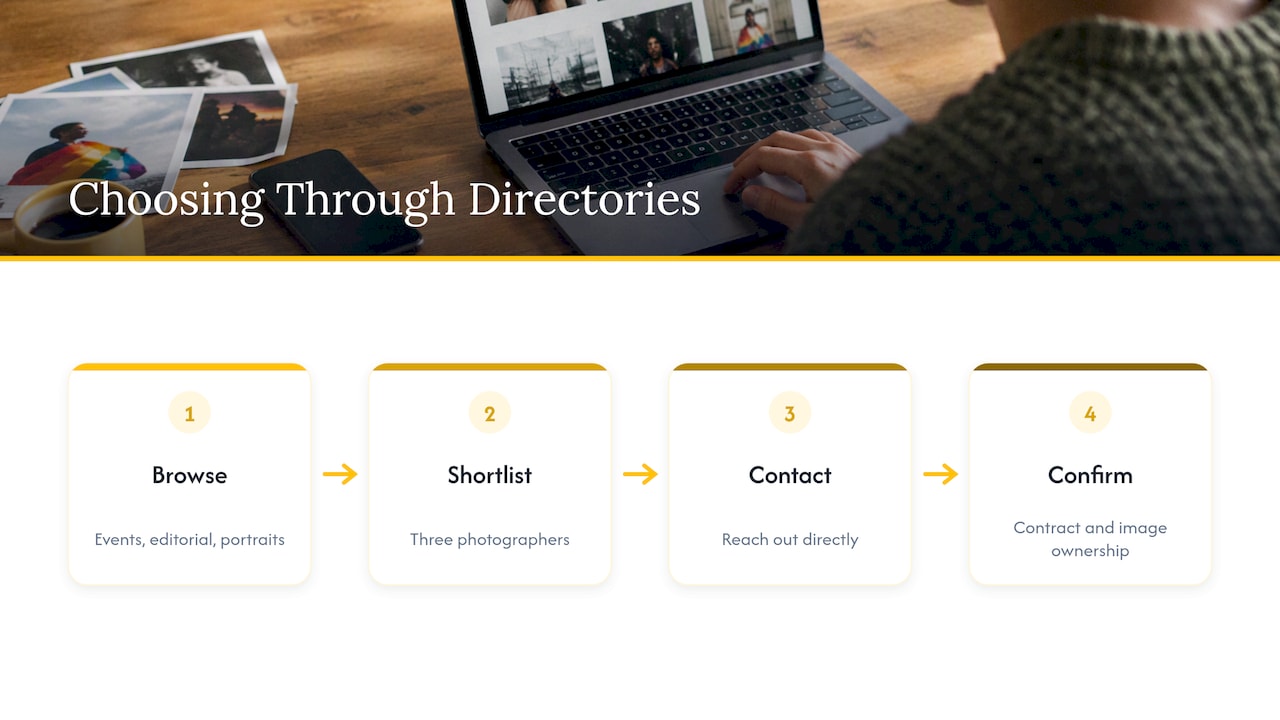
A directory suits you when time is short or you do not yet know who works in your area. Browse portfolios by category (events, editorial, portraits), shortlist three and contact them directly. Confirm who holds the contract and who owns the images if the platform sits in between.
Independent queer photographers
If your brief is about identity, visibility or protest, an independent with a documentary or art background may give you something no studio can. Kai Fiáin’s practice, for example, spans photography, moving image and exhibition work, and Bex Wade’s focus is queer and trans communities. These are strong choices for editorial and campaign work with a point of view. Ask early about turnaround, usage rights and how many revisions or selects are included, because artist-led practices vary a lot here.
Studios built for commercial turnaround
If you need images by a fixed date, for a team, an event or a product launch, a commercial studio brings structure: shot lists, a booking process, and delivery times you can plan around. That is where we sit.
How to judge whether a photographer is inclusive in practice
A rainbow in a bio proves little. Look at behaviour and paperwork.
Business Disability Forum’s 2023 guidance on inclusive imagery is written about disability, but its commissioning checklist applies to any inclusive shoot. It recommends asking about access requirements in advance, briefing everyone clearly, creating realistic representation, getting clear model releases, and specifying how images will be stored, used and for how long.
Turn that into questions you can ask any photographer:
- How do you brief the people being photographed before the day?
- What do you do if someone is uncomfortable with a pose, a location or a shot?
- Do you ask for names and pronouns, and how are people credited?
- What are your access arrangements for the studio or location?
- Who signs model releases, and what do they cover?
- Where are the files stored, and for how long can you reuse the images in your own portfolio?
A good photographer answers these without defensiveness. If someone is vague about usage rights or consent, treat that as a serious warning sign, particularly if your subjects are not out in every part of their lives.
What brand photography costs in London
Prices differ widely by scope, licence, usage and how many people appear. Rather than quote other businesses’ rates, here is how ours work, as published on our site, so you have one concrete reference point.
| Service | Published price |
|---|---|
| The Solo (portrait session) | £200 |
| The Brand | £500 |
| The Team | from £795 |
| London event photography | £400 to £900 |
| Corporate Half-Day | from £350 |
| Corporate Event Day Rate | from £650 per day |
| Two-Day Conference | from £1,100 |
| Weddings | from £1,850 |
Videography, business photography and event videography are quoted to the brief, so there is no fixed price for them. Whichever photographer you choose, ask for a written quote that lists hours, number of people, number of edited images, delivery time and usage rights. If any of those lines are missing, the quote is not comparable with the others.
How booking, planning and delivery usually work
Process matters as much as portfolio, and it is where commercial shoots most often go wrong. Before you enquire, have these ready:
- Your written brief from the section above.
- Dates and location, including any flexibility.
- Number of people and whether anyone has access, privacy or consent needs.
- Where the images will appear. This sets the licence.
- Your delivery deadline, working backwards from the launch or event date.
Then confirm with the photographer:
- the quote, deposit and what happens if the date moves;
- who attends a planning call, and whether there is a shot list;
- the delivery window and the format of files (web-sized, high-resolution, colour-corrected);
- how many edited images are included;
- whether videography or a second shooter is needed.
On delivery, we turn around event photos within 48 hours, because social posts and press coverage lose value fast. Ask every photographer on your shortlist for their equivalent figure, and what a rush option costs.
How LemonLens approaches LGBTQ+ brand work
We are a London photography and videography studio covering portraits, weddings, events and brand content. Every booking starts with one question: what are these images for? Because the answer shapes the shot list, the direction and the edit, the pictures can do a job rather than just look good.
For LGBTQ+ clients and audiences, that includes work you can look at on our own pages: LGBTQ event photography in London, a queer community night in Peckham, and LGBTQ event videography for The Hive. If your project involves gender-affirming portraits, our guide on choosing gender-affirming photography in London explains what to ask. For couples, there is a same-sex wedding shot list.
Founders and creatives who need a library of on-brand content from one session can look at our personal branding photography, and teams can see how corporate photography for internal business imagery works.
Perspective: purpose first, then the picture
We think most disappointing brand shoots fail before anyone picks up a camera. The brief says “authentic” and “diverse” but not what the images are meant to make a customer, a donor or a colleague do. Then the shoot becomes a search for pretty frames, and the usable set is smaller than it should be.
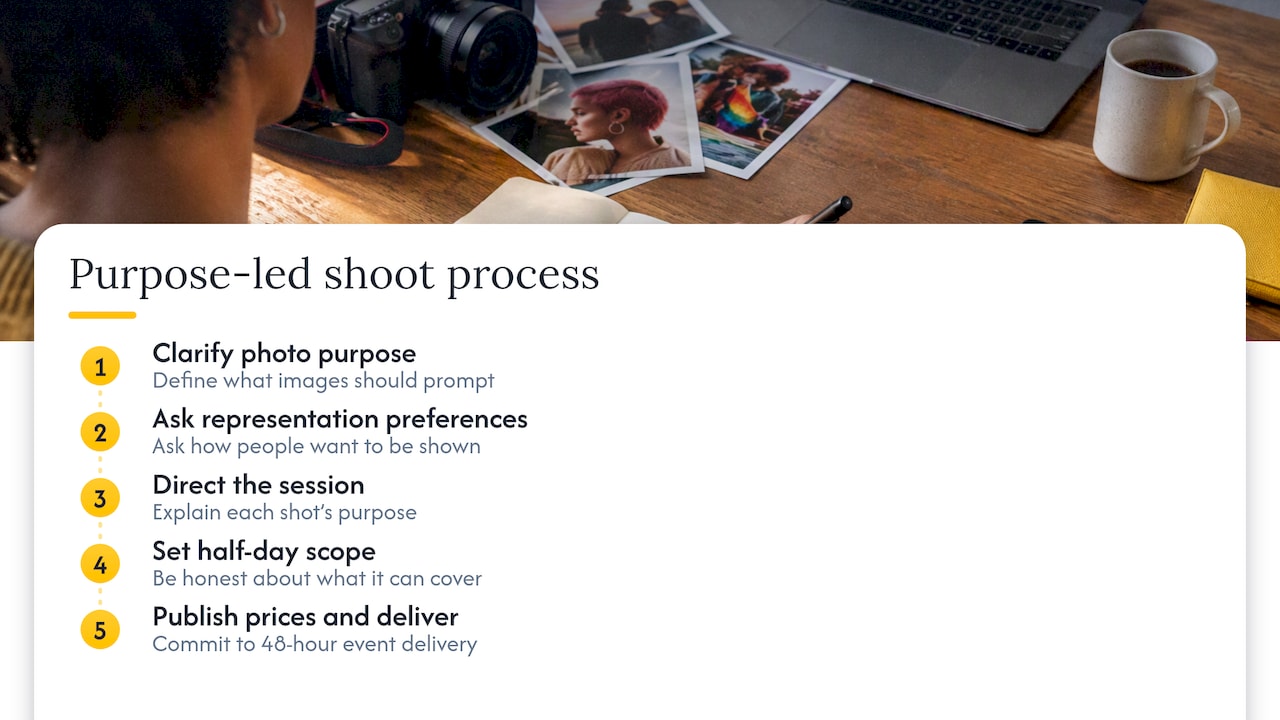
For queer and trans subjects the stakes are higher. People notice when they are being used as decoration. So we start every booking by clarifying the purpose of the photos, then we direct the session fully, so nobody is left to guess where to stand or how to look. We ask how people want to be shown, we explain what each shot is for, and we are honest about what a half-day can and cannot cover.
We also believe images have a shelf life. A launch photo that arrives three weeks late has lost much of its value. That is why we publish prices and commit to 48-hour delivery for events. You should be able to compare us with any other photographer on equal terms, and we are happy to be compared.
— Emmet
Ready to brief a shoot
If your project is a founder portrait, a team set, a community event or a brand campaign, start with our portrait packages, or our London event photography for nights and launches. For multi-day or corporate programmes, see our corporate event rates. Send us your written brief and we will reply with a clear quote. You can also start from LemonLens and tell us the purpose of the shoot.
A simple way to decide
Score each shortlisted photographer from 1 to 5 on these criteria, and weigh them to suit your brief:
- Portfolio fit: does the work look like what you need, with comparable subjects and settings?
- Direction and comfort: how do they describe working with non-professional subjects?
- Commercial clarity: quote, licence, delivery time and revisions in writing.
- Community understanding: do they know the context of the event or audience you serve?
- Availability: can they actually shoot when you need them?
A 20-minute call usually settles the last two. If a photographer is hard to reach before you have paid anything, expect the same afterwards.
FAQ
Does my brand photographer need to be LGBTQ+ themselves?
Not necessarily, and it depends on the project. For work centred on identity or protest, a photographer with lived experience may bring access and trust that is hard to replicate. For product, team or event work, what matters most is respectful direction, clear consent and a track record with comparable shoots.
How much should I budget for LGBTQ+ brand photography in London?
It varies with scope, people and licence, so get the same written brief quoted by two or three photographers. For reference, our published prices run from £200 for a solo portrait and £500 for The Brand, to from £795 for The Team, with events at £400 to £900.
How quickly can I get the photos back?
It depends on the photographer and the size of the shoot, so ask for a delivery window in writing. For events we deliver within 48 hours, which suits press, social and sponsor reporting.
What should I put in a brief?
State the purpose of the images, who appears in them, where and for how long they will be used, the look you want and your deadline. Creative Review’s commissioning guidance also recommends a mood board so the photographer sees your references before the shoot.
Sources
- How to commission great photography, Creative Review
- How to select and use disability-inclusive imagery, Business Disability Forum
- Event Branding Guidelines: Six Checks Organizers Can Tie to ROI