A brand story video is a short film that makes your customer the hero, not your product, and uses a clear transformation arc to build emotional connection. That connection is what drives measurable engagement: narrative-driven content consistently outperforms straightforward product pitches on both attention and purchase intent. The rest of this guide shows you real examples worth stealing ideas from, then walks through exactly how to plan, shoot, and distribute one.
TL;DR:
- Effective brand story videos focus on authentic, relatable protagonists and showcase a clear transformation to build emotional connection.
- Most successful formats highlight founder stories, customer testimonials, employee culture, or product use within real-life contexts, rather than polished pitches.
- To produce a compelling video, prioritize discovery, permission, and purpose-led planning, with careful attention to audio quality and editing that emphasizes storytelling.
- Distribution should be platform-specific, with shorter, attention-grabbing cuts for social media and longer versions for websites or YouTube, measured by engagement metrics like view duration.
- Costs vary by scope, locations, and revisions, but clear pre-production, rights clearance, and scoped deliverables help prevent budget leaks and project delays.
Table of Contents
- 12 Brand Story Video Examples Worth Studying
- What Makes a Brand Story Video Effective?
- How Do You Produce a Brand Story Video From Scratch?
- Which Storytelling Frameworks Actually Improve a Script?
- Where Should You Publish It and What Should You Measure?
- Common Brand Story Video Mistakes to Avoid
- How LemonLens Applies This Process in Practice
- Budget Planning and Cost Estimation for Brand Story Videos
- How Long Does It Take From Concept to Finished Video?
- An Editor’s Take on Authenticity Versus Polish
- Want a Brand Story Video Without Managing the Whole Process Yourself?
- Sources
- FAQ
12 Brand Story Video Examples Worth Studying
You learn more from watching ten good videos closely than from reading a hundred tips about theory. Below are formats worth studying, grouped by the job each one does, with a takeaway you can actually lift for your next shoot.
Founder origin stories work when the founder’s personal stakes explain the product’s reason for existing. The best ones resist the urge to turn into a résumé. A founder talking about the problem that kept them up at night, filmed in the actual garage or kitchen where the idea started, beats a polished boardroom interview every time. Takeaway: shoot founders in the real location tied to their story, not a rented studio.
Customer testimonial films succeed or fail based on one thing: whether the customer sounds like themselves or sounds coached. The strongest examples let the subject stumble slightly, laugh at their own answer, or pause before the honest line. That imperfection reads as trust. Takeaway: never hand a testimonial subject a script. Ask open questions and let silence do some of the work.
Mission-driven films for causes or sustainability brands tend to over-rely on sweeping drone shots and swelling music. The ones that land instead show one specific person affected by the mission, in close, unglamorous detail. Takeaway: trade the wide establishing shot for a five-second close-up of hands doing the actual work.
Employee and culture stories are the most commonly underused format. Companies default to customer stories and skip the people who build the product, even though employee-led films often carry more credibility because there’s no expectation of a sales pitch. Takeaway: interview someone two or three levels below leadership. Their answers tend to be more specific and more believable.
Product-in-context films show the product doing its job inside someone’s actual life rather than on a white background. Takeaway: film the product being used badly or urgently at least once. That messiness sells harder than a clean demo shot.
Here’s a quick reference for which format fits which goal:
- Founder origin — best for early-stage brands needing to explain “why we exist.”
- Customer testimonial — best for building trust ahead of a purchase decision.
- Mission or values film — best for brands competing on ethics or sustainability.
- Employee story — best for recruiting and internal culture reinforcement.
- Product-in-context — best for demonstrating utility without a hard sell.
- Event recap with narrative — best for extending the life of a single event into ongoing content.
If you want to see this applied rather than described, LemonLens’s testimonial video for a hospitality client follows the customer-as-hero pattern almost exactly: a specific person, a specific frustration, a specific fix, told without a single line of scripted dialogue.
What Makes a Brand Story Video Effective?
Every brand story video that actually moves an audience shares the same structural bones, even when the tone, industry, and budget differ wildly. Strip away the polish and you’ll find the same four elements underneath.
- A protagonist the audience recognizes. The hero should almost always be a customer, employee, or founder, not the product. Viewers connect with people, and positioning the customer as hero while the brand plays guide is the single most reliable narrative shortcut in commercial storytelling.
- A visible transformation. Something has to change from beginning to end, whether it’s a business that was struggling and now thrives, or a person who felt one way and now feels another. Academic work on narrative transportation shows that viewers who get pulled into a linear plot form stronger brand attachment than those watching a loosely assembled highlight reel.
- Social proof without a hard sell. The brand’s presence should feel like context, not commentary. A logo on a laptop sticker in the background does more work than a voiceover reciting the company mission statement.
- Authentic audio and unhurried pacing. Clean, directional sound on dialogue and a willingness to let a pause breathe on screen both read as production value, often more than expensive camera gear does.
Research on narrative advertising backs this up directly: ads built around a story consistently outperform ads built purely around a feeling or mood, particularly on measures of viewer involvement and lasting brand attachment. The takeaway isn’t “add more emotion.” It’s “add more plot.”
How Do You Produce a Brand Story Video From Scratch?
A brand story video lives or dies in pre-production, long before anyone presses record. Here’s the roadmap that keeps a shoot from turning into an expensive guessing game.
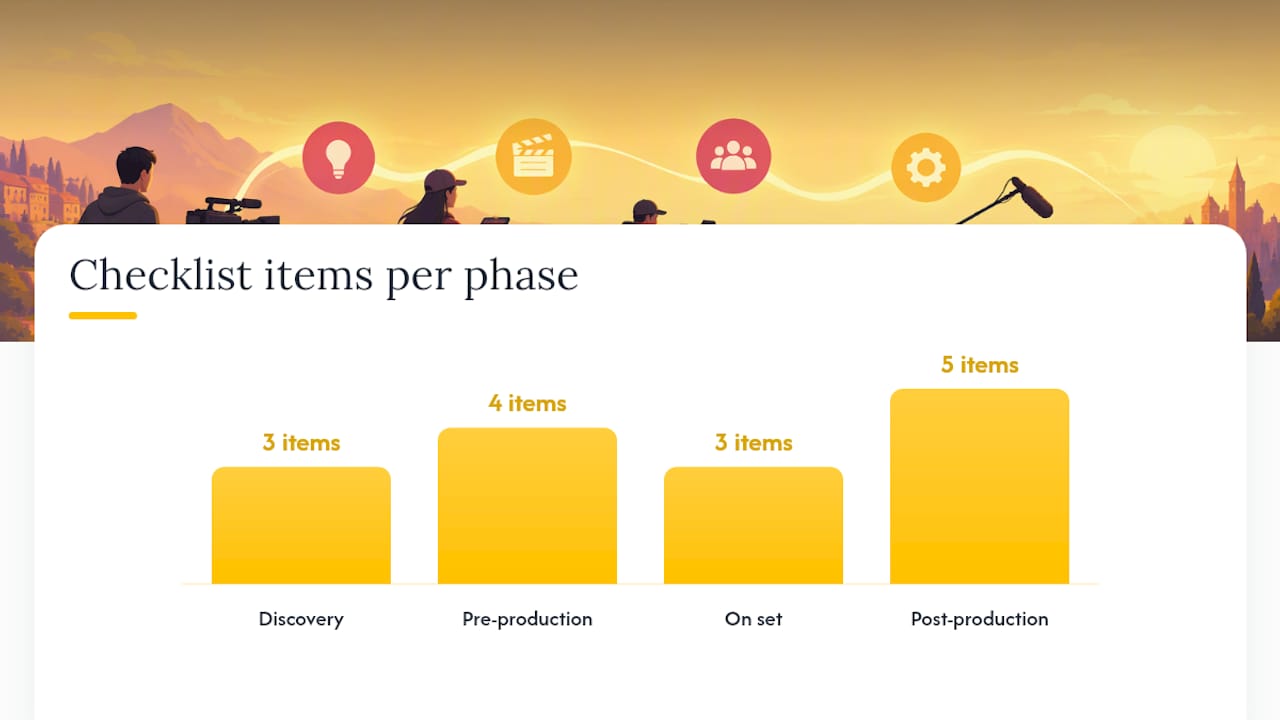
Discovery. Before you book a single crew member, answer three questions in writing: what is this video supposed to achieve, who is it for, and what single measurable outcome will tell you it worked. Then write your core narrative in one paragraph. If you can’t summarize the story in five sentences, you’re not ready to shoot yet. HBS Online’s framework for building a brand story is a useful gut check at this stage.
Pre-production. This is where most budgets quietly leak. Build your interview questions in advance, but keep them open-ended rather than yes/no. Confirm location permissions early, especially for public or commercial spaces in London where access can take weeks to clear. Get signed consent and release forms from every person on camera, and check whether any music you’re considering needs a sync license.
- Interview questions written and shared with subjects beforehand (but not scripted answers)
- Location permissions and any required insurance confirmed in writing
- Consent and release forms signed before the shoot day, not after
- Music licensing or original composition arranged ahead of the edit
On set. Prioritize audio over almost everything else. A lavalier or shotgun mic close to the subject matters more than a second camera angle. Build a B-roll shot list specifically designed to visually prove the transformation you’re claiming, not just pretty coverage of the office. Frame interview subjects slightly off-center rather than dead-on; it reads as more natural and less like a deposition.
Pro Tip: The fastest way to make a low-budget shoot look expensive is clean audio and an early cut to the subject’s face at the emotional beat. Skip the wide establishing shot and go straight to the reaction.
Post-production. Edit for story first, then polish. Cut ruthlessly toward the transformation arc rather than including every good line just because it’s good. Add music that supports pacing rather than dominating it, and always caption for sound-off viewing, since a huge share of social video gets watched muted.
Your final deliverables checklist should include a master edit, platform-specific cutdowns, burned-in and file-based captions, a folder of usage-rights documentation, and any raw assets the client might reuse later. Missing that last item is one of the most common reasons brands end up reshooting content they already paid for once.
Which Storytelling Frameworks Actually Improve a Script?
Three frameworks show up again and again in effective brand films, and each solves a different scripting problem.
The transformation arc is the backbone: status quo, disruption, struggle, resolution, proof. A beat sheet might look like this: “Business struggling with manual bookings → owner discovers a new system → early frustration adapting to it → confidence and results after three months → owner shows the current, smoother version of their day.” That five-beat shape works whether your subject is a small business owner or a marathon runner.
Customer-as-hero flips the usual instinct to feature the brand prominently. Instead, the brand becomes the guide who hands the hero a tool, and the camera stays locked on the customer’s problem and progress. In practice, this means fewer shots of your logo and more shots of your customer’s face mid-realization.
The 3-7-27 rule is a useful sanity check for run time rather than a rigid law. It suggests three seconds to hook attention before a viewer scrolls away, roughly seven seconds to establish what the video is actually about, and about 27 seconds as a natural length for a fully realized short-form story. Longer brand films can absolutely work, but if your video can’t earn attention in the first three seconds, the other two minutes won’t matter.
- Use a recurring visual motif (a color, an object, a location) to signal the story’s theme without narration.
- Let sound design carry emotional weight during silent B-roll instead of defaulting to a music swell.
- Resist voiceover exposition when a well-framed shot can say the same thing.
Where Should You Publish It and What Should You Measure?
Platform choice should follow the video’s job, not the other way around. A single master edit rarely performs well everywhere unmodified.
- Website hero placement calls for a longer, unhurried cut, since visitors there have already chosen to engage.
- YouTube supports the full-length version, often two to four minutes, where viewers expect a complete narrative arc.
- LinkedIn rewards a tighter, more professional cutdown focused on outcomes and credibility rather than emotional buildup.
- Reels and TikTok need a version built entirely around the first three seconds, since scroll-away happens almost instantly.
For measurement, track view-through rate and average view duration as your core engagement signals, alongside a genuine engagement rate rather than raw view counts, which are easy to inflate and hard to act on. If the goal is awareness, weight your KPIs toward reach and view duration. If the goal is conversion, track assisted conversions and landing-page behavior after a video view rather than the video metrics alone.
The Wistia State of Video report is a useful annual benchmark for how viewing behavior and format preference shift, and it’s worth checking before locking in your distribution plan rather than after.
Common Brand Story Video Mistakes to Avoid
Most weak brand videos fail for the same handful of avoidable reasons, not from lack of budget.
- No clear narrative spine, just a sequence of nice-looking clips loosely connected by music.
- Choosing the wrong interview subject, usually a senior leader instead of the person closest to the actual transformation.
- Skipping captions, which cuts off a huge share of social viewers who watch muted by default.
- Poor or inconsistent audio, which reads as unprofessional faster than any visual flaw.
- Never planning cutdowns in advance, forcing an expensive re-edit later for each platform.
- Skipping rights clearance for music, footage, or talent, which can block you from reusing the video at all.
One operational habit fixes most of that last point: clear music and talent rights before post-production starts, not after the edit is locked. And on ownership specifically, UK copyright guidance is blunt about a common misconception: paying for a video doesn’t automatically transfer copyright to you. You need a written assignment or license, or the person who filmed it may technically still own it.
How LemonLens Applies This Process in Practice
The workflow above isn’t theoretical. It’s the same one LemonLens runs on paid projects, adjusted for budget and timeline.
- A hospitality client needed proof that a new point-of-sale system actually solved a real operational headache. The resulting testimonial video leaned entirely on the owner’s own words and before/after framing rather than a scripted pitch.
- A creative short film project in Brighton used narrative techniques closer to independent filmmaking than corporate video, proving the same transformation-arc structure works outside a typical “business testimonial” mold.
- Studio-based brand content shoots follow the same discovery-first approach: clarify the goal before a single light gets set up.
Every project runs on the same operational backbone: purpose-led framing from the first conversation, with rapid delivery so footage remains relevant when used.
Budget Planning and Cost Estimation for Brand Story Videos
Costs for a brand story video vary enormously based on crew size, shoot days, and post-production complexity, but the biggest cost driver isn’t equipment. It’s time: how many locations, how many interview subjects, and how many rounds of revision you’re planning for.
A single-location, one-subject interview film with a half-day shoot and a straightforward edit sits at the lean end of the spectrum. Add multiple locations, a two-camera setup, custom music, or a same-day turnaround requirement, and costs climb quickly, since those all demand more crew hours and more post-production time.
Budget for these line items separately rather than as one lump sum: pre-production and scripting time, crew and equipment for the shoot day itself, music licensing or original composition, editing and revision rounds, and platform-specific cutdowns. That last item gets skipped most often, and it’s usually the reason a client comes back six weeks later needing an unplanned second invoice.
If your goal is a single strong asset for your website and one social cutdown, ask for a quote scoped exactly to that, rather than a broad “brand video” quote that assumes more deliverables than you actually need. LemonLens’s portrait and brand session packages show what transparent, scoped pricing looks like in practice, starting from £200 for a solo session up to £500 for a brand-focused shoot. Video pricing works the same way: scoped to what you’re actually asking for, not a flat industry rate.
How Long Does It Take From Concept to Finished Video?
A straightforward brand story video, one location, one or two subjects, typically runs four to six weeks from first conversation to final delivery. Complex projects with multiple locations or subjects can stretch to eight or ten weeks, mostly due to scheduling logistics rather than production time itself.
Here’s roughly how that time breaks down. Discovery and scripting take one to two weeks, since this includes the back-and-forth of nailing down the objective and writing the core narrative paragraph. Pre-production, meaning location scouting, permissions, and scheduling interview subjects, often takes the longest stretch, sometimes two to three weeks if you’re coordinating multiple people’s calendars.
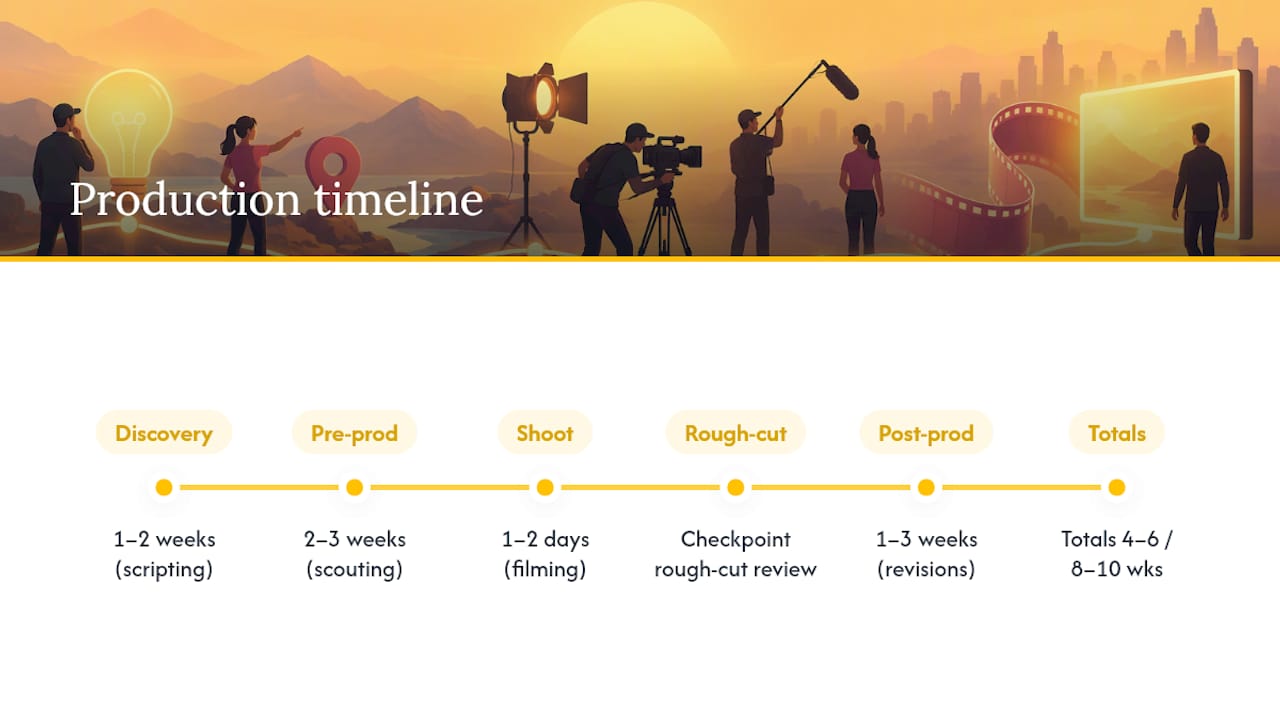
The shoot itself is usually the fastest part: a single day for most brand story videos, occasionally two days for multi-location projects. Post-production then takes one to three weeks depending on revision rounds, since a first cut, a client review, and a final polish pass is standard.
Build in checkpoints rather than waiting until the final cut to get feedback. A rough-cut review after the first edit pass, before music and color are locked, saves far more time than catching a narrative problem at the final review stage. For event-based projects specifically, delivery timelines are accelerated so the footage stays usable while the event is still fresh in people’s minds.
An Editor’s Take on Authenticity Versus Polish
Given the choice between a slightly rough video with a real moment in it and a flawlessly lit video with nothing to say, take the rough one every time. Viewers forgive shaky lighting. They don’t forgive a hollow story.
Three things I never compromise on: a narrative that’s clear before the camera turns on, audio clean enough that the words carry the emotion instead of fighting the noise floor, and B-roll shot specifically to prove the transformation, not just to fill time.
— Emmet
Want a Brand Story Video Without Managing the Whole Process Yourself?
Most of what’s above takes real time to execute well: scripting, permissions, interview technique, editing for pacing rather than just coverage. LemonLens handles that entire process directly, with purpose-led framing built into discovery from the first conversation and transparent packages so you know the scope before you commit.
Every project starts by clarifying what the video actually needs to achieve, not just how it should look, which is the same principle this whole guide has walked through. For events specifically, that means footage delivered within 48 hours, so it’s still relevant when you need to use it. If you’re ready to talk through what your brand story video needs to accomplish, get in touch through the videography services page to see example projects and request a scoped quote.
Sources
- Comparative study on narrative video effectiveness (Communication & Society)
- What Is a Brand Story? | HBS Online
- State of Video Report: Video Marketing Statistics for 2026 | Wistia
- Connecting Emotionally: Impact of Narrative Video Advertising on Consumer Involvement and Brand Attachment
- Gov
FAQ
What Is an Example of a Good Brand Story Video?
A strong example is a customer testimonial film that centers one specific person’s before-and-after experience rather than a general product overview. LemonLens’s hospitality client testimonial follows this exact pattern: one owner, one real frustration, one specific fix, told in their own unscripted words.
What Is the 3-7-27 Rule in Branding?
The 3-7-27 rule is a rough guideline for short-form video pacing: roughly three seconds to hook a viewer’s attention, about seven seconds to establish what the video is about, and around 27 seconds as a natural length for a complete short story. It’s a useful pacing check, not a strict formula every video must follow.
What Are the Four Pillars of Brand Storytelling?
While frameworks vary by source, the elements that show up consistently across effective brand story videos are a recognizable protagonist, a visible transformation, authentic supporting proof, and consistent tone across every touchpoint where the story appears. HBS Online’s brand story framework covers similar ground with its own step-by-step model.
Does Paying for a Video Mean I Own the Copyright?
Not automatically. Under UK copyright guidance, copyright typically stays with the creator unless there’s a written assignment transferring it to you, so it’s worth confirming rights in writing before the shoot, not after.
How Much Does a Brand Story Video Cost?
Costs depend heavily on shoot length, number of locations, and how many cutdowns you need, so there’s no single flat rate across the industry. LemonLens quotes video projects based on scope with transparent pricing, and current packages are listed on the videography services page.