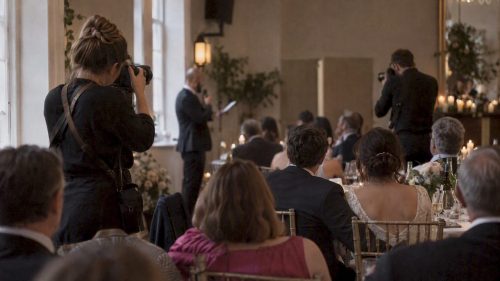
A second shooter is an extra photographer who works alongside your lead photographer on the day. They cover a different place, angle or moment at the same time. You don’t need one at every wedding. They earn their place when you have two getting-ready locations, a guest list of around 80 or more, a large venue, or a tight timeline. Below we explain what a second shooter does, when it’s worth paying for one, and what to agree in writing before you book.
TL;DR
- A second shooter doesn’t double your photographer’s work. They add coverage: a second location, a second angle, or the guests’ reactions while the lead photographer shoots the couple.
- They matter most with two prep locations, big guest lists, large or awkward venues, and busy ceremonies.
- Many council ceremony rooms are small and timed, so check that a second photographer is allowed before you plan around one.
- Ask who owns the copyright, who edits the second shooter’s images, and what happens if one photographer is ill.
- Book a second shooter for the part of the day that needs it. Full-day coverage isn’t always necessary.
Table of Contents
- What a second shooter actually does
- When a second photographer is worth it
- When you can skip it
- Partial coverage: paying for the hours that matter
- What to agree in writing
- Planning the day around two photographers
- If you are a photographer hiring a second shooter
- Our view on second shooters
- Booking wedding photography with LemonLens
- FAQ
- Sources
What a second shooter actually does
The lead photographer is responsible for the story of your day, the style of the edit and the final gallery. A second shooter works to that plan. They are usually a professional photographer in their own right, with their own cameras and lenses.
In practice, the job tends to fall into four parts:
- Covering the other side of the morning. While the lead photographer is with one partner, the second shooter is with the other. Neither of you is left without coverage, and neither of you waits for a photographer to arrive.
- Shooting the ceremony from a second angle. One photographer takes the aisle and the faces of the couple. The other takes the guests, the parents, the readers and the wide shot of the room. You get the vow and the reaction to it.
- Helping with group photographs. One person arranges the group while the other lines up the next one. It’s the most reliable way to keep family formals short, so you get to your drinks sooner.
- Acting as a backup. If a card fails or a camera stops working, a second photographer on site means the moment isn’t lost entirely.
What a second shooter doesn’t do is lead. They don’t direct your family, redirect the timeline or compete with the lead for the same frame. Experienced photographers who write about second shooting say the same: they stay out of the lead’s shot and work to the lead’s brief. You can read that in advice from working UK photographers such as Rachel Joyce and Laura Alpizar.
When a second photographer is worth it
The honest answer is that it depends on the shape of your day, not on a rule. Here are the situations where we’d usually recommend one.
Two prep locations
If one of you is getting ready at a hotel in Chelsea and the other at a family home in Enfield, one photographer can’t be in both places. A second shooter solves it without anyone rushing across London on the morning of the wedding.
Larger guest lists
Past about 80 guests, there is too much happening for one person to catch. Arrivals, the confetti line, the reception room being filled, the speeches seen from the other end of the room. Our shot list for UK couples shows how fast the must-have list grows when guest numbers rise.
Big or split venues
A ceremony in one building and a reception in another, or a long walk between a church and a marquee, means moments happen in two places at once. Two photographers can cover both without gaps.
Tight timelines
If you have a long list of family groups and a short window of daylight, extra hands speed things up. Our 8-hour wedding photography timeline shows where the day tends to get squeezed.
Video and photo together
If you also have a videographer, the second photographer and the videographer should know who is covering what, so neither blocks the other. If you’re booking film, our guide to wedding video audio covers the on-the-day steps that stop vows being lost.
When you can skip it
A second shooter is not essential for every wedding. You can reasonably do without one if:
- You’re having a small ceremony with a few guests, a single venue and a short day.
- You are getting ready together or in the same building.
- Your budget is tight and one experienced, well-directed photographer can cover the essentials.
- Your venue limits the number of people in the room.
That last point deserves attention in London. Many register office and town hall rooms are small, and ceremonies are short. The Royal Borough of Greenwich, for example, lists the rooms available at Woolwich Town Hall for ceremonies, and the capacities differ between them. Photographers may count towards the guest limit in a small room, so a second photographer could mean one fewer guest. Check with the register office before you commit.
If you’re marrying at a register office, our pages on Morden registry office ceremonies and Chelsea Town Hall weddings show how we approach tight rooms and short ceremonies.
Partial coverage: paying for the hours that matter
You don’t have to buy a second shooter for the whole day. Common patterns include:
| Moment | Second shooter useful? | Why |
|---|---|---|
| Getting ready (both partners) | Yes | Two locations at once |
| Ceremony | Often | Second angle, guest reactions |
| Group photographs | Yes | Faster, more organised |
| Drinks reception | Sometimes | Candid guest moments while couple portraits are taken |
| Speeches | Sometimes | Faces of the room as well as the speaker |
| Evening dancing | Rarely | One photographer usually copes |
This way you spend on the stretch of the day where two people make a difference. Ask your photographer whether they offer it.
As for the cost, UK photographers set their own prices and the figure varies widely with the photographer and the hours, so ask for it itemised. Our own wedding packages start from £1,850. Talk to us about what second-photographer cover would look like for your date and venue and we will give you a clear quote.
What to agree in writing
The second shooter is part of your booking, so the paperwork should cover them. Four things to check.
Copyright and licence
Under UK law, the creator of a photograph is generally the first owner of the copyright. GOV.UK’s copyright notice on digital images sets out the exceptions, including a commission for private and domestic purposes such as wedding photographs, where the rules differ. Because this is a point where couples and photographers often assume different things, read how your contract licenses the images, whoever took them. Ask specifically that the licence covers images taken by the second shooter as well as the lead.
Who edits the gallery
You want one consistent look. Ask whether the lead photographer culls and edits the second shooter’s frames, so the gallery feels like one day and not two photographers’ portfolios. Our guide to wedding photography styles lists what to ask about editing.
What happens if someone is ill
Ask what the plan is if the lead or the second photographer can’t make it. A good photographer will have a replacement process and will put it in the contract.
Who is covering what
Ask for a short coverage plan: who is with whom in the morning, who takes the ceremony from where, and who does the groups. It takes ten minutes to agree and prevents most problems.
Planning the day around two photographers
A few practical habits make two photographers work smoothly.
- Give both a shot list. Share names for the family groups and mark the must-have moments. A named person to gather each group helps, and the second shooter can use the list to get the next group ready.
- Brief the registrar or venue. Tell the venue there will be two photographers so they can say where each can stand. Some ceremony rooms restrict movement.
- Introduce them. A short word with the best man, the parents and the planner helps the second shooter find people quickly.
- Think about extra angles. Some couples add other coverage, such as a 360 view of the venue. If you’re curious about how that works, this guide to 360 photography explains the equipment and delivery. It is an extra, not a replacement for a second photographer who is following the story.
- Keep the timeline realistic. Two photographers do not mean you can fit in endless group shots. Thirty minutes of formals is still plenty.
If you are a photographer hiring a second shooter
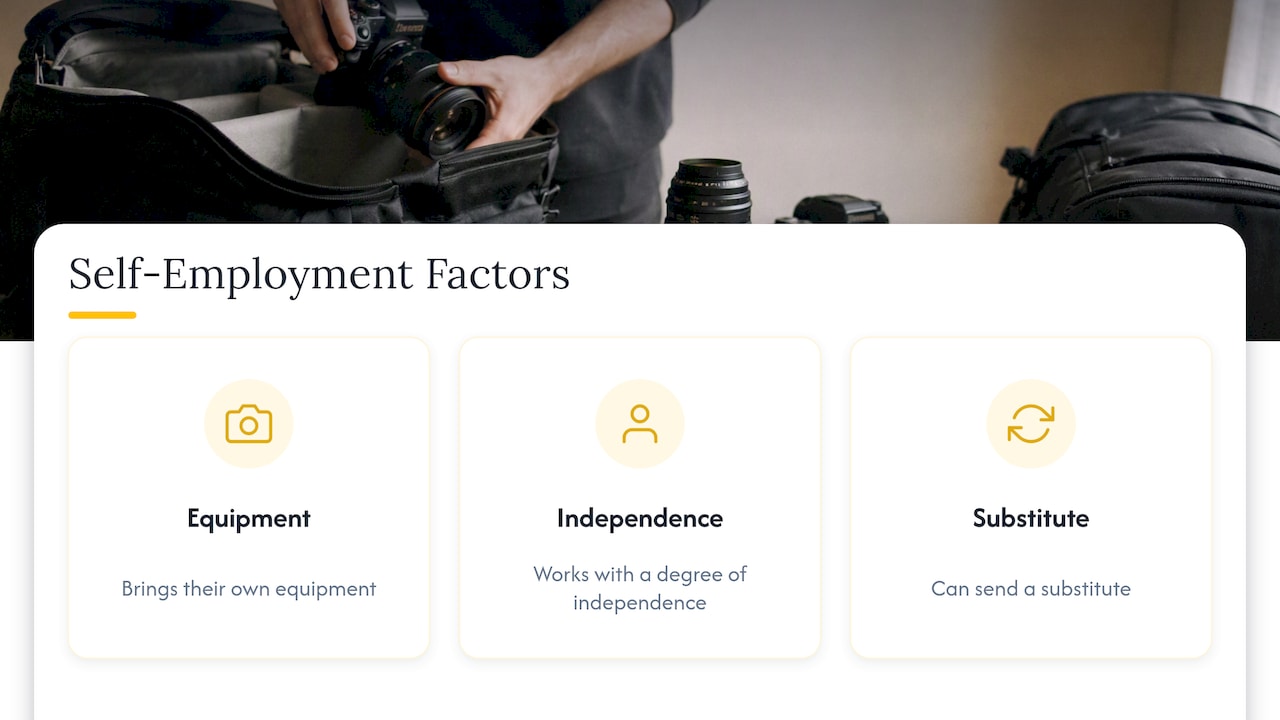
Some readers arrive here as photographers looking to hire. The point that matters most is employment status. HMRC guidance on film and video industry workers shows how self-employed status is judged for crews, and our reading of it is that a second shooter who brings their own equipment, works with a degree of independence and can send a substitute is more clearly self-employed. HMRC’s VAT manual page on off-air workers covers that industry’s accepted grades, and the UK photographer pay overview on SalaryTax describes the written agreement, substitution right and self-billing invoices commonly used. It isn’t tailored advice. If you aren’t sure how a particular arrangement would be classed, speak to an accountant or check HMRC’s own employment status guidance.
Our view on second shooters
We start every booking by asking what the photographs are for. For a wedding, that’s usually simple: you want to remember how the day felt, and to see the people who mattered, including the ones you didn’t see because you were busy getting married.
That’s the test we’d apply to a second shooter. If a second photographer helps you see more of that, such as the other partner’s morning, the parents’ faces at the vows or the room as the speeches begin, then it’s worth the money. If it only adds more frames of the same moments, it isn’t.
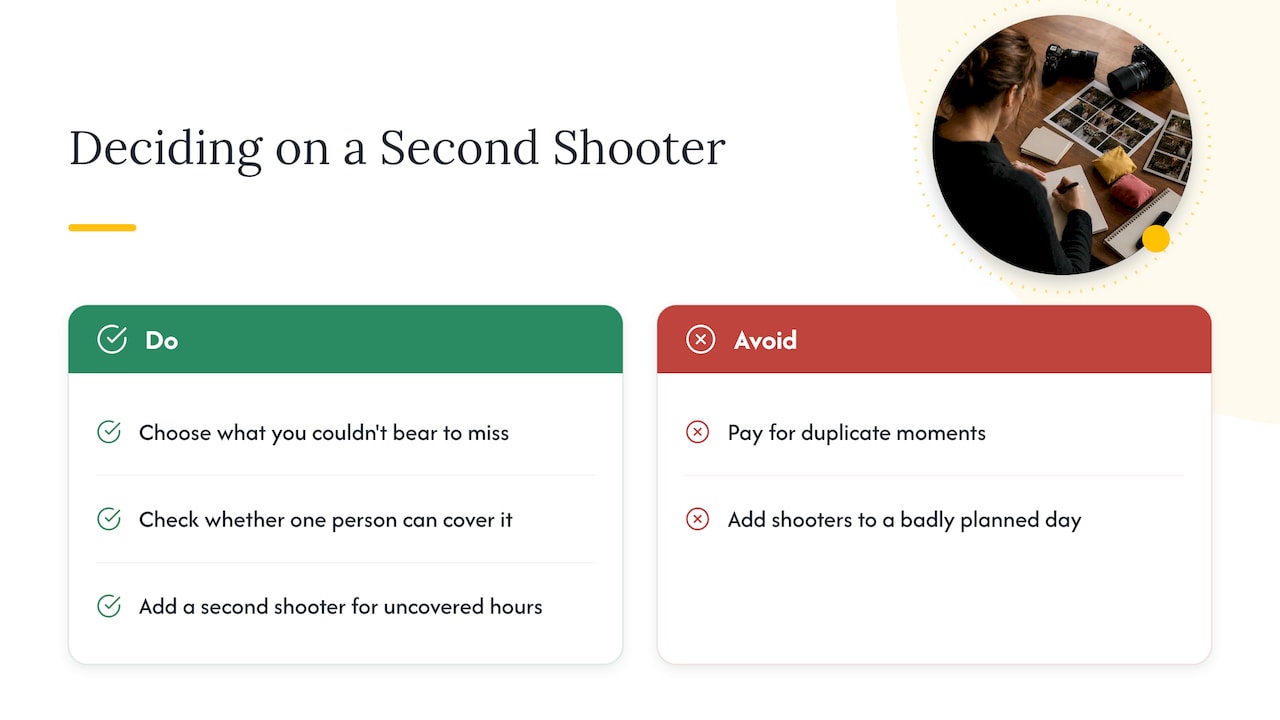
We’d also say that a second shooter only works if the lead directs the day well. The best coverage comes from a clear plan, a realistic timeline and two people who know their roles. More photographers on a badly planned day just gives you more of the same problem.
Our advice: decide what you couldn’t bear to miss, then work out whether one person can cover it. If not, add a second shooter for those hours. If so, keep your budget for the lead.
— Emmet
Booking wedding photography with LemonLens
Our wedding photography in London is relaxed and unposed, and our packages start from £1,850. If you think you need a second photographer, tell us your venues, guest numbers and timeline when you get in touch, and we’ll tell you honestly whether it’s worth it for your day. You can start from our main page.
FAQ
Is a second photographer at a wedding worth it?
It’s worth it when your day has two things happening at once: two prep locations, a big guest list, a split venue or a tight schedule. For a small, single-venue wedding, one good photographer is usually enough. Decide which moments you can’t afford to miss and plan around those.
Does a second shooter take photos of the same things as the lead?
They shouldn’t. A good second shooter covers a different place or angle, and avoids shooting over the lead’s shoulder. Agree a coverage plan beforehand so each photographer knows their role.
Do I own the photos my second shooter takes?
Not automatically. Under UK law, the creator of a photograph generally holds the copyright, with exceptions set out by GOV.UK. What you get is a licence to use the images. Check that your contract covers the second shooter’s work as well as the lead’s.
Can I have a second photographer at a register office ceremony?
Often yes, but check first. Rooms are small and photographers can count towards the guest limit, so ask your register office. If space is tight, one photographer plus a clear plan may serve you better.
Sources
- Copyright notice: digital images, photographs and the internet, GOV.UK
- VTAXPER63200, HMRC internal manual, GOV.UK
- Get married or have a civil partnership in Royal Greenwich, Royal Borough of Greenwich
- UK Photographer Pay 2026/27, SalaryTax
- How to be a good second shooter, Rachel Joyce Photography
- How to be a good second shooter, Laura Alpizar