The right alternative boudoir photographer in London is the one whose directing style, consent practice and written terms you can check before you pay a deposit. Style matters, but it comes second. This guide shows you how to compare your options, what to get in writing, and where we fit. We are a London portrait, wedding, event and brand studio. Boudoir is not one of our listed services, so we say plainly below what we can and cannot offer.
TL;DR
- Pick on consent practice and directing style first, then on look and price. Ask how the photographer handles boundaries before you ask about packages.
- Put privacy in writing before the shoot: a non-publication clause, who sees the images, and how they are stored and deleted.
- In the UK the photographer owns the copyright by default, so check what licence you get and whether the files are high resolution.
- Queer-led and queer-specialist photographers exist in London. Ask whether they have worked with people like you, not only whether they are “friendly”.
- LemonLens does not list boudoir. We do offer directed studio portraits from £200, and we will be straight about whether your idea suits us.
Table of Contents
- What “alternative” boudoir usually means
- The kinds of photographer you will find in London
- Questions to ask before you book
- Privacy and publication: get it in writing
- Who owns the photos you pay for
- Comparing options: a checklist you can use
- Our perspective
- Where LemonLens fits
- Red flags worth walking away from
- FAQ
- Sources
What “alternative” boudoir usually means
Traditional boudoir tends to follow a template: lingerie, soft light, a bed, a particular idea of who the client is. “Alternative” is a loose label for everything that steps outside it. Some people mean tattoos, alt fashion, fetish-adjacent styling or darker, moodier lighting. Others mean photographers who work with queer, trans and non-binary clients, with larger bodies, with disabled bodies, or with people who simply don’t see themselves in the standard portfolio.
The label tells you very little on its own. Two photographers can both call themselves alternative and work in completely different ways. So treat it as a prompt to ask better questions, not as a guarantee.
A useful first step is to decide which of these you actually want:
- A look. Gothic, editorial, punk, vintage, minimalist, playful.
- A kind of safety. A photographer who needs no explaining about your identity, your body or your relationship.
- A purpose. A private gift, a milestone, a project for yourself, a couple’s session, or images you may share publicly.
Most people want a mix, but knowing your priority makes the shortlist much shorter.
The kinds of photographer you will find in London
London has a deep pool, and it falls into a few broad types. We are naming the types and a couple of examples we came across in our research, not endorsing or ranking them.
| Type | Strengths | Watch for |
|---|---|---|
| Solo independent, often on Instagram | Strong personal style, intimate scale, often flexible on location | Contracts can be informal or missing. Check terms in writing |
| Queer-specialist roster or collective | Everyone on the team understands queer and trans clients. Couples sessions are a speciality | Popular periods such as Pride season fill up. Book early |
| Boudoir studio with hair, make-up and styling | Complete experience, wardrobe changes, a changing area | Can lean towards a house style. Ask to see range beyond it |
| Generalist portrait or fashion photographer | Technical polish, strong directing, good lighting | May not offer intimate work at all. Ask directly rather than assume |
In Google’s results for this search you will find independent photographers who describe themselves as female, SW-friendly glamour photographers working in a studio or on location, such as the account @alt.glam on Instagram. You will also find queer-specialist services in London, such as queer.photo, which describes working with queer and trans couples. Large studio operations such as Vanity Studios also sell packaged boudoir sessions with styling included. We have not worked with any of them and cannot vouch for them. Use them as examples of the types above, and check each one against the questions below.
Questions to ask before you book
A good photographer will be glad you asked these. A defensive answer tells you something too.
How do you direct a session?
Intimate shoots involve a real power imbalance: you are partly undressed, and the person holding the camera is in charge of the room. Guidance from Time’s Up UK, written for nude and intimate scenes on screen, is a helpful benchmark. It says a professional should proactively discuss boundaries, provide cover-ups between set-ups and agree in advance what will be shot. A private session is not a film set, but the same duty of care applies.
Listen for specifics. “I’ll make you feel comfortable” is a slogan. “We go through a shot list beforehand, you can say no to any pose, and I’ll never ask you to do something we haven’t agreed” is a practice.
Who will be in the room?
The same guidance supports asking for a closed set, meaning only essential people are present. Ask whether there is an assistant, a stylist or a make-up artist, who they are, and whether you can bring a friend or partner. If anyone else is present, you should know before the day.
Can you show me work that looks like what I want?
A portfolio of one body type, one gender presentation or one aesthetic is a polite answer to “do you work with people like me?” If you are queer, trans, non-binary, disabled, plus-size or heavily tattooed, ask to see examples, or ask for a short call first. Any photographer who has done this work will have an answer. You are within your rights to walk away from one who hasn’t.
Can I stop or change a pose at any time?
The answer should be an immediate yes, with no awkwardness and no penalty. Withdrawing consent for a specific pose or for the whole session partway through is your right, and a photographer who treats it as an inconvenience is the wrong photographer.
What happens to the images afterwards?
This is the question people forget, and it matters most. The next two sections cover it.
Privacy and publication: get it in writing
Under UK data protection law, photographs in which you can be identified are personal data. If a photographer wants to use them for marketing or their portfolio, they need a lawful basis, which is normally your consent. The University of Edinburgh’s data protection guidance sets out that you can withdraw that consent at any time. The photographer must then stop using the images for that purpose, although this does not undo earlier uses, and printed material already distributed generally cannot be recalled.
That last point is why you should decide before the shoot, not after. Withdrawing consent after an image has been printed or widely shared will not undo it.
There is a second safeguard in copyright law. For private domestic commissions, the Intellectual Property Office’s copyright notice explains that the person who commissioned the photographs can prevent them being issued to the public or exhibited without permission. That is a real protection, but do not rely on it alone. Spell out your wishes in the contract.
In practice, ask for these in writing:
- A non-publication clause if you want the images kept private. Sprintlaw’s guide to UK photographer contracts notes that standard terms often give the photographer a default right to showcase their work, so any restriction needs negotiating before the shoot.
- Where the files are stored, who can access them, and when they will be deleted.
- Whether any image can be shown in a portfolio, on social media or in advertising, and a specific, separate permission for each, including whether your face is visible.
- How to withdraw consent later, and how quickly the photographer will act on it.
Who owns the photos you pay for
Many people assume that paying for a shoot means owning the pictures. In the UK it does not. The photographer is the first owner of copyright, and control only shifts through a written assignment or licence. Sprintlaw’s guide makes the same point: you are usually buying a licence to use the images, not the copyright itself. It also advises checking whether your package includes high-resolution files or only low-resolution web versions.
For an intimate shoot this has practical consequences. Ask:
- Do I receive full-resolution files, and can I print them anywhere?
- Does the licence let me share them online myself?
- Will the photographer keep the unselected outtakes, and for how long?
Also compare how the photographer edits and delivers, not only how many pictures they promise. The same guide points out that a curated gallery is standard, since much of the work lies in selecting and retouching. Ask about the retouching style, the timeline for a first preview and the final delivery date.
Comparing options: a checklist you can use
Put each photographer on your shortlist through the same short test.
| Question | A good answer sounds like |
|---|---|
| Pre-shoot conversation | A call or messages to agree boundaries, wardrobe and shot list |
| Directing | Clear, specific, with a way to pause or change at any time |
| People present | Named, agreed in advance, optional extras on request |
| Written terms | Contract covers publication, storage, licence and deletion |
| Relevant portfolio | Work with clients whose bodies and identities resemble yours |
| Delivery | Dates stated, edited gallery, file size and format clear |
| Price | Total stated up front, including edits, styling and any extra fees |
If a photographer cannot answer most of these cleanly, keep looking. London has enough talent that you do not need to settle.
Our perspective
We are upfront about what we do. LemonLens is a London studio for portraits, weddings, events and brand content. We do not list boudoir as a service, and we would rather say so than imply otherwise. If you are after a dedicated intimate session with specialist styling, a photographer who works only in that field is probably the better choice, and our checklist above is what we would use to pick one.
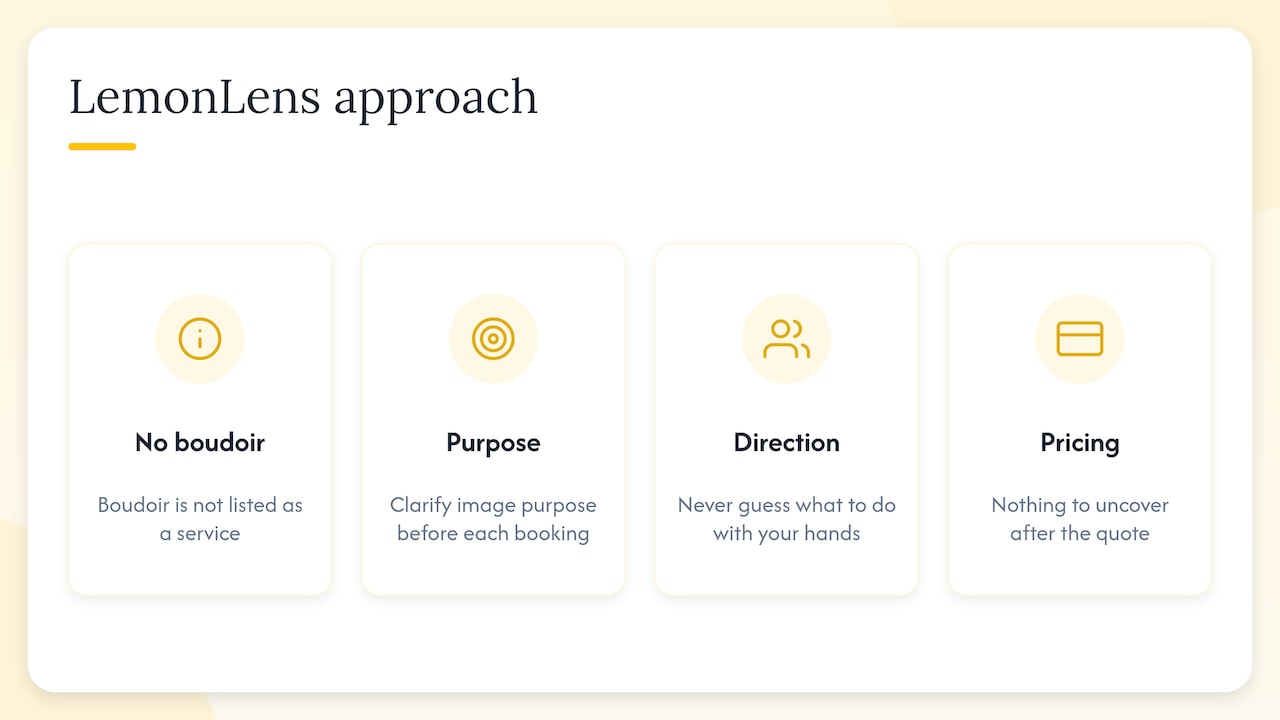
What we do bring is a way of working that applies to any sensitive shoot. Every booking starts by clarifying the purpose of the images: who they are for and what they should do. For a personal project, that conversation is about what you want to feel and who will see the pictures, if anyone. Our sessions are fully directed, meaning you are never left to guess what to do with your hands, and the point is to make you comfortable in front of the camera. Our pricing is transparent, so there is nothing to uncover after the quote.
We would also say this to anyone hiring any photographer: the best sign of a safe session is a boring contract. Clear terms, clear boundaries and a calm conversation beforehand are not a lack of romance. They are what make the rest possible.
— Emmet
Where LemonLens fits
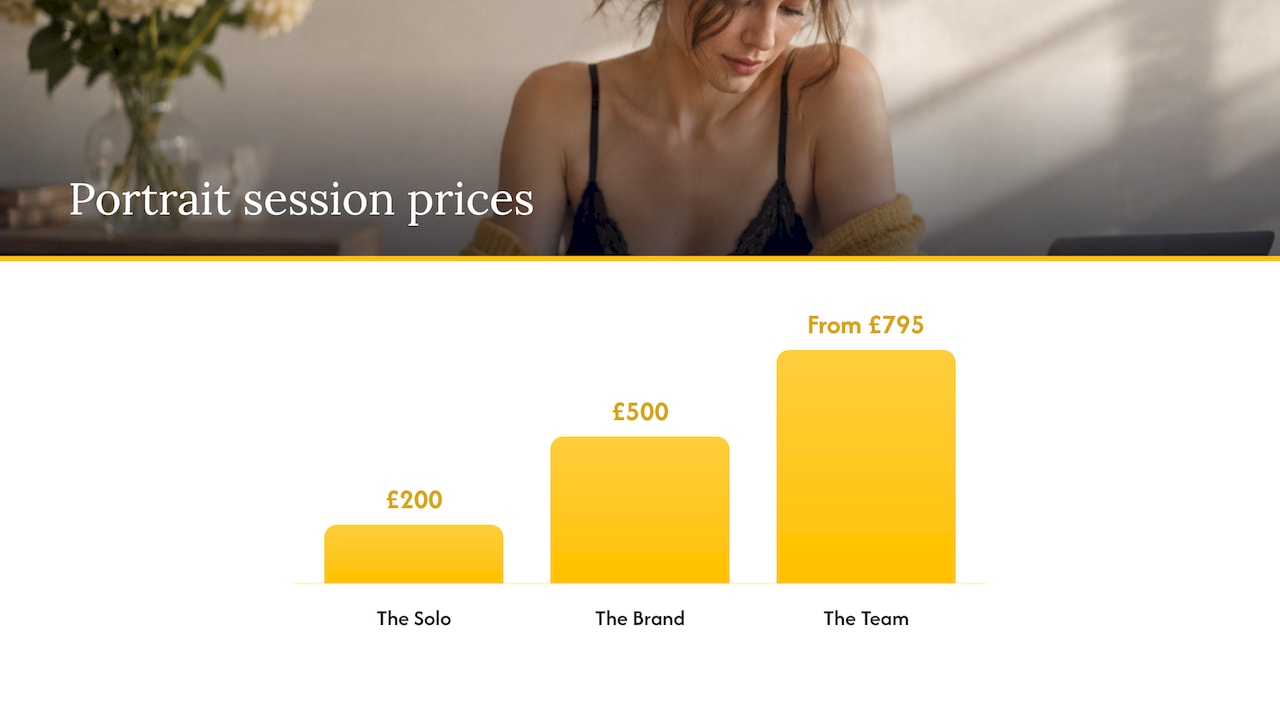
If what you want is a confident, directed, stylish portrait rather than a boudoir set, we may suit you well. Our portrait sessions are priced as published: The Solo is £200, The Brand is £500 and The Team starts from £795. Portraits start from £200 in total. These are built for personal branding, creative projects and headshots, and they can be shot in studio or on location.
For moodier, more creative work, our studio photography at Colour Factory is the place to start, and you can see how we direct people in our portrait gallery. If you are a musician or performer wanting expressive, high-contrast images, that studio is also where we shoot creative sessions. If you are not sure whether your idea fits, tell us what you have in mind and we will give you an honest answer, including pointing you elsewhere if that is better for you.
We work across London, so check the areas we cover if you would prefer a session close to home.
Red flags worth walking away from
- Pressure to do more than you agreed. Anything that was not agreed in writing beforehand is not agreed.
- No written terms for an intimate shoot, or terms that say “marketing purposes” without naming channels.
- Reluctance to discuss who sees the images, or a refusal to add a non-publication clause.
- Vague answers about your identity, such as treating a queer or trans client as a novelty.
- Payment demands that skip a contract, or a request to hand over the entire fee before you have received any terms.
- Unclear people in the room. A surprise assistant is a reason to stop.
If something has gone wrong in a shoot, the Time’s Up UK guide lists support routes, including Sexual Assault Referral Centres and the Havens in London. Consider speaking to one of those services, or to a solicitor if a contract has been breached. Civil claims over breach of contract can generally be brought within three years, according to the same guide.
FAQ
Is an alternative boudoir photographer different from a standard one?
The difference is in who they serve and how they work rather than in the name. Alternative photographers often cater to queer, trans, tattooed or non-traditional clients, or favour a less polished, more editorial style. Ask to see work that looks like the session you want, and ask how they direct.
How do I find a queer boudoir photographer in London?
Start with photographers and rosters that say clearly that they work with queer and trans clients, and ask to see relevant examples. A short call beforehand helps you judge whether you feel at ease. East London has a good concentration of studios, but the right person may be anywhere in the city.
Can I stop a boudoir photographer from using my photos publicly?
Yes, but ask for it in writing before the shoot. Standard terms often let photographers showcase their work, so you need a non-publication clause. As a commissioner of a private session you also hold a right under UK copyright law to prevent public issue of the photos without permission.
Do I own the copyright to my boudoir photos?
Not by default. The photographer owns the copyright unless there is a written assignment. What you normally receive is a licence, so check what it allows, and whether you get high-resolution files.
Does LemonLens offer boudoir photography?
It is not one of our listed services. We offer directed portraits, creative studio sessions, weddings, events and brand content in London. If your idea sits close to portraiture, get in touch and we will tell you honestly whether we are the right fit.
Sources
- Time’s Up UK: Your Rights in Nude, Intimate and Sex Scenes
- University of Edinburgh: Photography and data protection guidance
- GOV.UK: Copyright notice on digital images, photographs and the internet
- Sprintlaw UK: Wedding photographer contract key terms