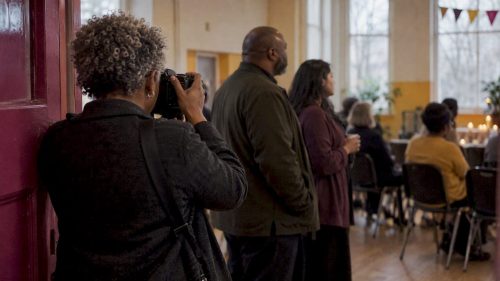
There is no single “LGBTQ+ memorial photographer” category in London. There are queer-led photographers who document vigils, tributes and remembrance gatherings, archives that preserve community images, and venues that sell their own tribute packages. Which one suits you depends on what you are marking: a funeral or celebration of life, a community vigil, an anniversary event, or a permanent record. This guide compares the real routes, explains what to agree before anyone lifts a camera, and shows where LemonLens fits.
TL;DR
- Memorial photography is quieter and more consent-sensitive than Pride coverage or general portraits. Pick someone who will ask before they shoot.
- Your realistic options are an independent queer or community photographer, an archive or community project, a venue’s own tribute service, or a studio such as LemonLens that can direct, cover events and deliver fast.
- Cemeteries and crematoria can require written permission before any photography. Ask the venue first.
- Agree in writing who owns the images, where they may be shown, how they are delivered and when.
- LemonLens publishes prices for portraits (from £200) and events (£400 to £900), and quotes memorial work individually.
Table of Contents
- What memorial photography means for the LGBTQ+ community
- Your options compared
- What it costs
- Permission, privacy and consent come first
- What to agree in writing before the day
- Our perspective
- How LemonLens can help
- How to choose: a short checklist
- FAQ
- Sources
What memorial photography means for the LGBTQ+ community
It helps to separate three things people often lump together.
Pride and event coverage is about energy: crowds, colour, movement. Queer portraiture is about the person in front of the lens. Memorial photography sits between them and has a different job: to honour someone, hold a community together at a hard moment, or leave a record that outlasts the day.
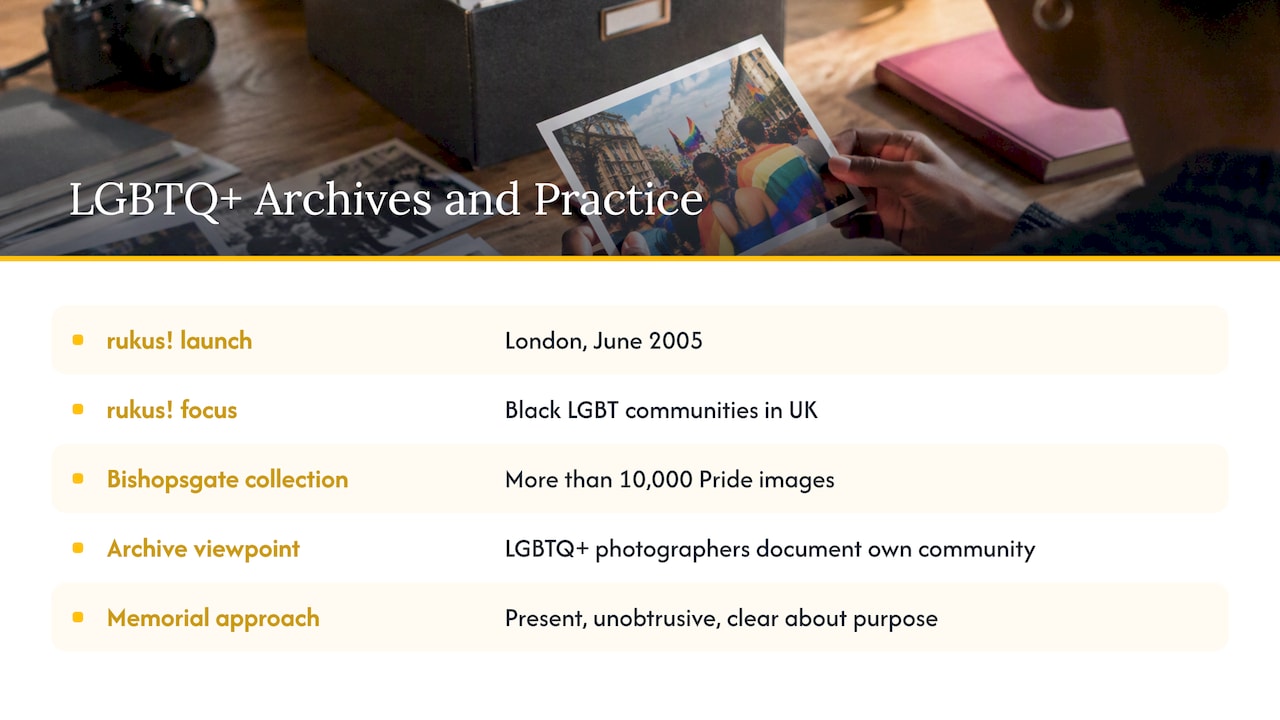
That last purpose matters in LGBTQ+ history. The rukus! archive, launched in London in June 2005 by photographer Ajamu X and filmmaker and theatre director Topher Campbell, was set up to preserve materials related to Black LGBT communities in the UK. Bishopsgate Institute holds one of the UK’s most extensive LGBTQ+ history collections, including more than 10,000 images of Pride. Its archives also include LGBTQ+ photographers documenting their own community, which is a different view from the one press photographers give.
Photographer Christa Holka describes queer documentary work as a mix of intention and chance, observation and participation, contributing to a living record of a time and place. A good memorial photographer works the same way: present, unobtrusive, and clear about why they are there.
Your options compared
The table sets out the routes a family, friend group or organiser realistically has in London. It describes the type of provider, not a ranking of individuals.
| Option | Best for | Strengths | Watch-outs |
|---|---|---|---|
| Independent queer documentary or portrait photographer | Intimate celebrations of life, small vigils, tribute portraits | Lived understanding of the community, personal approach | Availability can be limited; terms vary, so get them written down |
| Studio with portrait, event and video capability (LemonLens) | Memorial events, anniversary gatherings, tribute portrait sessions, photo plus film | Directed sessions, clear published pricing, 48-hour event delivery, video in-house | Memorial work is quoted individually rather than sold as a fixed package |
| Community archive or oral-history project | Preserving an image or story for the long term | Public memory, specialist curation | Not a booking service; you donate or contribute rather than commission |
| Venue’s own tribute service | Funerals and services at a crematorium or cemetery | Convenient, already approved by the venue | Tribute slideshows and webcasts, not a photographer who documents the day |
| Friend or family member with a camera | A very small, private gathering | Trust, no fee | No backup kit, no edit, and the photographer is not able to be fully present as a mourner |
A few independent photographers in London are visible for LGBTQ+ work. Miss Gen Photography, for instance, describes a portrait and wedding background with an approach rooted in storytelling and real people, and The Colourful Photographer works under Pride and LGBTQ themes. Look at portfolios, ask about experience with sombre occasions, and judge for yourself. Large-name fashion portraiture, such as Tim Walker’s book of portraits of LGBTQ+ trailblazers, which includes health professionals and researchers who worked through the AIDS crisis of the 1980s, shows how portraiture can honour a community’s history, but it is a published project, not a service you book.
What it costs
Be wary of anyone who quotes a single “memorial photography price”. The fee depends on length, number of people, editing and whether you want film too.
Here is what we publish at LemonLens, and what it is a useful guide to:
| Service | Price |
|---|---|
| The Solo (portrait session) | £200 |
| The Brand | £500 |
| The Team | from £795 |
| London event photography | £400 to £900 |
| Corporate Half-Day | from £350 |
| Corporate Event Day Rate | from £650 per day |
| Two-Day Conference | from £1,100 |
A tribute portrait session for a living family member or friend sits naturally in the portrait range. A remembrance evening, vigil or anniversary gathering sits in the event range. Videography and event videography are priced on request.
Venue costs are a separate line, and it is easy to confuse the two. The Royal Borough of Kingston upon Thames lists memorial-media extras rather than a photographer’s fee: a live webcast with 28 days’ viewing costs £60, a keepsake DVD, Blu-ray or USB £65, a slideshow £45 and a professional tribute £75. GreenAcres Kemnal Park’s price list, effective 1 January 2025, shows a 60-minute memorial or burial service at £795, with a music tribute of up to 25 photos included and a professional themed tribute at £95. Those are venue services. They are not a substitute for someone documenting the gathering, and they do not tell you what a photographer will charge.
Permission, privacy and consent come first
This is where memorial work differs most from a party or a wedding.
Ask the venue before you book anyone
Some sites restrict photography heavily. Kensal Green Cemetery’s rules, for example, require prior written permission before photographing any grave, memorial or funeral gathering, and they prohibit using such images for publicity or marketing. That last point matters: if you want to share images publicly, or if a photographer wants to use them in a portfolio, you need to know the venue’s position first. Other cemeteries, crematoria and churches have their own rules, so ask each one directly.
Identifiable people and data protection
When people can be identified, data protection applies. University guidance on UK practice explains that a legal basis is required for taking photographs of identifiable people, and that publishing identifiable photos online needs a safeguard. For gatherings, people should be told photography is happening and be given a clear way to opt out, such as speaking to the photographer or moving away from photo areas, and consent can be withdrawn.
For an LGBTQ+ memorial this is more than a legal point. Some attendees may not be out to family, colleagues or employers. A photograph posted online can out someone. Practical steps:
- Tell guests in the invitation that a photographer will be present.
- Set aside a no-photo area or seating section.
- Ask the photographer to check with individuals before publishing close-up or named images.
- Decide in advance whether anything goes on social media, and who approves it.
- Agree what happens if someone later asks for their image to be removed.
Accessibility and tone
Ask how the photographer works around wheelchair users, people who are grieving openly and people who find cameras distressing. Ask about dress and kit too: quiet shutter, no flash during readings, no intrusive positioning. A photographer who has covered both ceremonies and nightlife will tell you how they adjust. You can see our range across nightlife, portraits and weddings in our galleries.
What to agree in writing before the day
A short written agreement prevents most disputes, and it is kinder to settle these things before a hard day than after it. Cover:
- Scope: hours, location, number of people, and whether video is included.
- Image rights: who holds copyright and what licence you receive, including whether you may print, share and post the images. Do not assume; get it stated.
- Portfolio use: whether the photographer may show the images at all. For memorial work, many families will say no, and that should be easy to agree.
- Delivery: the format, the method and the date. For emotional events, waiting weeks is hard.
- Fees and payment: what is charged, when, and what happens if the date moves or the event is cancelled.
- Privacy handling: the steps above for guests and publishing.
If you are a photographer reading this and building your own offers, session package pricing examples show how to lay out what each tier includes so clients know exactly what they are buying. Clients benefit from the same clarity: ask any photographer for a written breakdown of what each price covers.
Our perspective
We start every booking by asking what the images are for. For a memorial that question has a gentle answer: to honour someone, to give a community a place to gather, or to leave something for people who could not be there. Once that is clear, the way we work follows. We keep the session or event fully directed where directing helps, and quiet and observational where it does not.
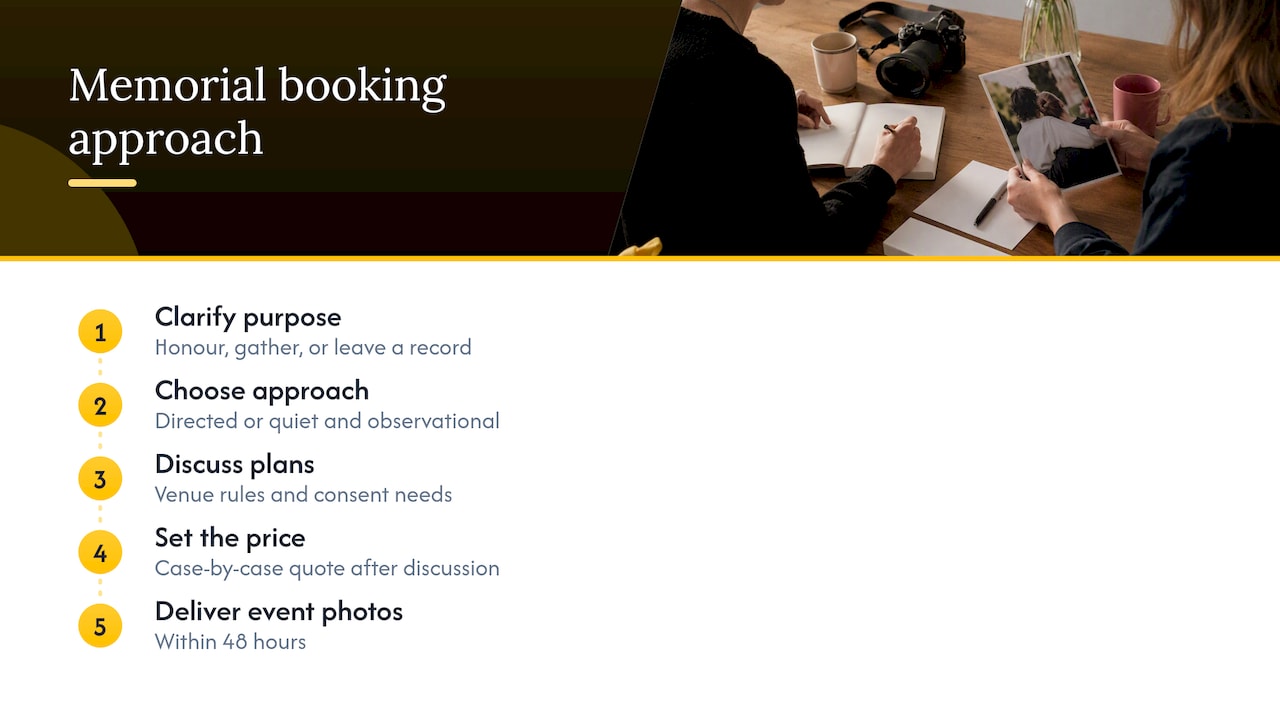
We also think delivery speed matters more at a memorial than at most events. Images are most useful while the day is still fresh, and we deliver event photography within 48 hours. We publish our prices because uncertainty about cost is the last thing anyone needs when planning something like this. Our memorial work is quoted case by case, so we talk through your plans, venue rules and consent needs first, and then give you a figure.
We would rather you ask us hard questions about privacy and image use than assume. If we are not the right fit, we will say so.
— Emmet
How LemonLens can help
If you want a tribute portrait session, a remembrance evening or an anniversary gathering covered with care, we can plan it with you. Our London event photography runs from £400 to £900, and portrait sessions start at £200. If you want film alongside stills, see our videography and event videography services. For related reading, our guide on how to hire a queer photographer in London covers briefing and questions to ask, and our page on LGBTQ event photography in London shows how we cover community nights. Tell us about the occasion through lemonlens.com and we will come back with a clear quote.
How to choose: a short checklist
- Have they covered something similar? Ask to see sensitive or ceremonial work, not just parties.
- Do they ask about consent? A good photographer raises it before you do.
- Is the venue cleared? Get written permission where the site requires it.
- Is pricing written down? Hours, edits, delivery and licence should all be itemised.
- When will you get the images? Ask for a date, not a range.
- Do they understand the community? Lived experience is not essential, but respect and context are.
- Can they offer film? If you want a short tribute film, check it before booking.
FAQ
How much does an LGBTQ+ memorial photographer cost in London?
There is no standard rate. Fees depend on length, guests and whether you want video. At LemonLens, portrait sessions start at £200 and event photography runs from £400 to £900, and we quote memorial work individually after talking through your plans.
Do I need permission to photograph at a cemetery or crematorium?
Often, yes. Kensal Green Cemetery, for example, requires prior written permission before photographing any grave, memorial or funeral gathering, and it prohibits using such images for publicity or marketing. Ask the cemetery or crematorium before you book anyone.
Can guests refuse to be photographed?
They should be able to. Guests need to be told that photography is taking place and given a clear way to opt out, and consent can be withdrawn. At an LGBTQ+ gathering, it is sensible to offer a no-photo area, because some people are not out publicly.
Is memorial photography the same as Pride photography?
No. Pride coverage captures crowds and celebration, often from a public vantage point. Memorial photography is quieter, closer to the people involved and bound by the venue’s rules and the family’s wishes, so the briefing, consent steps and pace are all different.
Sources
- Love and Lubrication in the Archives, or rukus!: A Black Queer Archive for the United Kingdom
- Pride at 50: Rare photos of early marches, BBC News
- The Steering Committee, Twilight People
- Tim Walker’s Fairyland: Love and Legends, National Portrait Gallery shop
- Kensal Green Cemetery Rules and Regulations, January 2023
- Photography, Data Protection, University of Edinburgh
- Funeral fees and charges, Royal Borough of Kingston upon Thames
- GreenAcres Kemnal Park price list, January 2025