Inclusive corporate headshots in London come down to two decisions: the kind of session you book (studio, on-site at your office, environmental or at home) and whether the photographer will treat every person in front of the lens as they ask to be treated. This guide compares the main options, shows what LemonLens charges, and gives you a checklist for LGBTQ+ staff, queer professionals and the HR or marketing teams booking for them.
TL;DR
- Choose the session type first: on-site suits teams, a studio suits individuals who want a controlled setting, and environmental portraits suit people who dislike a blank backdrop.
- Inclusive means practical things: names and pronouns recorded before the day, freedom over clothing and presentation, step-free access, and retouching that stays light.
- LemonLens publishes its portrait prices: The Solo is £200, The Brand is £500 and The Team starts from £795.
- Ask every photographer the same questions about consent, retouching, usage rights and delivery time before you pay a deposit.
- If one person on your team feels uneasy about the day, offer them a private slot or a different setting rather than a group queue.
Table of Contents
- What “inclusive” should mean in a headshot session
- The four main ways to book corporate headshots in London
- What London headshot sessions cost
- How to find a photographer who is genuinely affirming
- Questions to ask for queer and LGBTQ+ clients
- Preparing for the session
- Delivery, retouching and usage
- Our perspective
- Booking LemonLens for corporate headshots
- FAQ
- Sources
What “inclusive” should mean in a headshot session
Most photographers’ sites describe themselves as friendly. Few say what that looks like. For a headshot, inclusion is a set of small, checkable behaviours rather than a rainbow on a website.
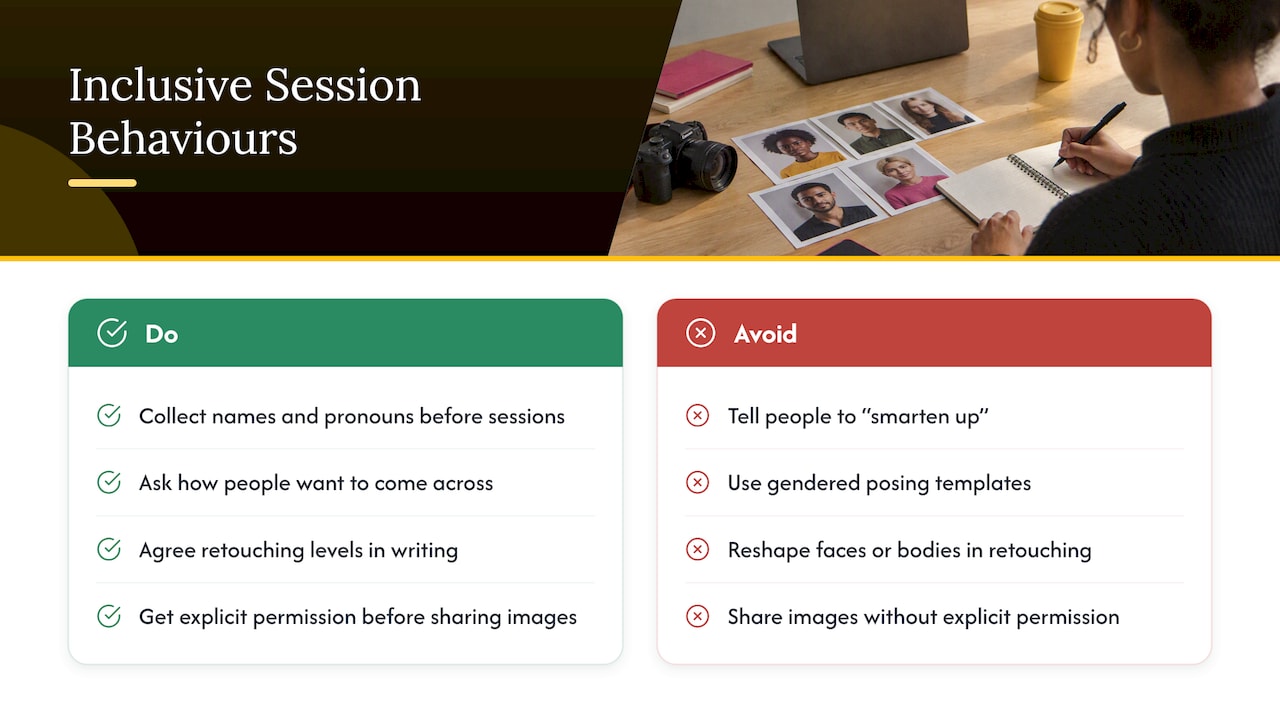
Names and pronouns. The photographer should have the name each person uses and their pronouns before the session, not discover them at the door. For a team shoot, that means the organiser collects them on a form, and the photographer uses them in captions, file names and the delivery gallery.
Gender expression. Nobody should be told to “smarten up” into a style that is not theirs. A suit, a dress, a shirt and tie, a bold jacket or no jacket at all should all be treated as equally professional. The same goes for hair, makeup, jewellery, binders and visible tattoos.
Posing and direction. Many portrait habits are quietly gendered: chin angles, hand placement, “power” stances versus “soft” ones. A good photographer asks how you want to come across and directs towards that, instead of using one template for men and another for women.
Retouching. Light cleaning is normal. Reshaping jawlines, smoothing away facial hair, or changing body shape is not what most people asked for. Agree the retouching level in writing.
Access. Step-free entry, a place to sit between frames, quiet time, and a clear idea of how long you will be in the room all matter for disabled and neurodivergent staff, and they cost nothing to provide.
Privacy. Some people are not out at work, or not out everywhere. A photographer should not post anyone’s image, tag them or share the gallery beyond the agreed recipients without explicit permission.
The four main ways to book corporate headshots in London
The page types that rank for this search tell you what the market offers: on-site team sessions, fixed studios, and photographers who travel to you. Here is how they compare.
| Option | Best for | Strengths | Watch out for |
|---|---|---|---|
| On-site at your office | Teams of five or more, consistent look | Little lost working time, easy to coordinate, one backdrop across the company | Shared room can feel exposed; limited privacy for anyone self-conscious |
| Fixed studio | Individuals, founders, anyone who wants control | Quiet, private, reliable lighting, easy to reschedule | Travel time, less relaxed for people who dislike studios |
| Environmental (on location) | Creatives, brand-led businesses, people who dislike plain backdrops | Context and personality, images that look less generic | Needs a good location and a little more time per person |
| At home or a venue you choose | People who want comfort, or have access needs | Familiar surroundings, flexible timing | Needs enough space and light; agree what is realistic beforehand |
None of these is automatically more inclusive. The difference is whether the person booking has a choice. A team policy that offers an on-site slot and a private alternative is more inclusive than any one format on its own.
On-site team sessions
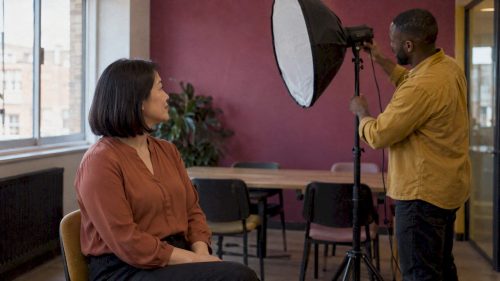
A photographer sets up lighting and a backdrop in a meeting room and works through the team in short slots. It is efficient, and it gives you matching images for your website, LinkedIn and email signatures. Our on-site team headshots in London work this way, and our corporate headshot page explains the format in more detail.
To make a team day inclusive, schedule slots rather than a queue, keep the door closed, and tell people in advance what to expect. Let anyone swap to a different time or location without having to explain why.
Studio sessions
A studio gives a photographer total control over light and removes the distraction of an office. It suits individuals who want a quiet hour of attention. We run studio headshots in Fulham for quick professional portraits, and the City is covered through our City of London photography page.
Environmental portraits
If a plain grey wall feels like a mugshot, an environmental portrait puts you in a workspace, street or building that fits your role. Our environmental portrait photography is directed throughout, so you are not left to “just be natural”.
Headshots at home
Some people are more themselves in their own space, and for others travelling is the barrier. We offer corporate headshots shot at your home, which can suit freelancers, consultants and anyone who wants the session on their own terms.
What London headshot sessions cost
Published pricing is not universal in London. Many photographers quote only after an enquiry, and per-person, half-day and day rates all coexist, so compare like with like: number of people, session length, number of finished images, retouching and usage.
Here are LemonLens’s own prices, as published on our site in September 2026:
| Package | Price | What it suits |
|---|---|---|
| The Solo | £200 | One person, a single portrait session |
| The Brand | £500 | A founder or professional who needs a wider set of images |
| The Team | from £795 | Groups who want consistent headshots |
| Corporate Half-Day | from £350 | A shorter on-site corporate booking |
| Corporate Event Day Rate | from £650 per day | A full day of coverage |
You can see the portrait packages on our portrait pricing page and the corporate day options on our corporate events page. The Team starts at £795, and the final quote depends on headcount and how long we are on site, so we confirm it in writing before the booking.
When you compare quotes from anyone, ask four things: how many people are included, how many finished images each person gets, what level of retouching is included, and where the images may be used. A low headline price that excludes retouching or restricts usage to one platform is not a cheaper option.
How to find a photographer who is genuinely affirming
Independent directories can help you start. One roundup of UK personal branding photographers, for example, notes photographers who describe themselves as queer, genderfluid or LGBTQ+ in their own profiles (UK personal branding photographers list). A listing is a starting point, not proof. The better evidence is on the photographer’s own site and in how they answer your first email.
Look for:
- Portfolio range. Do the portraits show different genders, ages, body types, skin tones and styles of dress, and do they look equally well lit?
- Plain language. Do they mention pronouns, name changes or access needs on their enquiry form or FAQ?
- Their reply. Ask how they handle a client who wants a less traditional look. A confident, specific answer beats a generic assurance.
- Lighting skill. Different skin tones need careful exposure and lighting. Ask to see examples of darker skin tones in their work.
- Terms. Clear, written usage rights, retouching limits, and deletion or removal rules if someone leaves your company or wants an image taken down.
Where a company is on a public path to showing its identity and values consistently, headshots are one part of a wider visual system. Teams working on that often start with visual communication across print and digital and then commission headshots that match it.
Questions to ask for queer and LGBTQ+ clients
If you are booking for yourself or for colleagues, these are fair questions to put to any photographer, including us:
- Can you record names, pronouns and any different name used at work before the day?
- Will you use the pronouns I give in captions and file names?
- Can I choose my own clothing, makeup and hair, and will you direct to that rather than correct it?
- Who else will be in the room, and can I have a private slot?
- What retouching do you apply by default, and can I see before and after?
- Who gets the gallery, and can I choose to keep an image out of public channels?
- What access adjustments can you make: step-free entry, seating, breaks, a quieter setting?
A photographer who welcomes these questions is a good sign. One who seems irritated by them has answered for you.
Preparing for the session
You do not need to overthink it, but a few things help whatever the format.
- Bring two or three outfits that you feel good in. Solid colours usually photograph well, and heavy patterns can distract.
- Think about where the image will live. A LinkedIn profile, a company site and a speaker bio may each want a different crop or mood. Our LinkedIn headshot guide covers what works at thumbnail size.
- Eat, drink, and arrive unhurried. Tension shows in the shoulders and jaw.
- Tell the photographer what you dislike. A favourite side, a tooth you are conscious of, a glasses glare. This is standard information, not fuss.
- Expect direction. A good session is a conversation. You should be told what to do with your chin and hands, and told when it is working.
For a team, send everyone the same short brief a week before: where, when, how long, what to wear, and who to tell about any access or privacy needs.
Delivery, retouching and usage
Three things frustrate clients more than the photos themselves: slow delivery, unclear retouching and vague rights.
For delivery, we turn event work around in 48 hours, and we approach headshots with the same aim, because a new starter’s image is no use in six weeks’ time. Whatever provider you choose, get the delivery time in writing.
For retouching, ask what is included per image, and whether extra edits cost more. Agree that features such as scars, facial hair, body shape and skin tone stay as they are unless you say otherwise.
For usage, confirm that images can be used on your website, LinkedIn, press materials and internal tools, and for how long. If you plan to use them in paid advertising, say so up front.
Our perspective
We start every booking by asking what the photos are for. A headshot that is meant to win clients looks different from one that introduces a new team member to colleagues, and neither looks right if the person in it is uncomfortable.
That is why we direct the session fully. Most people do not enjoy being photographed, and a stiff, tense portrait helps nobody. When we know how someone wants to be seen, including their name, pronouns and presentation, we can light and frame them to match, rather than steering them towards a default.
For LGBTQ+ clients, and for companies that want their LGBTQ+ staff to feel properly represented, our advice is simple. Make the booking easy to adjust, give people choice over setting and timing, and judge a photographer by how they handle your first questions. If you want to see how we work at queer events, our LGBTQ event photography page shows the approach.
— Emmet
Booking LemonLens for corporate headshots
If you are a team lead, HR manager or marketing manager planning a round of headshots, we can come to your office, shoot in a studio, or work on location. Individual sessions start at £200 with The Solo, and The Team starts from £795. See the options on our portrait services page, or tell us about your team and what the images are for, and we will confirm a quote in writing. If you need broader business imagery alongside headshots, our corporate photography covers internal and office settings.
FAQ
Do I need to tell the photographer my pronouns before the shoot?
You do not have to, but it helps. Sharing them in advance means they can be used on the day and in captions and file names. If you prefer to keep them private, say so and the photographer should respect that.
Can a company book headshots without outing anyone?
Yes. Collect names, pronouns and access needs on an optional form that goes only to the photographer, offer private slots, and never ask people to explain their choices. Agree beforehand who receives the gallery.
How much should corporate headshots in London cost?
It depends on headcount, session length, finished images and retouching. Our published prices are £200 for The Solo, £500 for The Brand and from £795 for The Team. Compare any quote on the same four points before you decide.
Is on-site or studio better for a team?
On-site is usually quicker and gives a consistent look across the team, while a studio gives more privacy and control. For an inclusive approach, offer both so that staff can choose the setting where they feel most at ease.