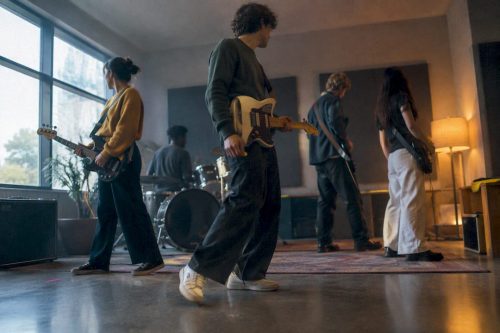
The most reliable way to get versatile band promo photos is to mix a handful of posed group formations with candid performance shots, rather than relying on one or the other. That combination covers the practical need for a clean press shot and the emotional pull of a live moment. The rest of this guide breaks down exact poses, locations, lighting and the UK logistics you need to plan around, with a working photographer’s perspective from LemonLens woven through.
TL;DR:
- Combining posed group formations with candid performance shots provides the most versatile band promo images suited for press and branding needs.
- Use specific, directional cues for each pose category, such as staggered-depth or instrument-anchored stances, to capture natural personality and avoid stiff expressions.
- On-location shoots with natural light and architecture often yield more authentic images, but studios offer control for clean line-ups and portraits.
- UK public locations require permits and insurance, with TfL demanding at least £10 million in public liability coverage before shooting.
- A typical shoot covers six to eight varied poses, including full-body, close-up, and candid frames, with a focus on natural interaction and relaxed expressions.
Table of Contents
- 1. Pose categories and how to direct each one
- 2. Choosing locations that match the pose
- 3. Lighting, lenses and framing for group shots
- 4. Styling, wardrobe and direction cues that shape the pose
- 5. Permissions, insurance and a UK shoot checklist
- 6. How LemonLens plans and directs a band shoot
- What the pose lists get wrong
- Booking a band or promo shoot with LemonLens
- Sources
- FAQ
1. Pose categories and how to direct each one
Every band photo falls into one of a few families. Knowing which one you’re shooting, and giving the band a precise direction rather than a vague “look natural”, is what separates a usable set from a wasted afternoon.
Classic line-ups and formations. A straight line-up works when the band has strong, consistent energy and you want symmetry. Direction: feet shoulder-width apart, weight on the back foot, chins level, and stagger the eyeline so not everyone looks dead-centre at once. A V-formation puts the frontperson slightly forward and the rest fanning back at 45 degrees, which reads as a natural hierarchy without anyone looking sidelined. For four or five members, a diagonal line across the frame (front-left to back-right) uses the whole width of a wide lens and avoids the flat, passport-photo look a straight row can produce.
Staggered-depth poses. Steps, stools, and doorways are the quickest way to add height variation without asking anyone to crouch awkwardly. Direction: put the tallest or most central member on the highest point, others one step down and offset left or right, hands resting on a rail or in pockets, never crossed tightly over the chest. A doorway frame, shot straight on with the band spread across the threshold and one step forward, adds a natural vignette and forces slight depth even in a narrow space.
Action and performance poses. These sell energy over composition precision. Direction: ask the drummer to mid-swing a stick, the guitarist to lunge on one knee, and shoot on a fast shutter, 1/500 second or faster, to freeze motion cleanly. Jump shots work best with three or fewer people (more than that and someone always lands early), shot from a slightly low angle to exaggerate height. For stage-energy shots without an actual stage, have the band play to an imagined crowd rather than the camera. It reads as authentic rather than posed.
Intimate portraits and small pairings. Not every promo image needs the whole band. Pull two members together, shoulder to shoulder or back to back, for a warmer, more editorial frame. Direction: minimal space between bodies, relaxed hands, and let them talk to each other for a beat before you shoot, since the resulting half-smile beats a held pose every time.
Instrument-anchored poses. Instruments should look integral, not held for the sake of it. Direction: a guitarist can rest a forearm across the body of the guitar rather than gripping the neck stiffly, a drummer can lean over the kit with sticks crossed rather than standing beside it, and a vocalist can hold the mic stand at hip height rather than clutching the head of the mic. Avoid direct reflections in cymbals or guitar lacquer, which pull the eye away from faces.
Backstage, candid and lifestyle poses. These are the frames that make the set feel real. Direction: shoot the band mid-conversation, tuning up, or walking through a corridor rather than posing, and shoot in bursts so you catch the unguarded moment between poses rather than the posed one itself.
A quick reference for building your shot list:
- Straight line-up: symmetry, level chins, staggered eyelines.
- V-formation: frontperson forward, others fanned at 45 degrees.
- Diagonal line: uses full frame width, avoids flat rows.
- Staggered steps: height variation, hands relaxed, no crossed arms.
- Doorway frame: natural vignette, one member stepped forward.
- Mid-motion action: fast shutter, exaggerated gesture.
- Low-angle jump shot: three people maximum, shot from below.
- Imagined-crowd performance: energy without an audience.
- Shoulder-to-shoulder pairing: warmth, minimal gap.
- Back-to-back pairing: tension or playfulness depending on expression.
- Instrument-integrated stance: forearm or body resting on the instrument.
- Candid tuning or conversation: shot in continuous bursts.
2. Choosing locations that match the pose
Studios give total lighting control and a clean backdrop, which suits line-ups and instrument-anchored portraits where you want nothing competing with the band. On-location shoots trade that control for texture and story, better suited to action poses and candid frames. Architecture does a lot of the composition work for you: staircases and tunnels create natural leading lines toward the band, rooftops give clean negative space against sky, and an actual stage backdrop reinforces the performance poses without extra effort.
For composition, keep a few habits consistent:
- Use the rule of thirds and a rough triangle shape when arranging three or more people, so the eye has a stable base to rest on.
- Leave negative space on one side of the frame rather than centring the band dead-on, which gives room for text on press materials.
- Look for leading lines (railings, kerbs, tunnel walls) that point toward the group rather than away from it.
- Shoot a wide establishing frame, a mid-range group frame and a tight detail frame at every location, so you’re never short of an option in the edit.
Match the shot list to the location before arriving: line-ups and staggered poses in a studio or doorway, action and candid poses on a stage or street, and pairings anywhere with clean light.
3. Lighting, lenses and framing for group shots
A 35mm or 50mm lens on a full-frame camera keeps a group of four or five in frame from a natural, undistorted distance, usually 3 to 4 metres back. Wider than that and faces near the edge start to stretch.
- For a minimal studio setup, one key light at 45 degrees and a large diffuser or bounce card on the opposite side is enough to keep everyone evenly lit.
- On street or stage shoots, position the band so ambient light (a doorway, a streetlamp, stage wash) falls across faces rather than behind them.
- Shoot at f/5.6 to f/8 for a group of four or more, which gives enough depth of field to keep every face sharp without needing to stop down so far that backgrounds go distracting.
- Add a rim or backlight behind the band, even a phone torch or a small LED panel, when the background is busy, to separate hair and shoulders from the clutter behind them.
Pro Tip: Focus on the eyes of whoever is furthest from the lens, not the nearest face. It’s the easiest way to lose depth of field on the wrong person in a line-up.
4. Styling, wardrobe and direction cues that shape the pose
Clothing should read as one unit without looking like a uniform. A shared colour palette (all dark, all muted earth tones) or a single anchor item, like matching boots or jackets, does more work than asking everyone to wear the same shirt.
- Pick one dominant colour family and let textures vary, denim next to leather next to knit reads as coordinated rather than costumed.
- Keep hands out of pockets when holding an instrument, and check for reflections in glossy instrument finishes or sunglasses before you shoot.
- Give one direction at a time: “chin down slightly”, “weight onto your back foot”, “look past the camera, not at it”. Stacking three instructions at once tends to freeze people up.
Directing quick, repeatable cues, a small weight shift, a hand reposition, a change in chin angle or eyeline, is an efficient way to generate natural variety without resetting the whole pose each time.
5. Permissions, insurance and a UK shoot checklist
Public locations in the UK almost always require sign-off before you turn up with a full band and gear. On London’s transport network, a licence is required to film or photograph on TfL-managed property, and applications typically need a brief or storyboard, a certificate of public liability insurance, and a site-specific risk assessment. Many UK councils apply a similar process for city-centre shoots, commonly requesting proof of insurance and a risk assessment alongside a fee paid in advance.
TfL asks applicants to show public liability insurance of at least £10 million, which sets a realistic benchmark even for shoots outside the network.
- Confirm whether the location needs a permit or council sign-off before booking the band’s time.
- Arrange public liability insurance and have the certificate ready to send on request.
- Draft a shot list, a rough schedule and a one-page risk assessment covering trip hazards and equipment.
- Get a named venue or site contact and agree a backup location in case of access issues.
If original songs will be used in any recorded promo content, it’s worth checking whether PRS or PPL licensing applies, since the two bodies cover different public-performance rights in the UK.
6. How LemonLens plans and directs a band shoot
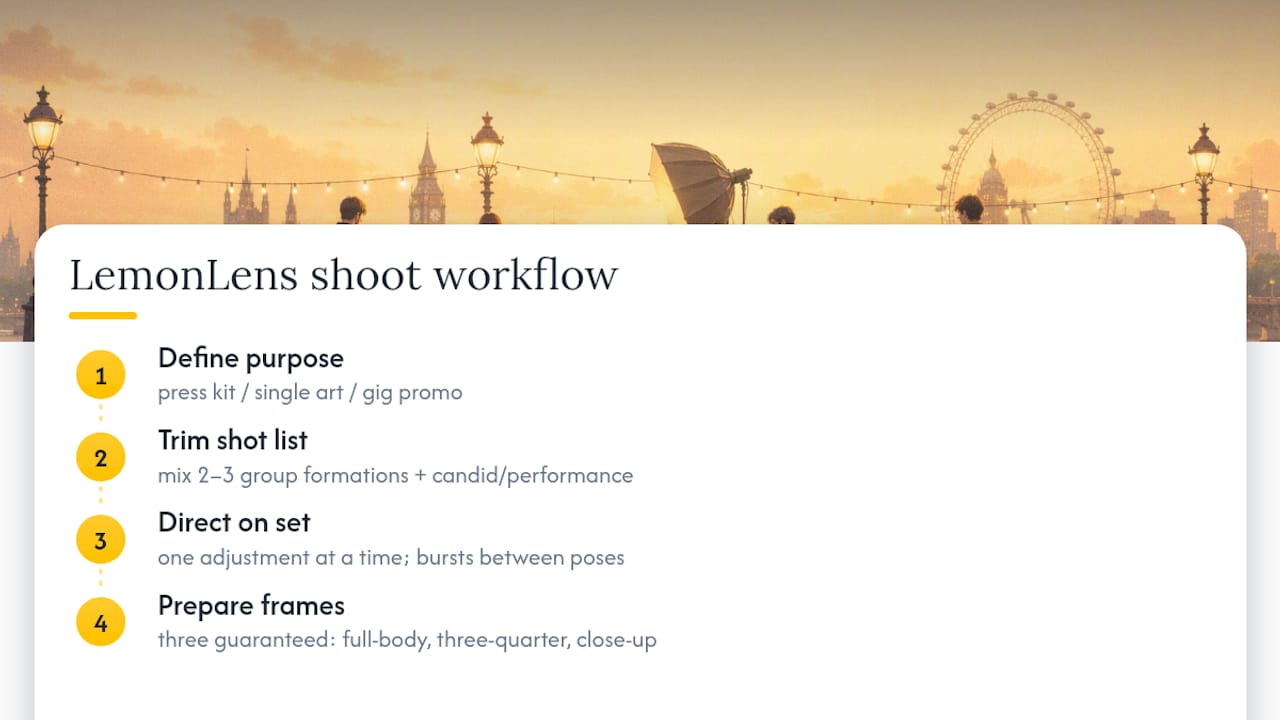
A LemonLens band brief starts with the purpose of the images: press kit, single artwork, or gig promotion, since that decides which pose families make the final shot list before anyone arrives on location. The list is trimmed to a realistic number for the time available, usually a mix of two or three group formations and several candid or performance frames, rather than an open-ended wish list.
On the day, direction stays short and sequential: one adjustment at a time, a beat to let the band react to each other rather than the lens, and continuous bursts through the transition between poses to catch the unplanned frame. Preparing three guaranteed frames per pose category, full-body, three-quarter and close-up, keeps the edit stocked even when time runs short. Recent work covering live band coverage and regular band briefings shows how that shot list holds up once a set actually starts.
What the pose lists get wrong
Most pose guides treat band photography as a menu of shapes to copy, when the real variable is how quickly a band relaxes in front of a camera. A technically perfect V-formation with five stiff faces is worse than a slightly imperfect line-up where everyone is mid-laugh. The pose is the container, not the content.
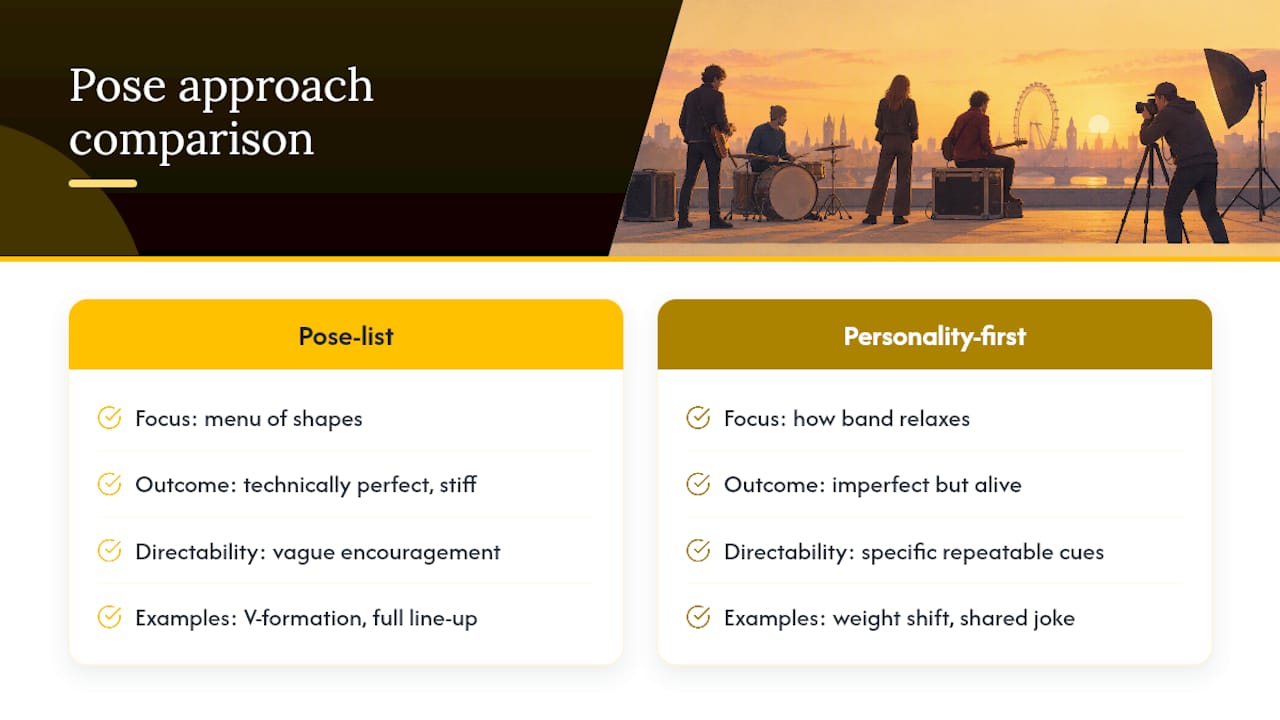
The advice that consistently falls short is “capture the band’s personality” without saying how. Personality shows up in specific, repeatable cues: a weight shift, a shared joke before the shutter clicks, a genre-appropriate mood (moody and still for a post-punk act, loose and mid-motion for a pop-punk one). That’s directable. Vague encouragement isn’t.
If you take one thing from this guide, prioritise the candid and pairing shots over the full-band line-up. A press kit lives or dies on one or two images that feel true to the band, not on how neatly everyone fits into a formation.
— Emmet
Booking a band or promo shoot with LemonLens
Bands typically fit best under The Team, or the full group session package with direction included throughout. For live coverage of a gig alongside the posed set, London event photography runs from £400 to £900 GBP depending on scope.
Every booking starts with a short brief on what the images are for, press kit, single release, gig promo, which shapes the shot list before the camera comes out. Event photos are delivered within 48 hours, so images stay usable while the release or show is still current, and pricing is confirmed upfront with no surprises added after the shoot.
To book a session, get in touch through the portraits and team packages page with your date and the kind of images you need.
Sources
- Filming & photography on TfL – Transport for London
- Permission to film or hold a photo shoot in the city centre | Sheffield City Council
- Copyright notice (UK guidance)
FAQ
What are the most versatile band photo poses to start with?
A straight line-up, a staggered-step formation and a few candid performance frames cover most press and promo needs on their own. Adding one or two intimate pairings rounds out a set without overcomplicating the shot list.
How many poses should a band photoshoot cover?
Most working shoots cover around six to eight distinct pose setups, mixing formations, action shots and candids, with three guaranteed frames (full-body, three-quarter, close-up) per setup. That gives enough variety for a press kit without stretching the session too thin.
Do you need permission to shoot band photos in public UK locations?
Yes, in most managed public spaces. TfL requires a filming and photography licence for its property, and many UK councils ask for similar permissions and insurance evidence for city-centre shoots.
What lens is best for band group photos?
A 35mm or 50mm lens on a full-frame camera, shot from roughly 3 to 4 metres back, keeps a group of four or five in natural proportion. Wider lenses at close range tend to stretch the faces nearest the edge of the frame.
How can bands get natural, less stiff expressions in photos?
Give one short direction at a time rather than several at once, and let band members interact with each other between shots rather than only facing the camera. Shooting in continuous bursts through that interaction usually produces the most natural frame in the set.