
The six questions that matter most are: what is your filming style, how many hours and shooters do you include, what exactly will we receive and when, what does it cost, how do you handle audio and music licensing, and how do you back up footage. Get these answered in writing, in the contract, before you pay a deposit.
TL;DR:
- Ensure the videographer provides a detailed, written contract specifying hours, deliverables, backup procedures, and licensing terms before payment.
- Confirm the videographer’s full wedding films are available to assess consistency, style, and venue suitability, not just highlight reels.
- Clarify exactly who will film, their team size, coverage hours, and additional costs like overtime, travel, and parking beforehand.
- Ask about audio recording quality and licensing of music, emphasizing the use of licensed libraries to avoid copyright issues.
- Request a detailed, itemized quote covering all costs, including extras like drones or raw footage, and verify turnaround times are explicitly stated in the contract.
Table of Contents
- 1. Ten quick questions for your first enquiry call
- 2. How do you judge a videographer’s style from their portfolio?
- 3. Who will actually film your wedding, and for how long?
- 4. How will vows, speeches and music be recorded and licensed?
- 5. What files and formats will you actually deliver?
- 6. How is your footage backed up if something fails?
- 7. How do you read a wedding videography quote properly?
- 8. How will your videographer coordinate with your other suppliers?
- 9. What optional extras are worth asking about?
- 10. How we put these questions into practice at LemonLens
- What couples get wrong when interviewing videographers
- See full wedding films and get a quote from LemonLens
- FAQ
- Sources
1. Ten quick questions for your first enquiry call
A short call or enquiry form should tell you whether it is worth booking a longer conversation. Run through this shortlist first:
- Are you available on our wedding date?
- What is your price range for our hours and guest count, and how much is the deposit?
- How many hours of coverage are included, and is a second shooter part of the package?
- How long after the wedding will we receive our films?
- Can we watch two or three full wedding films, not just a highlight reel?
- What happens if you are ill or your equipment fails on the day?
- Do you record backup audio and video simultaneously?
- Is music licensed, or do we need to approve every track?
- Will you provide a written contract listing deliverables?
- Do you carry public liability insurance?
Treat vague answers, such as “we’ll sort that closer to the time,” as a reason to keep looking.
2. How do you judge a videographer’s style from their portfolio?
A highlight reel shows a videographer’s best five minutes, not their average wedding. Before you commit, ask to see complete films so you can judge consistency across a whole day.
- Request two or three full wedding films, not only showreels, so you can see pacing and structure start to finish.
- Ask whether their approach is cinematic (voiceover, dramatic framing) or documentary (candid, unscripted), and which better suits your day.
- Find out the typical length of a finished highlight edit, since styles range from three minutes to fifteen.
- Ask if they have filmed at a venue with similar lighting or layout to yours, especially for marquees or low-light receptions.
Watching a venue-specific example, such as a relaxed brewery wedding, can show you how a team handles an unconventional space rather than a traditional hall.
3. Who will actually film your wedding, and for how long?
Coverage hours and team size shape everything else in the quote. Before signing anything, clarify exactly who turns up and when they leave.
- Confirm how many people will film: a sole operator, a lead plus second shooter, or a lead with an assistant.
- Ask for exact start and finish times, and what the overtime rate is if the day runs long.
- Check travel costs, parking charges and whether an overnight stay is needed for venues far from their base.
For weddings where photography and film run alongside each other, a combined photo and video coverage approach shows how two disciplines can share a timeline without duplicating setup time.
4. How will vows, speeches and music be recorded and licensed?
Poor audio ruins more wedding films than poor camera work. Vows spoken quietly and speeches delivered without amplification are the two moments most likely to be lost.
- Ask what microphones are used: lapel mics on the couple, a boom for ambient sound, or a mixed setup for speeches.
- Confirm whether speakers at the top table will be individually mic’d, not just picked up by a room microphone.
- Ask who chooses the soundtrack, whether you get a say, and which licensing library they use.
Licensed music libraries such as Musicbed or Artlist are standard industry practice, used to avoid copyright claims on delivered films, according to UK wedding videographer cost guidance. Treat any promise to use a popular chart track without mentioning a licence as a red flag: it can get your film muted or taken down if shared online.
5. What files and formats will you actually deliver?
A quote means little until you know precisely what lands in your inbox. Ask for a written breakdown before you book.
- Request the exact deliverable list: a highlight film of roughly four to six minutes, the full ceremony, speeches, and whether raw, unedited footage is available separately.
- Confirm the file resolution (4K or 1080p), how films are delivered (private online gallery or physical drive), and how long that gallery stays live.
- Ask for a firm turnaround window in the contract. Standard UK delivery for a finished wedding film commonly falls between 12 and 20 weeks, so treat anything vaguer than that as worth questioning.
6. How is your footage backed up if something fails?
Footage that exists in only one place is one dropped card away from being gone. Ask how a videographer protects your day before anything else.
- Ask whether footage is recorded to two cards simultaneously during filming, so a single card failure does not wipe the day.
- Ask about public liability and equipment insurance, and what recourse exists if files are corrupted despite backups.
- Confirm how quickly footage is copied to a second, off-site location after the wedding, a step industry guidance recommends to protect against loss.
Pro Tip: Ask exactly where your files are stored after editing and for how long, since some studios archive for only a few months while others keep copies for years.
7. How do you read a wedding videography quote properly?
Quotes vary wildly because they bundle different things. A fair comparison means asking each vendor to itemise, rather than quote a single headline figure.
- Request a written quote that separately lists overtime, travel, a second shooter and drone work, rather than one lump sum.
- Ask about deposit size, since the typical range across the UK market runs between 25% and 50% of the total, with the balance due several weeks before the day.
- Ask what happens if you need to cancel or postpone, and request proof of public liability insurance alongside the quote.
For context, full-day UK coverage from an experienced videographer commonly runs between £2,000 and £4,000, with a second shooter adding roughly £500 to £800 depending on guest numbers and venue layout.
8. How will your videographer coordinate with your other suppliers?
A videographer who has never spoken to your photographer or planner before the day is more likely to miss a moment or block someone else’s shot. Ask how they plan to work alongside your other suppliers.
- Ask how they liaise with your photographer and planner on timings and the shot list, ideally before the week of the wedding.
- Ask whether they attend a run-through, site visit or pre-wedding call to walk through the schedule.
- Ask how they film formal photographs without doubling up or getting in the photographer’s frame.
Civic or registry venues often have tighter timings and stricter rules, so ask specifically how a videographer handles a compact ceremony slot, as shown in examples from registry office weddings.
9. What optional extras are worth asking about?
Beyond the core package, a handful of add-ons shape both cost and creative scope. Confirm these before assuming they are included.
- Ask about drone filming permissions, local no-fly restrictions, and the separate cost this typically adds to a package.
- Ask whether raw, unedited footage is available to purchase alongside the finished film, and at what extra cost.
- Clarify what bespoke edits are possible, such as a longer director’s cut, and how many rounds of revisions are included.
10. How we put these questions into practice at LemonLens
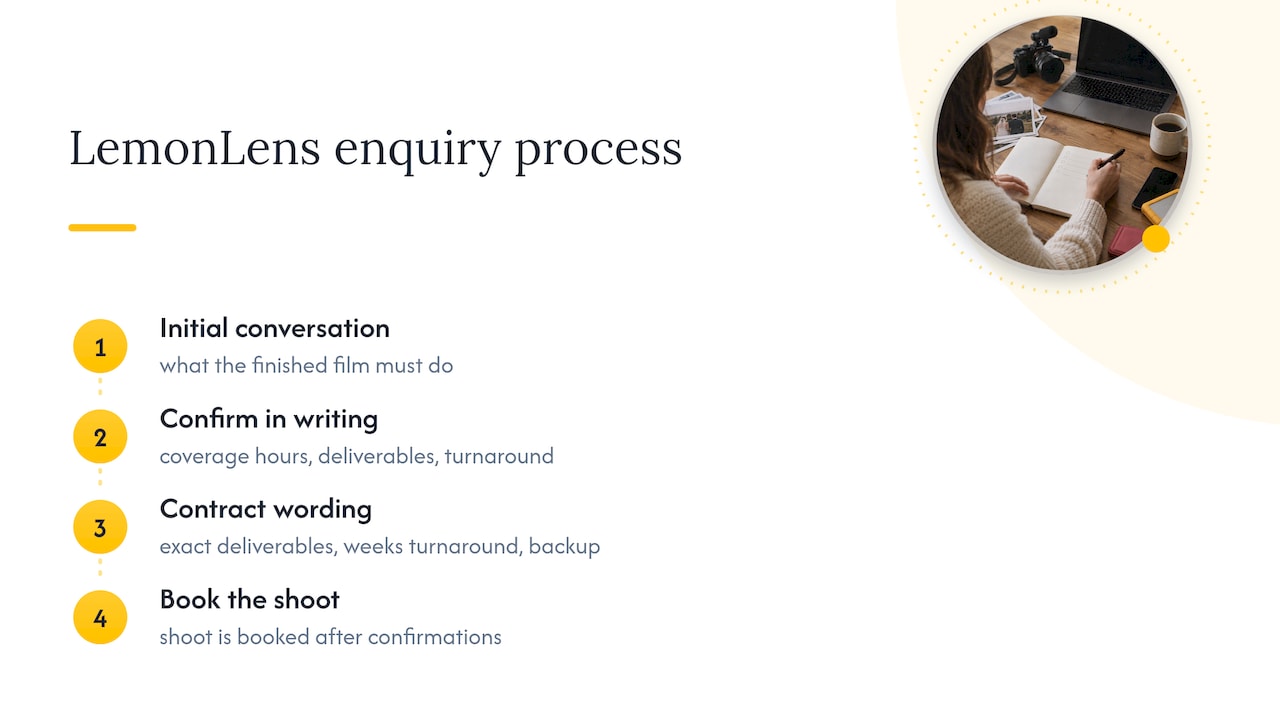
Every enquiry we take starts with a conversation about what the finished film needs to do. From there, we confirm hours, deliverables and turnaround in writing before a shoot is booked. Contract wording commonly agrees an exact deliverable list, a stated turnaround in weeks, and confirmation of backup procedure.
What couples get wrong when interviewing videographers
Most advice on this topic focuses on taste: find someone whose style you love. That matters, but it is not where weddings actually go wrong. The failures we hear about come from unanswered logistics: a turnaround date that was never written down, a deposit policy that was assumed rather than confirmed, or speeches lost because nobody asked about microphones.
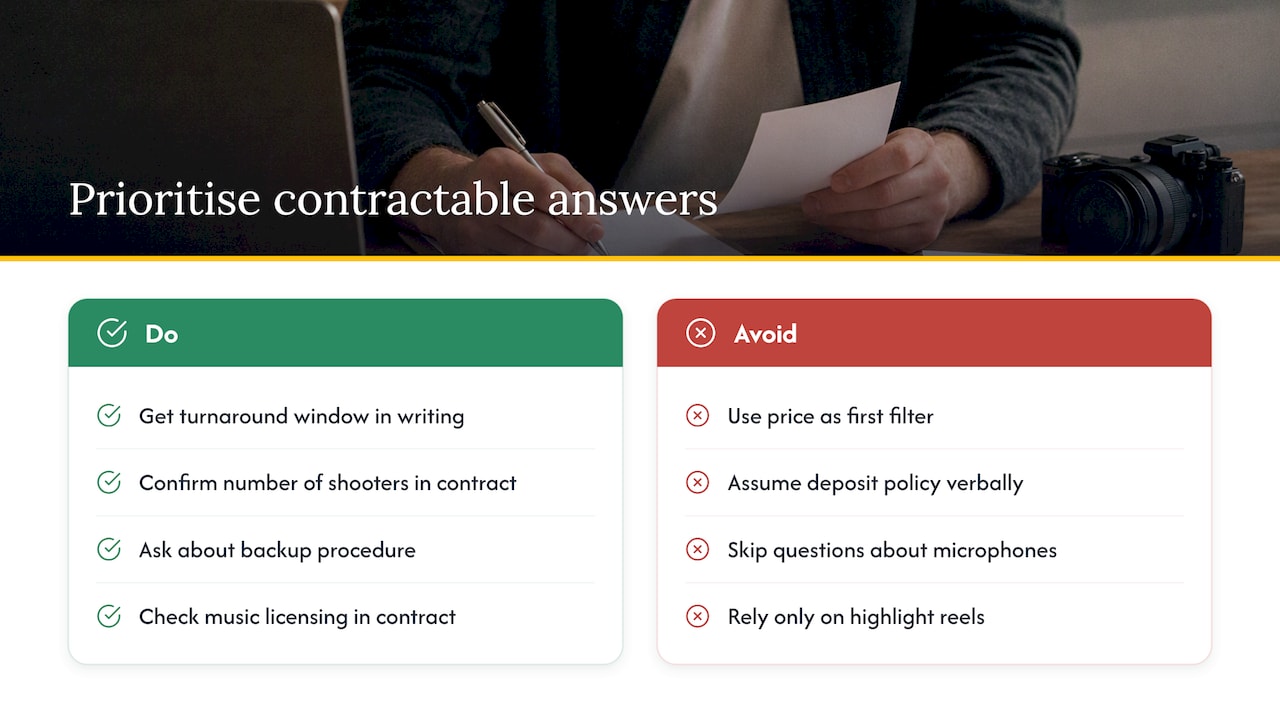
The conventional checklist treats price as the first filter. We would put it fourth or fifth. A cheap quote with no backup plan, no itemised inclusions and a vague delivery date costs you more in stress than the money it saves. Prioritise contractable answers: turnaround window, number of shooters, backup procedure, and music licensing. If a videographer cannot commit those to writing, treat it as information, not an oversight.
The most underrated question on any list is the simplest: can we watch two or three complete films? A highlight reel tells you nothing about how someone handles a quiet ceremony, a dim marquee, or a speech that runs long. Consistency across a full day is the real test, and it is the one question couples skip most often.
— Emmet
See full wedding films and get a quote from LemonLens
We film weddings with priorities such as clear deliverables, a stated turnaround, and backup procedures confirmed before the day. Every enquiry gets a written quote that separates coverage hours, second shooter costs and any extras. If you would like to see full wedding films and talk through your date, visit our videography services page to request a bespoke quote.
FAQ
What are some common videography interview questions?
Couples typically ask about coverage hours, team size, turnaround time, deliverables and pricing structure. The strongest interviews also cover backup procedures, music licensing and how the videographer coordinates with other suppliers on the day.
What are some tips for a wedding videographer?
Videographers are generally advised to record audio and video with built-in redundancy, use licensed music libraries rather than unlicensed commercial tracks, and agree a clear turnaround window with clients in writing. Clarity on deliverables before the wedding day reduces disputes afterwards.
Is a videographer worth it at a wedding?
Many couples value a videographer because photographs cannot capture voices, vows or movement the way film does. Whether it is worth the cost depends on budget and priorities, though a written quote itemising inclusions makes that decision easier to weigh against other spending.
What questions should I ask a couple as a wedding photographer?
This checklist is written for couples interviewing a videographer, so photographer-side questions sit outside its scope. Couples hiring any wedding supplier should still confirm coverage hours, deliverables, pricing and backup procedures regardless of discipline.